The Moon and the Earth
Paul Gauguin · 1893
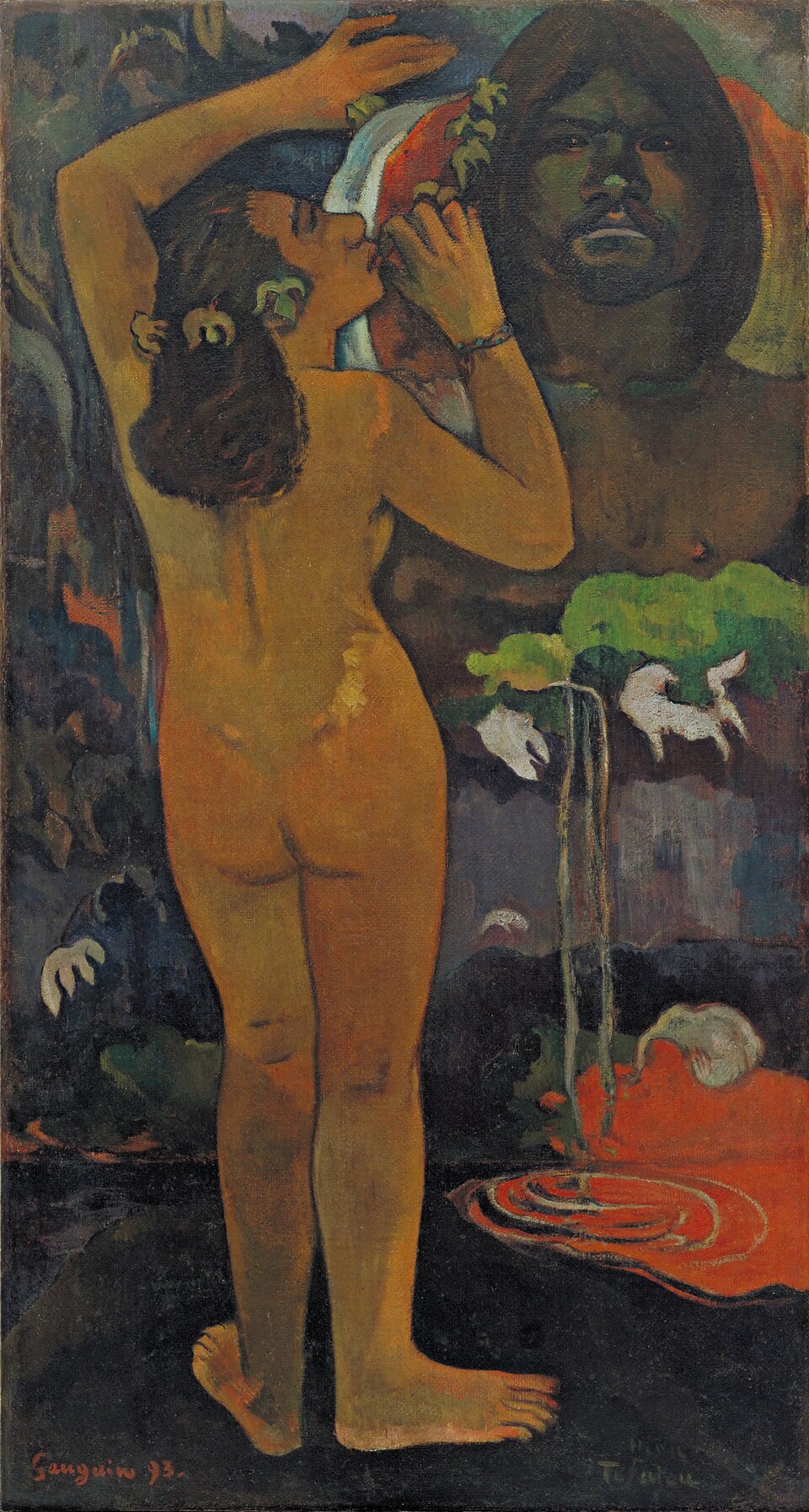
A pale goddess seen from behind leans toward a dark, unbending god, begging for the immortality of humankind. He refuses. Gauguin painted this Polynesian myth in 1893, and Degas, against the critics, bought it.
The story behind the painting
Hina te Fatou, The Moon and the Earth, was painted by Paul Gauguin in 1893. The pantheon of Tahitian gods was an endless source of inspiration for him, and according to the French Wikipedia article this is one of his most important paintings, both for its theme and its ambitions. It tells an ancient Polynesian myth: Hina, goddess of the Moon, asks Tefatou, the spirit that animates the Earth, to grant immortality to humans. He refuses outright, and Hina responds by agreeing to govern the almost eternal return of the Moon's cycle. The tall canvas measures about 114 by 62 cm.
What to look for
Gauguin imagined the dialogue between the two gods as we see it. Tefatou stands back, with a wild, truly oceanic face, and turns on Hina a manly, unshakeable gaze. The Moon goddess has a tender, gently massive body and is seen from behind, recalling Western models such as the Bathers of Courbet and Ingres. She tries, in vain, to plead for humanity. Her gesture is caressing and merciful, his is pitiless and inflexible. Look too at the spring that gushes from Fatou, tinted a flaming, almost blood-red colour, a strong note in the painting's bold colours.
Meaning and intent
The picture sets mercy against necessity. Hina's soft, pleading figure turned away from us makes her our advocate, and Tefatou's refusal is the answer every human must face: death remains. Yet the myth ends not in defeat but in a kind of consolation, the endless waxing and waning of the Moon. By giving a Tahitian goddess the pose of European bathers, Gauguin joins two worlds of images in a single figure. The bold scale and colour, and the large place given to what the source calls a wild folklore, still raise some reservations today.
Legacy
Shown in 1893 at the Durand-Ruel gallery, the work caused much perplexity because of its daring proportions and colours. Camille Pissarro was among its critics. Even so, it was admired and bought by Edgar Degas, who went on to collect Gauguin's work eagerly. Wikidata lists the Degas collection among its owners. The painting entered the Museum of Modern Art in New York in 1934, and it is still on display there, so a myth about the Moon and the Earth told in Tahiti now hangs in a museum devoted to modern art.
Lo sapevi?
- Painted by Gauguin in 1893.
- Tells the Polynesian myth of Hina, the Moon, and Tefatou, the Earth.
- Shown at Durand-Ruel in 1893 and bought by Edgar Degas.
- In the Museum of Modern Art, New York, since 1934.
L'artista
Paul Gauguin (1848-1903)
genre art · Museum of Modern Art · Degas Collection
Altre opere di Paul Gauguin
 Where Do We Come From? What Are We? Where Are We Going? - Paul Gauguin (1897-1898)
 Cristo giallo - Paul Gauguin (1889)
 When Will You Marry? - Paul Gauguin (1892)
 Donne di Tahiti - Paul Gauguin (1890)
 Vision After the Sermon - Paul Gauguin (1888)
Manaò tupapaú - Paul Gauguin (1892)
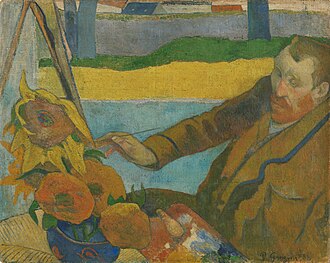 Vincent van Gogh Painting Sunflowers - Paul Gauguin (1888)
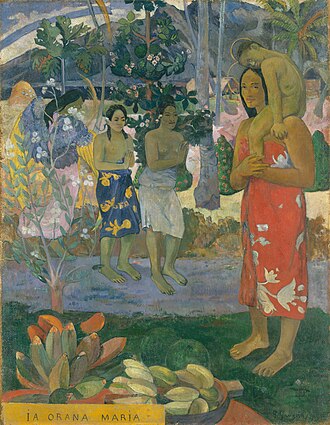 Ia Orana Maria - Paul Gauguin (1891)
Dipinti di artisti collegati
 The Starry Night - Vincent van Gogh (1889)
 Café Terrace at Night - Vincent van Gogh (1888)
 Walk on the mountain - Joaquín Sorolla (1909)
 Sad Inheritance - Joaquín Sorolla (1898)
 Les Grandes Baigneuses - Paul Cézanne (1900s)
 The Boy in the Red Vest - Paul Cézanne
 Dance at Le Moulin de la Galette - Pierre-Auguste Renoir (1876)
 Luncheon of the Boating Party - Pierre-Auguste Renoir (1881)
 At the Moulin Rouge - Henri de Toulouse-Lautrec (1892)
 La Toilette - Henri de Toulouse-Lautrec (1896)