The Milkmaid of Bordeaux
Francisco Goya · 1827
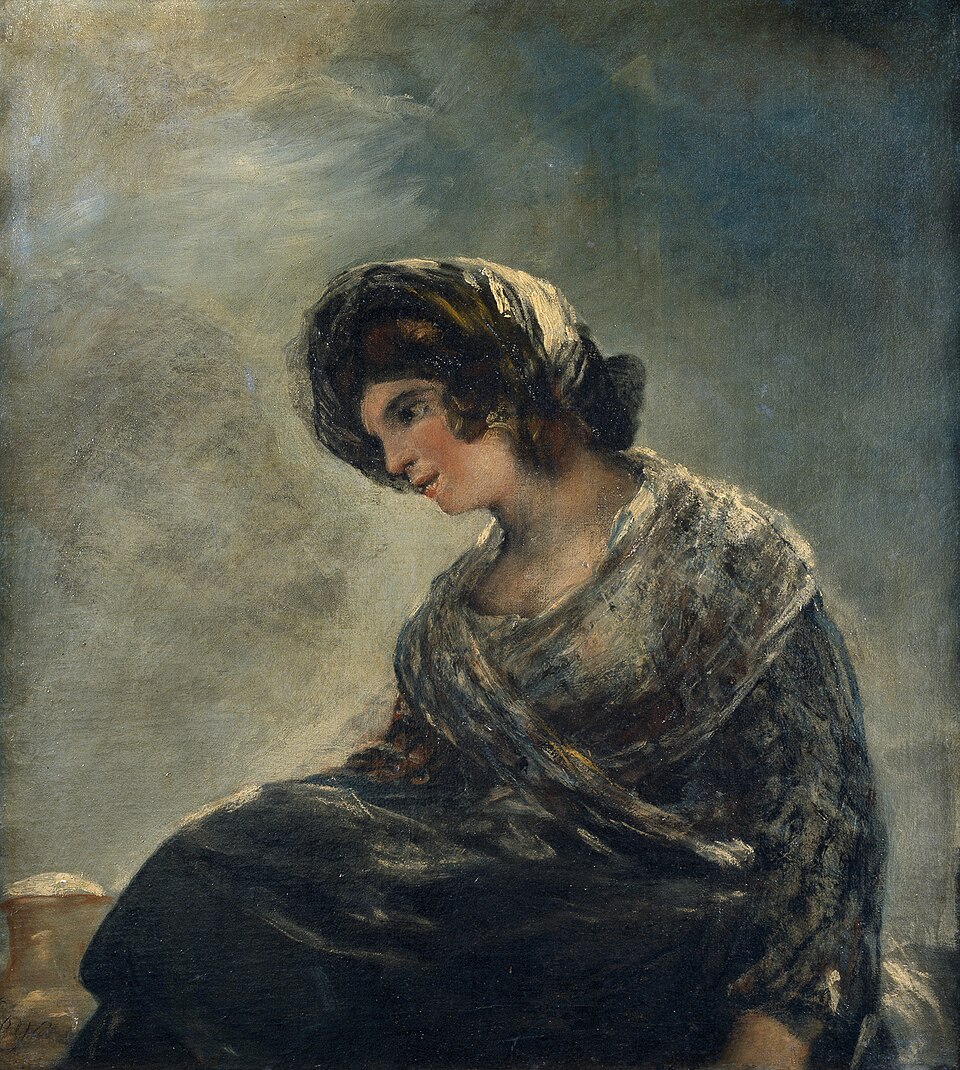
A young woman sits with her head bowed, wrapped in a shawl, glowing against a sky of blurred colour. It is generally attributed to Goya in his last years, though historians have questioned whether his hand painted it.
The story behind the painting
The Milkmaid of Bordeaux was completed between 1825 and 1827, and is generally attributed to Francisco Goya, who died in 1828. If it is his, it belongs to the end of his life, which he spent in exile in Bordeaux among politically liberal friends. There he was cared for by Leocadia Weiss, described by many sources as his nurse or housekeeper and by others as his mistress; the lack of documentation leaves the relationship uncertain. In Bordeaux, Goya made several drawings and paintings of the daily life of ordinary people. A letter from Leandro Fernández de Moratín to Juan Antonio Melón suggests that the shawl the sitter wears was likely bought by Goya himself. The work is described as his last portrait of a woman.
What to look for
The young woman, presumably a milkmaid or peasant, seems to sit in contemplation with her head lowered. A scarf partly covers her hair, a shawl wraps her shoulders, and an apron lies in her lap. Look to the lower left: beside her rests what appears to be a milk jug or some kind of container. Behind her, the sky is only a blur of colour, without any detail to hold the eye, so that she becomes the whole subject. Some have read her position as suggesting she is riding a mule, although neither the animal nor her hands can be seen. The canvas measures 74 by 68 centimetres. Writers on the painting point to its brushstrokes and colouring as signs of a master's technique.
Meaning and intent
The painting has been interpreted as an ode to youth by an old man in failing health. Its brightness marks a striking departure from the sombre Black Paintings for which Goya is famous, and some of the drawings and paintings he made in Bordeaux have been read as an expression of faith in humanity, this one included. Who is the woman? If the work is authentic, she is likely Rosario Weiss or, more likely, her mother Leocadia. Some have even claimed that Rosario, who later became a painter, made the picture herself, but comparison with her relatively amateur works in the Academia de San Fernando makes that seem highly unlikely. The idea that Rosario was Goya's daughter is unsubstantiated.
Legacy
After Goya's death the painting passed by will to his son Javier, who, facing financial difficulties, sold it to a distant relative, Juan Bautista de Muguiro. Muguiro's descendants donated it to the Museo del Prado in Madrid in 1946, and it remains a popular work there. Critics and the public alike hold it in high esteem and consider it one of Goya's masterpieces, yet doubts about its authorship persist, and it is less often discussed than his other works, perhaps because it seems less ambitious. The argument that its brightness rules Goya out has little support. Its quiet tenderness, whoever painted it, continues to draw visitors to it.
Lo sapevi?
- Completed 1825-1827, generally attributed to Goya
- Authorship has been questioned by art historians
- Sitter possibly Leocadia or Rosario Weiss
- Donated to the Museo del Prado in 1946
L'artista
Francisco Goya (1746-1828)
woman · portrait · Museo del Prado · sitting · brown hair
Altre opere di Francisco Goya
 The Third of May 1808 - Francisco Goya (1814)
.jpg) La maja nuda - Francisco Goya (1800)
La maja nuda - Francisco Goya (1800).jpg) Saturn Devouring His Son - Francisco Goya (1819)
Saturn Devouring His Son - Francisco Goya (1819) La famiglia di Carlo IV - Francisco Goya (1800)
 The Clothed Maja - Francisco Goya (1800)
 Il 2 maggio 1808 a Madrid - Francisco Goya (1814)
 Cane semiaffondato - Francisco Goya (1819)
 Il sabba delle streghe - Francisco Goya (1820s)