The last communion of St Joseph of Calasanz
Francisco Goya · 1819
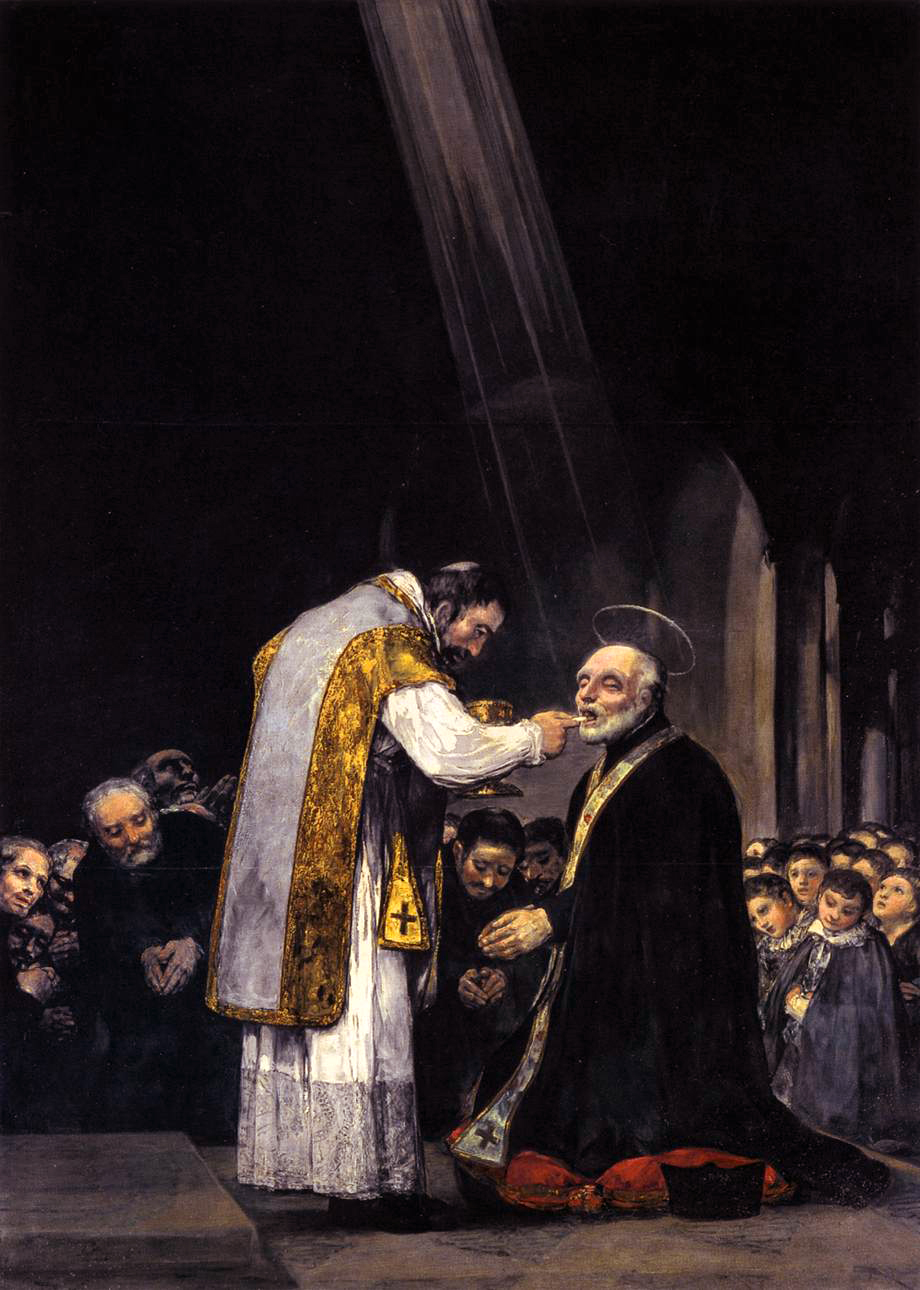
An old priest, close to death, kneels on a red cushion to receive the host as a beam of light cuts through the darkness. Goya painted it in 1819 for the order of the school where he had his first lessons.
The story behind the painting
Goya painted this large oil on canvas, about 250 by 180 cm, in 1819 for the Escuelas Pias of the school of San Anton in Madrid, whose church is linked to the altar of the church of Saint Anthony by one of its side chapels. Joseph Calasanz was the founder of the school order in which Goya had received his first lessons. When he delivered the canvas, Goya gave back most of the advance he had received for his Christ in the Garden of Olives, with a note saying he did so for his compatriot Joseph Calasanz.
What to look for
The painting shows Joseph Calasanz taking communion at eighty-one in the church of San Pantaleo in Rome. The saint, his face already that of a dying man, kneels on a red cushion to receive the host, lit by a ray of divine light that fills the dark picture with a pious, mystical tension. The background is black and the palette very dark; the only warm areas are the reds and yellows of the skin. They contrast with the white vestment of the priest, and recall the Black Paintings, the first of which date from this same period.
Meaning and intent
The two paintings Goya made for the Escolapios return to Spanish religious painting of the Golden Age. José Camón Aznar went so far as to call them the swan song of Western religious painting, noting how radically society had changed since the Habsburgs, especially after the French Revolution. The work shows real fervour, yet the old religious transcendence was no longer possible. Now it is the human that gives religious images their meaning: the agony of the old founder, the devout attitude of those around him, their recollection, and the nearness of death.
Legacy
The painting was made for the Escuelas Pias of San Anton in Madrid, which still holds it according to Wikidata. A sketch for the composition is kept at the Musee Bonnat in Bayonne. It is a very free and fiery study of the project, in ochres and shades of black and grey, and very typical of the palette Goya used in these years. Seen together, the sketch and the finished altarpiece show a painter already moving toward the darkness of the Black Paintings, still able to give an old man's last communion a deeply human gravity.
Lo sapevi?
- Painted in 1819 for the Escuelas Pias of San Anton, Madrid.
- Calasanz founded the school order where Goya had his first lessons.
- Its dark palette recalls Goya's Black Paintings of the same period.
- A sketch is kept at the Musee Bonnat in Bayonne.
L'artista
Francisco Goya (1746-1828)
religious art · man · history painting · standing · kneeling · chalice
Altre opere di Francisco Goya
 The Third of May 1808 - Francisco Goya (1814)
 La maja nuda - Francisco Goya (1800)
 Saturn Devouring His Son - Francisco Goya (1819)
 La famiglia di Carlo IV - Francisco Goya (1800)
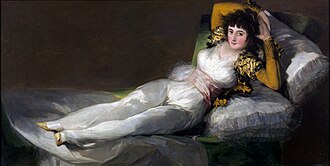 The Clothed Maja - Francisco Goya (1800)
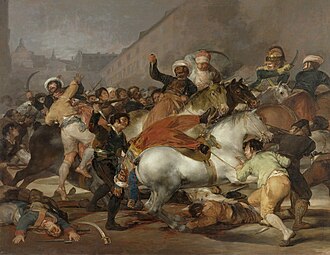 Il 2 maggio 1808 a Madrid - Francisco Goya (1814)
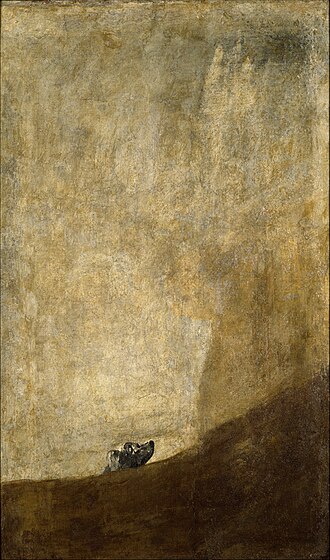 Cane semiaffondato - Francisco Goya (1819)
 Il sabba delle streghe - Francisco Goya (1820s)
Dipinti di artisti collegati
 Wanderer above the Sea of Fog - Caspar David Friedrich (c. 1818)
 The Abbey in the Oakwood - Caspar David Friedrich (1800s)
 Liberty Leading the People - Eugène Delacroix (1830)
 Death of Sardanapalus - Eugène Delacroix (1827)
 The Fighting Temeraire - J. M. W. Turner (1839)
 Rain, Steam and Speed - The Great Western Railway - J. M. W. Turner (1844)
 The Blue Boy - Thomas Gainsborough (1770)
 Mr and Mrs Andrews - Thomas Gainsborough (1748)