The Institution of the Eucharist
Nicolas Poussin · 1641
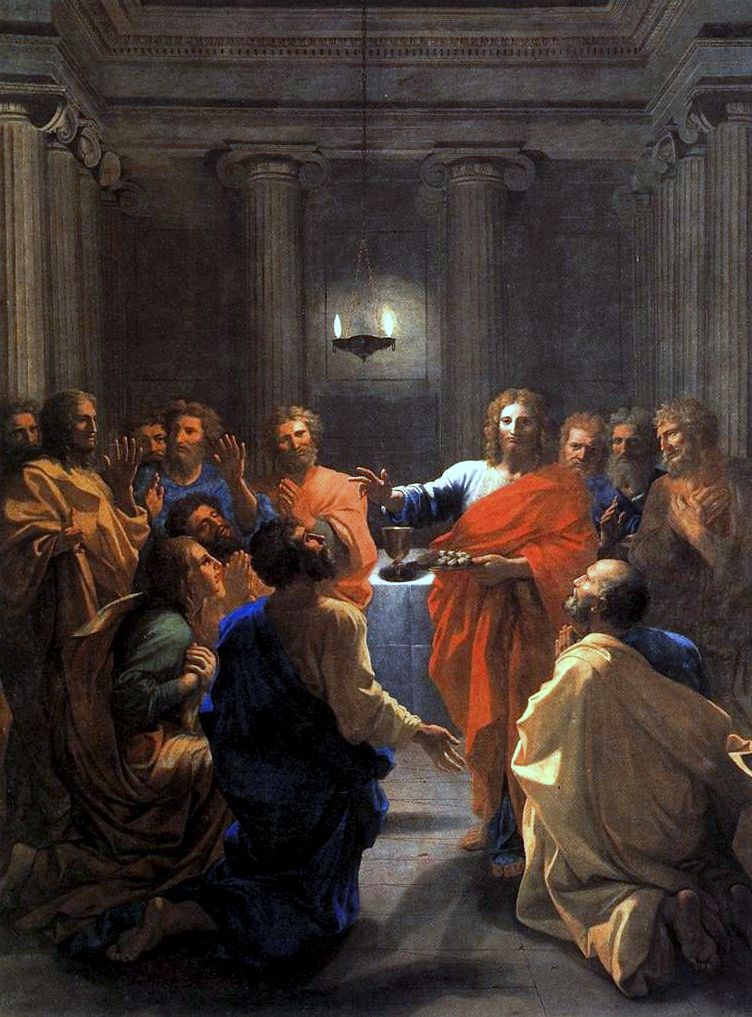
In a dark antique hall lit by a single two-flamed lamp, Christ raises three fingers above the chalice and twelve apostles turn toward him. It was Poussin's first royal commission, and it surprised the king by going not to his rival but to him.
The story behind the painting
At the end of Louis XIII's reign, the king and Cardinal Richelieu wanted art to serve the monarchy and make Paris another Rome. Francois Sublet de Noyers, named superintendent of buildings in 1638, and his cousins worked to bring the best French artists home from Rome. Poussin resisted for a long time, but Chantelou and his brother brought him back at the end of 1640. On 21 December he was presented to the king at Saint-Germain, who ordered an altarpiece for the chapel of the Chateau-Vieux, then being remodelled after the birth of the future Louis XIV. The high altar had been meant for Simon Vouet, and the king reportedly exclaimed that Vouet had been well caught. Poussin signed the receipt on 16 September 1641, and four days later the picture was in place.
What to look for
The canvas is huge and vertical, 325 by 250 cm. Christ stands at the right in a heavy red drapery over a blue tunic, holding in his left hand a paten with freshly consecrated bread. Three raised fingers of his right hand, thumb, index and middle, point to the Trinity, and that hand lines up with the chalice on the altar behind him. All the apostles look toward it. Four stand to his left and eight to his right; four kneel and three turn their backs to us, among them Peter and John. A single antique oil lamp with two flames lights the scene; its right flame falls on the faces of Christ and Peter, and the two flames echo the two main columns behind. Ionic columns and an ochre floor frame everything with rigour.
Meaning and intent
The art historian Mickael Szanto wrote that Poussin condenses into one image the mystery of the eucharistic sacrifice. Pierre Rosenberg believed the subject was suggested, or rather imposed, by Sublet de Noyers, as a reference to the chapel's renewal: the priest at Mass would repeat Christ's gesture in front of the king and court, like a mirror. Poussin also renewed the tradition. Western painters usually showed Christ reclining at a long table for the Last Supper, and standing only in communion scenes. Here he blesses the bread as at the institution, yet stands as in a communion. Gail S. Davidson suggests the vertical format was meant to fit the tall Gothic vaults around it. The night setting recalls that this is Christ's last night.
Legacy
The king and queen marvelled at the altarpiece, but it did not win popular success because of its austerity; the source calls it Poussin's most austere canvas and a pivotal work in his style. Its severe, undecorative look and its place in a royal chapel rather than an open Paris church long kept it little known. It stayed at Saint-Germain until the Revolution, entered the Louvre at the end of 1795, and was shown when the Grande Galerie reopened in April 1799. Poussin had treated the theme before in his first series of the Seven Sacraments for Cassiano dal Pozzo, and returned to it in the second series for Chantelou. The Louvre also keeps a smaller seventeenth-century copy.
Lo sapevi?
- Poussin's first royal commission, for the chapel at Saint-Germain-en-Laye.
- Installed on 20 September 1641.
- Oil on canvas, 325 by 250 cm.
- In the Louvre since the end of 1795.
L'artista
Nicolas Poussin (1594-1665)
religious art · Department of Paintings of the Louvre · column
Altre opere di Nicolas Poussin
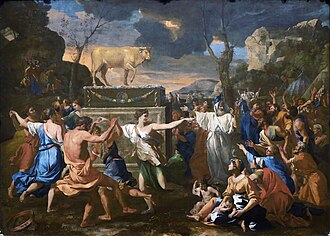 The Adoration of the Golden Calf - Nicolas Poussin (1634)
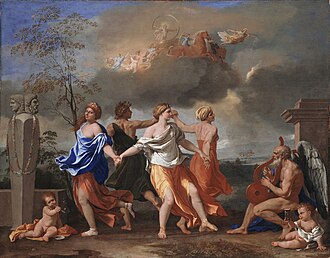 A Dance to the Music of Time - Nicolas Poussin (1630s)
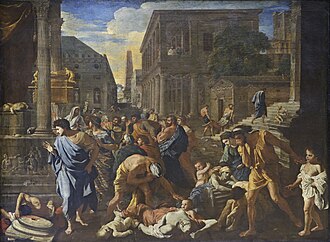 The Plague at Ashdod - Nicolas Poussin (1630)
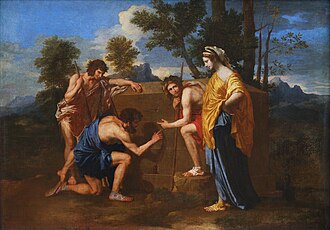 Et in Arcadia ego - Nicolas Poussin (1638)
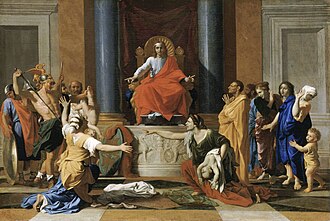 The Judgment of Solomon - Nicolas Poussin (1649)
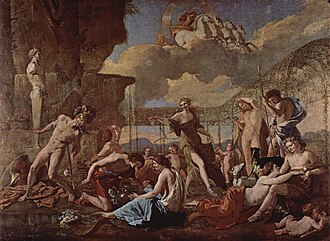 The Empire of Flora - Nicolas Poussin (1631)
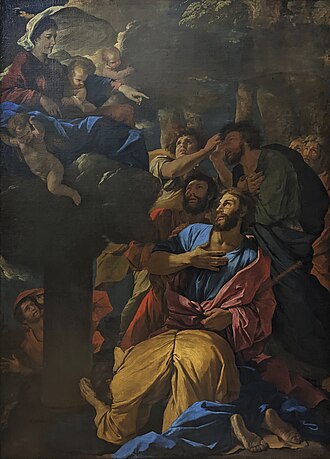 The Apparition of the Virgin to Saint James the Great - Nicolas Poussin (1620s)
 The Martyrdom of Saint Erasmus - Nicolas Poussin (1628)