The game of pelota with rackets
Francisco Goya · 1779
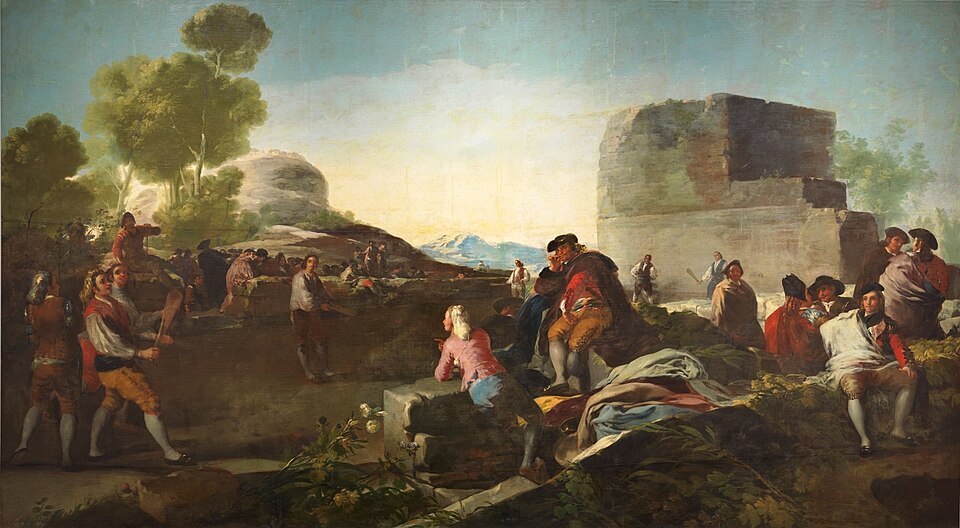
Players with wooden bats chase a ball across a wide open court while a man in the foreground calmly smokes. At more than four metres wide, this was the largest cartoon in its series, painted by the young Goya to hang at the heart of a prince's bedroom.
The story behind the painting
El juego de pelota a pala belongs to Goya's third series of tapestry cartoons, for the bedroom of the Prince of Asturias, the future Charles IV, and his wife Maria Luisa of Parma at the Pardo palace. Goya painted it between 5 January and 20 July 1779 and delivered it to the Royal Tapestry Factory on 21 July. The French Wikipedia article places it between 1778 and 1779, and Wikidata gives 1779. It was meant to replace The Blind Guitarist, whose weaving had caused many problems.
What to look for
This is the largest cartoon of the series, about 261 by 470 cm, designed to cover the central part of the prince's bedroom. Unlike the festive scenes of the rest of the series, it shows a genre scene of daily life: a game of pelota played with bats. Look for the smoker in the foreground. The colours are muted, and the handling recalls Velazquez, whom Goya admired. The balance between the figures and the space is carefully judged, so the volumes feel right.
Meaning and intent
The source sees in this canvas Goya's growing command of perspective, light and colour: for the first time he builds a space that clearly marks distance and closeness, while the viewer does not notice the strict geometry beneath it. The picture shares features with the Italian Baroque painting whose masterpieces Goya had studied. According to Janis Tomlinson, the scene also hides a sexual meaning, as Goya included in tapestries for princely bedrooms, though works for the royal apartments could never be explicit.
Legacy
Like many of the cartoons, this one was stored in the basement of the Royal Palace of Madrid and was considered lost until 1869, when Gregorio Cruzada Villaamil found it there. It was handed to the Prado in 1870 under orders of 19 January and 9 February, and has been part of the permanent collection ever since. It was first cited in the Prado catalogue in 1876. The same series included The Fair of Madrid, The Crockery Vendor and Boys Playing at Soldiers.
Lo sapevi?
- Part of Goya's third series of tapestry cartoons, for the Pardo palace.
- Painted between 5 January and 20 July 1779.
- The largest cartoon of its series, about 261 by 470 cm.
- Rediscovered in 1869 and in the Prado since 1870.
L'artista
Francisco Goya (1746-1828)
Altre opere di Francisco Goya
 The Third of May 1808 - Francisco Goya (1814)
 La maja nuda - Francisco Goya (1800)
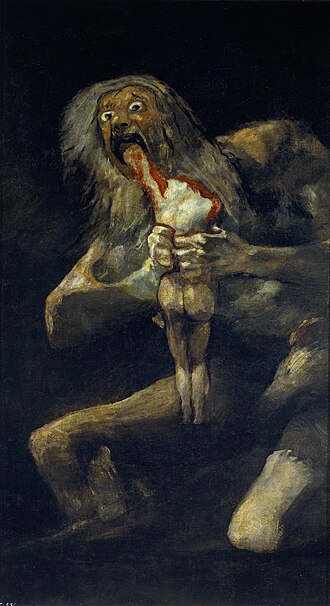 Saturn Devouring His Son - Francisco Goya (1819)
 La famiglia di Carlo IV - Francisco Goya (1800)
 The Clothed Maja - Francisco Goya (1800)
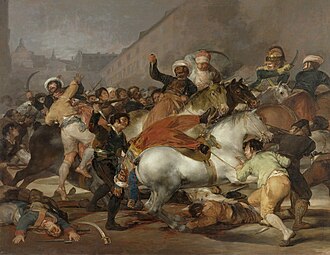 Il 2 maggio 1808 a Madrid - Francisco Goya (1814)
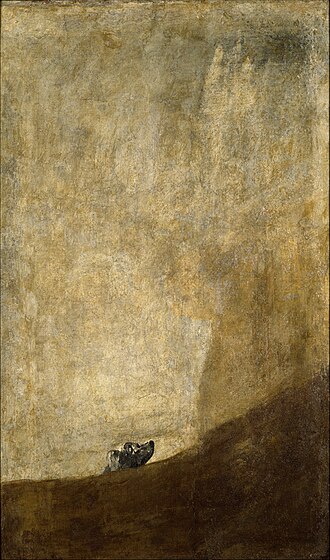 Cane semiaffondato - Francisco Goya (1819)
 Il sabba delle streghe - Francisco Goya (1820s)
Dipinti di artisti collegati
 Wanderer above the Sea of Fog - Caspar David Friedrich (c. 1818)
 The Abbey in the Oakwood - Caspar David Friedrich (1800s)
 Liberty Leading the People - Eugène Delacroix (1830)
 Death of Sardanapalus - Eugène Delacroix (1827)
 The Fighting Temeraire - J. M. W. Turner (1839)
 Rain, Steam and Speed - The Great Western Railway - J. M. W. Turner (1844)
 The Blue Boy - Thomas Gainsborough (1770)
 Mr and Mrs Andrews - Thomas Gainsborough (1748)