The Bunch of Flowers
Paul Gauguin · 1891
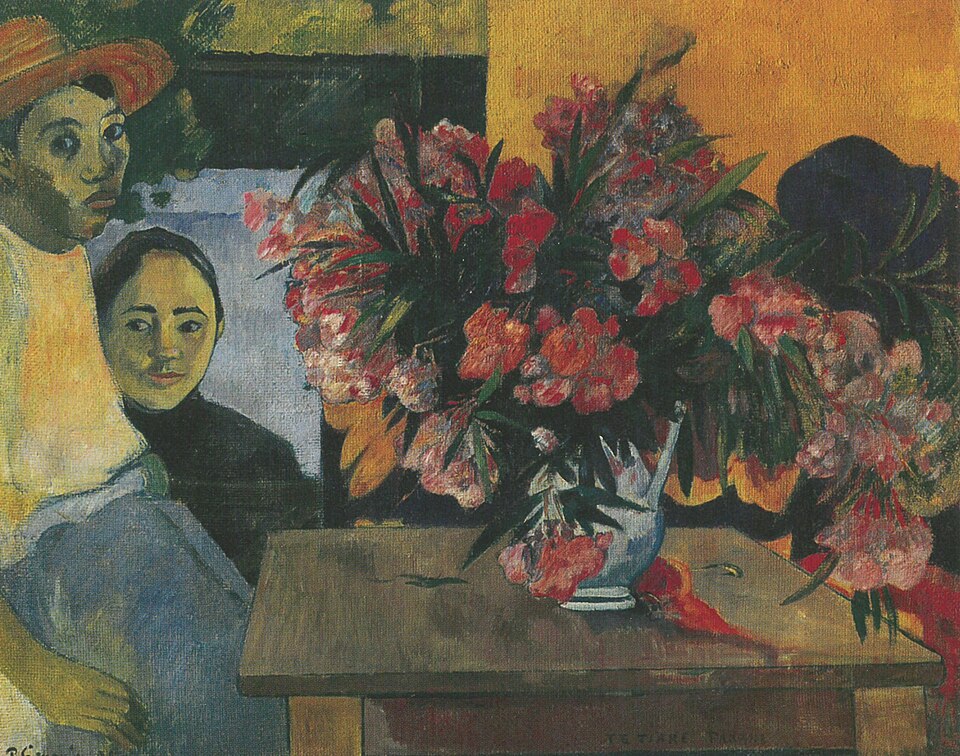
A vase of flowers on a table, a map of South America beneath it, a young Tahitian man to one side and a girl at the window behind. Gauguin wrote its Tahitian name, Te tiare farani, right on the table top.
The story behind the painting
Gauguin painted this canvas in 1891, one of the first works of his Tahitian series. It was only the second painting, after Tahitian Woman with a Flower, to which he gave a Tahitian title: Te tiare farani, Flowers of France. In 1893 he sent the work to Paris, where it was first shown to the public at Paul Durand-Ruel's gallery, and it was then that it received its French title, The Bunch of Flowers.
What to look for
The Tahitian title is painted on the table top, just to the right of centre, so the name becomes part of the picture. Under the vase lies a map with the outline of South America. A young Tahitian man sits at the left, and behind him a girl in a dark dress looks out of a window. The canvas, about 72 by 92 cm, sets a still life of flowers among people and a glimpse of the world beyond.
Meaning and intent
The two names hold the painting between two places: a bouquet called Flowers of France, painted in Tahiti, with a map of another continent beneath it. Gauguin chose to write the Tahitian words inside the image rather than in a corner, as he did only once before. The sources do not explain his intention further, but the table, the map, the seated man and the watching girl gather his new island life around a familiar European subject.
Legacy
On 18 February 1895 the painting was offered at a sale of Gauguin's works at the Hotel Drouot, meant to fund another trip to Tahiti, but it did not sell and Gauguin bought it back. It went on to Ambroise Vollard's gallery and was shown at the 1906 Autumn Salon. Ivan Morozov bought it in 1908. After the October Revolution the Soviet state seized his collection; the work went to the State Museum of Modern Western Art in 1923, and to the Pushkin Museum in 1948.
Lo sapevi?
- Painted in Tahiti in 1891.
- Gauguin's second work with a Tahitian title, Te tiare farani.
- Unsold at the 1895 Hotel Drouot sale.
- Bought by Ivan Morozov in 1908, now in the Pushkin Museum.
L'artista
Paul Gauguin (1848-1903)
Altre opere di Paul Gauguin
 Where Do We Come From? What Are We? Where Are We Going? - Paul Gauguin (1897-1898)
 Cristo giallo - Paul Gauguin (1889)
 When Will You Marry? - Paul Gauguin (1892)
 Donne di Tahiti - Paul Gauguin (1890)
 Vision After the Sermon - Paul Gauguin (1888)
Manaò tupapaú - Paul Gauguin (1892)
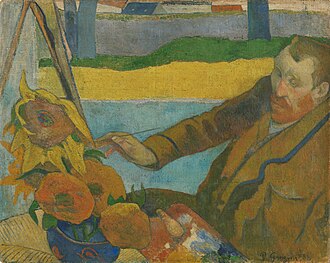 Vincent van Gogh Painting Sunflowers - Paul Gauguin (1888)
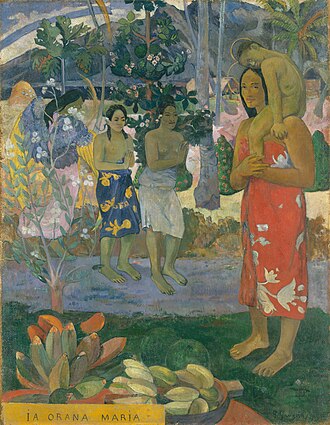 Ia Orana Maria - Paul Gauguin (1891)
Dipinti di artisti collegati
 The Starry Night - Vincent van Gogh (1889)
 Café Terrace at Night - Vincent van Gogh (1888)
 Walk on the mountain - Joaquín Sorolla (1909)
 Sad Inheritance - Joaquín Sorolla (1898)
 Les Grandes Baigneuses - Paul Cézanne (1900s)
 The Boy in the Red Vest - Paul Cézanne
 Dance at Le Moulin de la Galette - Pierre-Auguste Renoir (1876)
 Luncheon of the Boating Party - Pierre-Auguste Renoir (1881)
 At the Moulin Rouge - Henri de Toulouse-Lautrec (1892)
 La Toilette - Henri de Toulouse-Lautrec (1896)