the bullfight
Francisco Goya · 1779
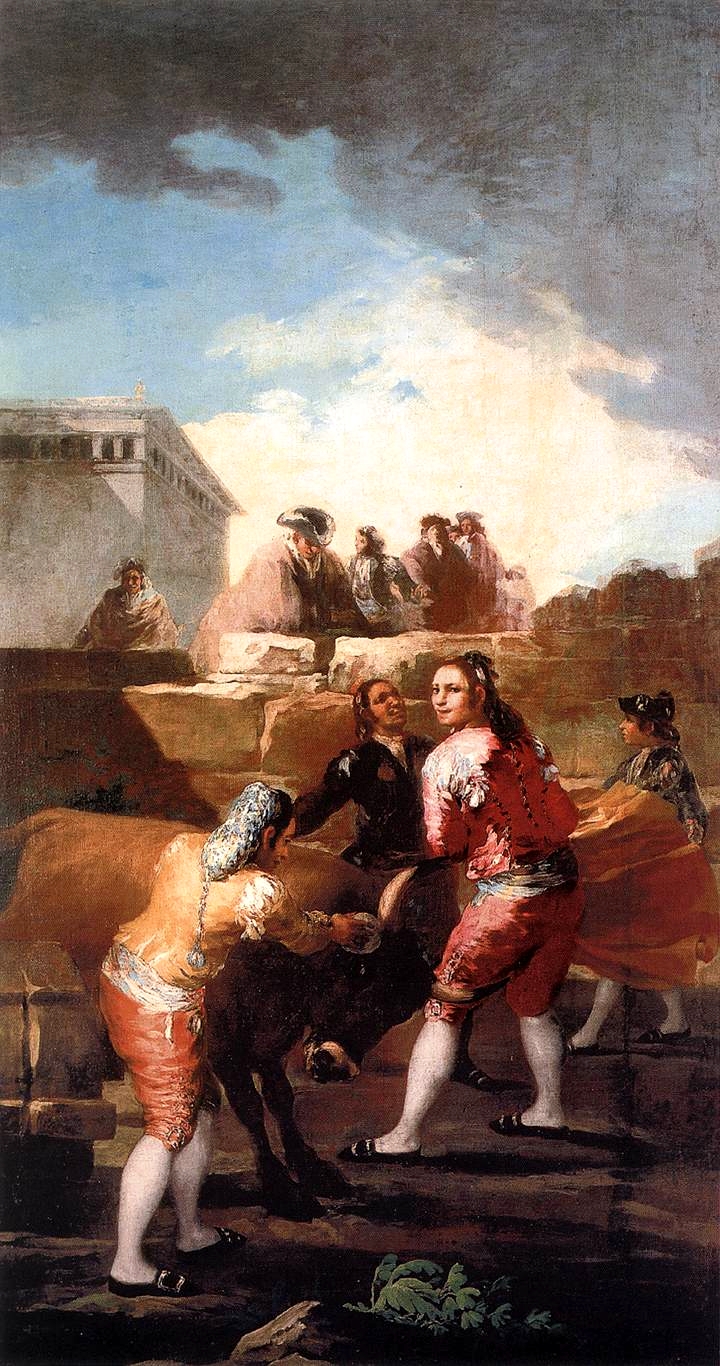
Young men in bright costumes play a young bull with capes, and the one in red turns to look straight at us. Many see Goya himself in that face, a memory of the bullfights he loved, painted as a design for a royal tapestry.
The story behind the painting
Goya painted La Novillada as one of the fourth series of tapestry cartoons for the antechamber of the Prince of Asturias, the future Charles IV, and his wife Maria Luisa of Parma in the Pardo Palace. It was delivered to the Royal Tapestry Factory on 24 January 1780 and received by its director, Cornelio Vandergoten. A document dated 2 October 1777 says the tapestry was to hang on the south wall next to El Resguardo de tabacos. Wikipedia dates the work 1780, while Wikidata gives 1779.
What to look for
A group of young men in colourful costumes works a young bull with a cape. The main figure, turning his head toward the viewer, has been seen as a portrait of Goya. Claude Pelletier writes that Goya, probably an amateur bullfighter in youth, portrayed himself in a red costume as the main character. The bright colours are typical of Goya's first period, and so are the majos. It is said that the colours drove the weavers at the Royal Factory mad.
Meaning and intent
Goya was an aficionado of a world then called a refuge of scoundrels and adventurers. He described the scene as a cape pass by several young men, without naming himself, though he more or less painted himself in. The historian José Camón Aznar links it to Goya's childhood attempts at bullfighting. Vandergoten gave a different reading of the figures. A link to a passage in a poem by Nicolás Fernández de Moratín has been proposed, but Jeannine Baticle thinks Goya only knew that poem after making this cartoon.
Legacy
The cartoon was considered lost until 1869, when Gregorio Cruzada Villaamil found it in the basement of the Royal Palace in Madrid. It went to the Prado in 1870 and first appeared in the museum's catalogue in 1876; it hangs in room 91. Bullfighting stayed with Goya: he later painted bullfighters such as Pedro Romero, and after the illness that left him deaf he made a series of twelve small paintings on metal of national pastimes, years before his engraved Tauromaquia.
Lo sapevi?
- A tapestry cartoon for the Pardo Palace, delivered on 24 January 1780.
- The figure in red is often seen as a self-portrait of Goya.
- Rediscovered in the Royal Palace basement in 1869.
- In the Museo del Prado since 1870.
L'artista
Francisco Goya (1746-1828)
Altre opere di Francisco Goya
 The Third of May 1808 - Francisco Goya (1814)
 La maja nuda - Francisco Goya (1800)
 Saturn Devouring His Son - Francisco Goya (1819)
 La famiglia di Carlo IV - Francisco Goya (1800)
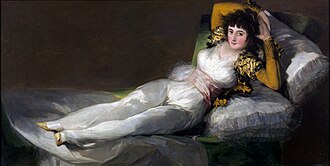 The Clothed Maja - Francisco Goya (1800)
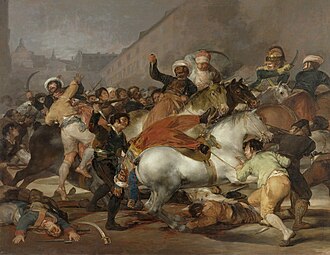 Il 2 maggio 1808 a Madrid - Francisco Goya (1814)
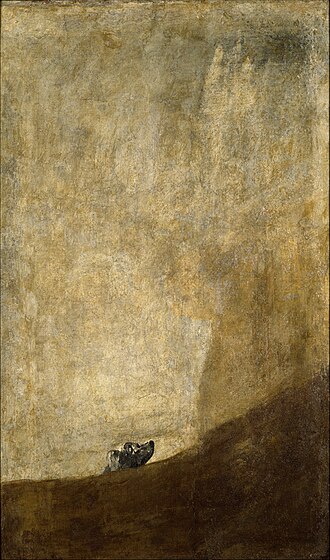 Cane semiaffondato - Francisco Goya (1819)
 Il sabba delle streghe - Francisco Goya (1820s)
Dipinti di artisti collegati
 Wanderer above the Sea of Fog - Caspar David Friedrich (c. 1818)
 The Abbey in the Oakwood - Caspar David Friedrich (1800s)
 Liberty Leading the People - Eugène Delacroix (1830)
 Death of Sardanapalus - Eugène Delacroix (1827)
 The Fighting Temeraire - J. M. W. Turner (1839)
 Rain, Steam and Speed - The Great Western Railway - J. M. W. Turner (1844)
 The Blue Boy - Thomas Gainsborough (1770)
 Mr and Mrs Andrews - Thomas Gainsborough (1748)