The Blind of Jericho
Nicolas Poussin · 1650
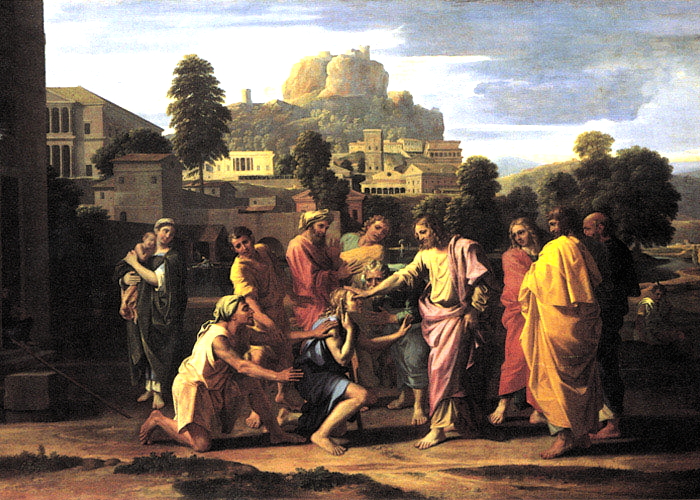
Christ reaches out and touches the eyes of a blind man kneeling before him. Two years after Poussin's death, a painter stood before the Royal Academy to explain, light by light, why this picture mattered.
The story behind the painting
Poussin painted the picture around 1650 for Bernardin Reynon, a merchant from Lyon. It later belonged to the duc de Richelieu, a great collector of Poussin's paintings, and entered the collection of Louis XIV in 1665. It is also known as Christ Healing the Blind. The canvas measures 1.19 by 1.76 metres and is kept at the Louvre in Paris, under inventory numbers INV 7281 and MR 2320, where it is shown in room 826.
What to look for
Two blind men approach Christ; one kneels as he touches his eyes, and a woman in the group turns around. In 1667 the painter Sébastien Bourdon analysed the play of light and shadow and argued that the scene takes place in the morning. He compared the left blind man to the ancient Wounded Gladiator, the right one to an antique Apollo, and the turning woman to the Venus de' Medici. The buildings behind recall early Christian churches of Rome: a basilica with a wide portico, a bell tower on the left, a palace behind on the right, and a building with stacked porticos taken from designs by Palladio.
Meaning and intent
The traditional title refers to Matthew 20, where two blind men call out to Jesus as he leaves Jericho followed by a great crowd, and he touches their eyes. Mark tells it with one blind man, Bartimaeus. But Matthew 9 describes a similar healing of two blind men in Capernaum. The Louvre, Bellori, Félibien and Bourdon all followed Jericho, yet another speaker at the 1667 conference thought the details pointed to Capernaum, a view taken up in modern times by Elizabeth Cropper. The composition may draw on a tapestry cartoon by Raphael showing the blinding of Elymas.
Legacy
Bourdon's lecture to the Royal Academy of Painting and Sculpture on 3 December 1667 made this canvas a teaching example only two years after Poussin's death. In 1684 Félibien called it one of the most beautiful pictures to come from Poussin's hand, for the arrangement of its subject, the strength of its drawing, its colour and the fine expressions of its figures. It is a quiet scene of a miracle, measured and luminous rather than dramatic.
Lo sapevi?
- Painted around 1650 for the Lyon merchant Bernardin Reynon.
- Entered the collection of Louis XIV in 1665.
- Subject of a Royal Academy lecture by Sébastien Bourdon in 1667.
- Some see Capernaum rather than Jericho in the scene.
L'artista
Nicolas Poussin (1594-1665)
religious art · Department of Paintings of the Louvre · city · cliff
Altre opere di Nicolas Poussin
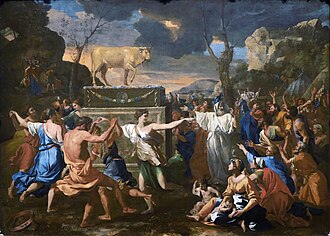 The Adoration of the Golden Calf - Nicolas Poussin (1634)
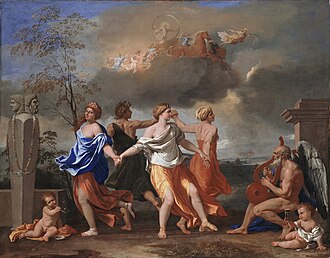 A Dance to the Music of Time - Nicolas Poussin (1630s)
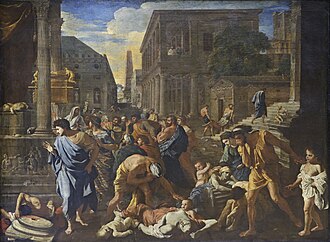 The Plague at Ashdod - Nicolas Poussin (1630)
.jpg) The Judgment of Solomon - Nicolas Poussin (1649)
The Judgment of Solomon - Nicolas Poussin (1649)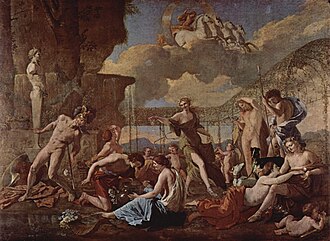 The Empire of Flora - Nicolas Poussin (1631)
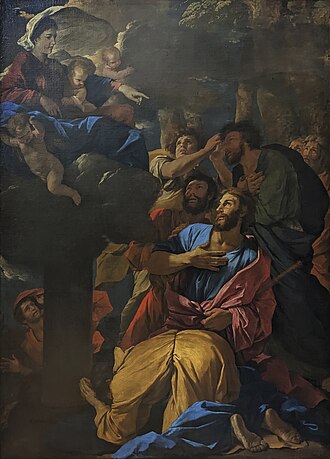 The Apparition of the Virgin to Saint James the Great - Nicolas Poussin (1620s)
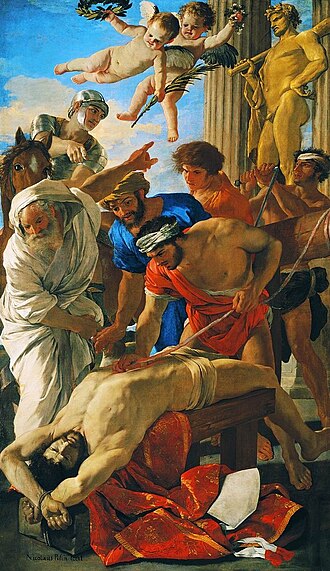 The Martyrdom of Saint Erasmus - Nicolas Poussin (1628)
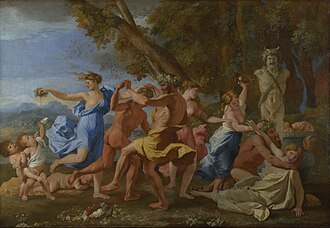 A Bacchanalian Revel Before a Term - Nicolas Poussin (1630s)