The Bacchanal of the Andrians
Titian · 1520s
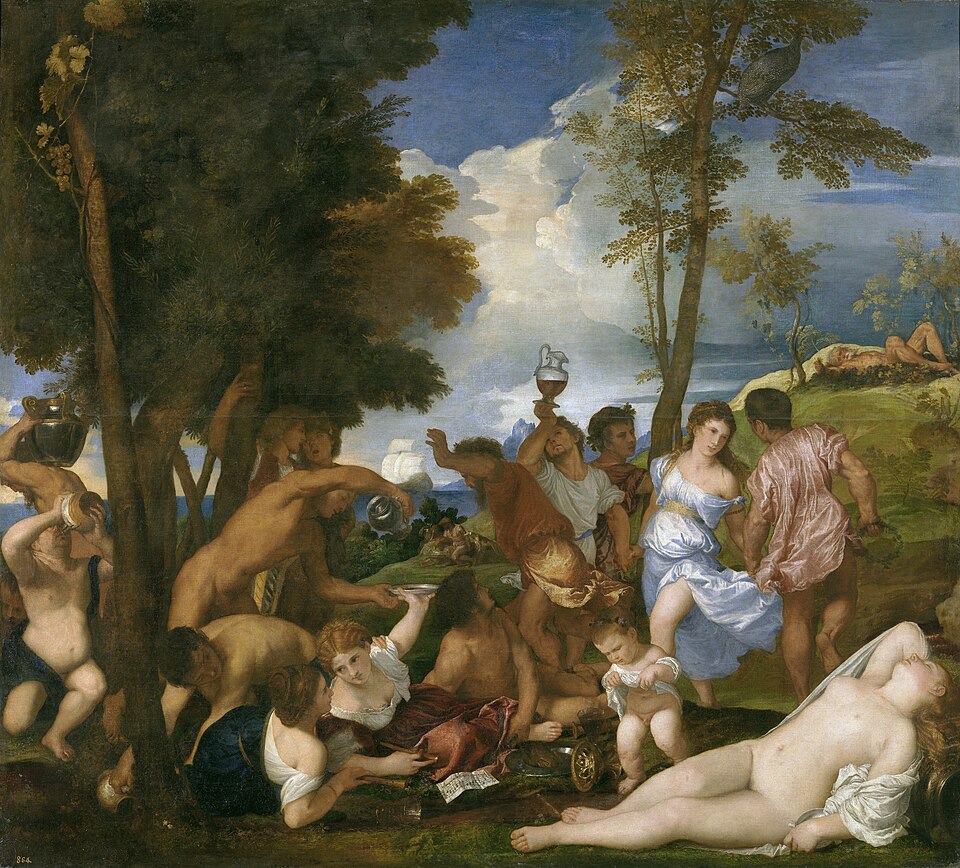
On the island of Andros a river runs with wine, and everyone is celebrating. Titian painted this joyous bacchanal for a duke's private rooms, and it went on to dazzle Rubens, Poussin and Velázquez.
The story behind the painting
Titian painted The Bacchanal of the Andrians, signed TICIANUS F., around 1523-1526 for Alfonso I d'Este. It was made for the Sala dei Baccanali in the Camerini d'alabastro in Ferrara, following The Worship of Venus and Bacchus and Ariadne, and after Titian had retouched the landscape of Bellini's Feast of the Gods to match. In 1598 Ferrara passed to the Papal State, and Cardinal Pietro Aldobrandini quietly appropriated the painting. His theft only became known in 1629, after it passed through the Ludovisi inheritance and was sold to the Duke of Monterrey, who gave it to Philip IV of Spain in 1639. It is now in the Museo del Prado in Madrid.
What to look for
Begin in the lower right, where a sleeping nymph lies with her arm bent behind her head, a pose borrowed from the Sleeping Ariadne; Vasari wrote that she was so beautiful she seemed alive. Behind her a small boy relieves himself into the river. At the centre two young women recline in full light, one holding up her plate as a man pours wine. To the left a heavy, Silenus-like man drinks from a pitcher filled at the wine river. Dancers move to the right, one balancing a glass jug on his fingertips. Far in the background sails a ship. Look too at the sheet of music in the foreground, and the recorders held by the two women.
Meaning and intent
The scene is set on Andros, and like Bacchus and Ariadne it was inspired by the Imagines of Philostratus. Bacchus himself is missing, and Erwin Panofsky suggested the god is aboard the departing ship. The decorative programme celebrated Bacchus and Venus, gods of wine and love. Music is part of the meaning: the score, a playful canon in French attributed to the Ferrarese court musician Adrian Willaert, links music to Dionysian pleasure and hints at Ferrara's musical culture and Titian's musically influenced colour. Yet no instrument is played. The article notes the beauty and joy, even erotic, is never disturbed by vulgarity. Ivy and vine, sacred to Dionysus, appear among the figures and trees.
Legacy
The three Titian canvases from Ferrara were admired and copied in Italy and Spain by Rubens, Guido Reni, Nicolas Poussin and Diego Velázquez, and they contributed to the development of the Baroque. Rubens's copy of this Bacchanal is in the Nationalmuseum in Stockholm. Domenichino is said to have wept when the masterpieces left Italy. In 1782 Joshua Reynolds, admiring the painting, compared Titian to Virgil, writing that whatever Titian touched, however mean or familiar, he invested with grandeur and importance by a kind of magic. Still in Madrid today, the painting has been a lesson in colour, movement and joy for painters across several centuries.
Lo sapevi?
- Signed TICIANUS F. and dated to 1523-1526; Wikidata gives the 1520s.
- Painted for Alfonso I d'Este's Camerini d'alabastro in Ferrara; now in the Prado.
- The musical canon in the foreground is attributed to Adrian Willaert.
- Rubens's copy of the painting is in the Nationalmuseum, Stockholm.
L'artista
Titian (1488-1576)
High Renaissance · mythological painting · Museo del Prado · nude · Venetian school · nudity · sailing ship · wine · nymph · recorder
Altre opere di Titian
.jpg) Venus of Urbino - Titian (1538)
Venus of Urbino - Titian (1538)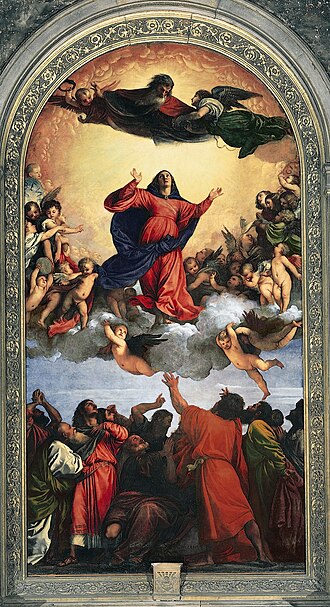 Assumption of the Virgin - Titian (1510s)
FXD.jpg) Sacred and Profane Love - Titian (1510s)
Sacred and Profane Love - Titian (1510s)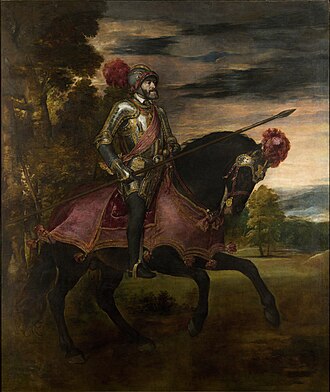 Equestrian Portrait of Charles V - Titian (1548)
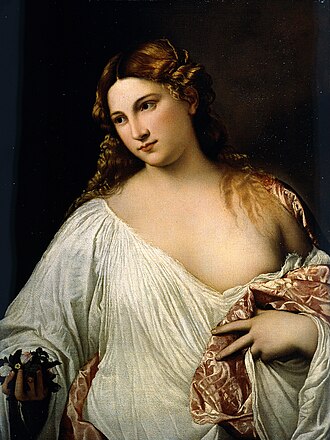 Flora - Titian (1517)
 Allegory of Prudence - Titian (1550)
 Bacchus and Ariadne - Titian (1520s)
%20nave%20left%20-%20Altar%20of%20Madona%20di%20Ca'Pesaro.jpg) Pesaro Madonna - Titian
Pesaro Madonna - Titian