The Altar of St. John
Rogier van der Weyden · 1455
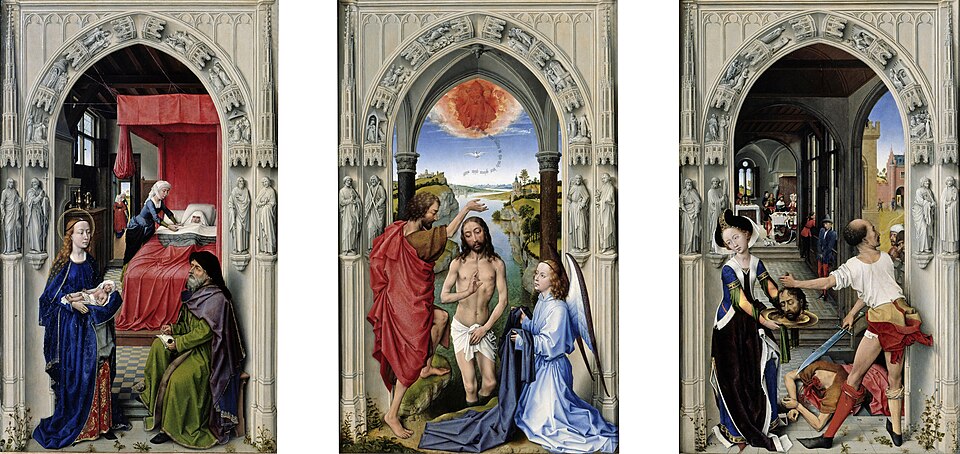
A birth, a baptism, a beheading: three moments of John the Baptist's life, each framed in a painted stone arch. Rogier van der Weyden turned them into a meditation on the sacraments, down to a head on a plate that recalls the Mass.
The story behind the painting
Rogier van der Weyden painted the Saint John Altarpiece in oils on oak around 1455; tree-ring study shows the wood was ready for use around 1454. Erwin Panofsky dated it after 1450, since the birth scene resembles Andrea Pisano's relief at the Florence Baptistery, which Rogier may have seen on his visit to Italy that year. It was commissioned by Battista Agnelli, a merchant from Pisa, for Saint James's Church in Bruges, though it is also thought to have had a Spanish donor. Wikidata gives 77 by 48 cm, which corresponds to a single panel. It is now in the Gemäldegalerie, Berlin.
What to look for
From left to right: the birth of John, his baptism of Christ in the Jordan, and his beheading. Each scene sits inside painted grisaille archivolts with statuettes of the Apostles and small reliefs, so the scenes seem to take place inside a church. In the first, Mary presents the baby to his father Zacharias, who holds pen and scroll, following the Golden Legend rather than the Gospel. In the centre Christ stands in the stream, John in red blesses him, and a curving inscription descends with the dove. On the right the executioner hands the head on a golden charger to Salome, both looking away.
Meaning and intent
The overall theme is salvation and the sacraments, each panel linked to a liturgical ceremony. Barbara Lane notes that Salome's charger corresponds to the golden paten used for the Host at Mass, and Victoria Reed adds that by receiving the head Salome takes the part of the communicant, her sleeves recalling a liturgical cloth. The beheading also departs from the Gospel: a domestic interior instead of a prison, and the head already on the plate. Figures echo each other across panels; the woman in the birth scene mirrors Salome on the far right, a harmony typical of Rogier.
Legacy
The frames are fixed together and cannot fold, so it is a purpose-designed altarpiece rather than a true triptych, smaller than Rogier's others and probably for a side altar or private devotion. A portable oratory seen in the Carthusian monastery of Santa Maria de las Cuevas in Seville in 1744, then attributed to Albrecht Dürer, is probably this work. An almost equal version in Frankfurt is considered a near-contemporary copy. Scholars link it closely with the Miraflores Altarpiece and it appeared in the 1980 BBC Two series 100 Great Paintings.
Lo sapevi?
- Oil on oak, around 1455; wood ready for use around 1454.
- Shows the birth, the baptism of Christ and the beheading of John.
- The Berlin version is the original; Frankfurt has a near-contemporary copy.
- Closely linked to Rogier's Miraflores Altarpiece.
L'artista
Rogier van der Weyden (1390s-1464)
religious art · Early Netherlandish painting · Gemäldegalerie Berlin · John the Baptist
Altre opere di Rogier van der Weyden
 The Descent from the Cross - Rogier van der Weyden (1440s)
 Portrait of a Lady - Rogier van der Weyden (1460)
 The Last Judgment - Rogier van der Weyden (1443)
 Saint Luke Drawing the Virgin - Rogier van der Weyden (1490)
 Columba Triptych - Rogier van der Weyden (1450s)
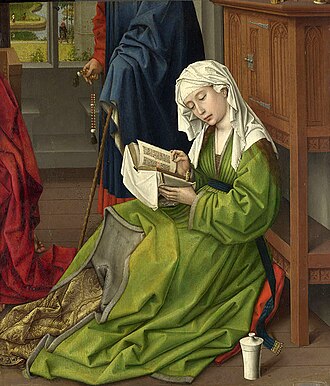 The Magdalen Reading - Rogier van der Weyden (1435)
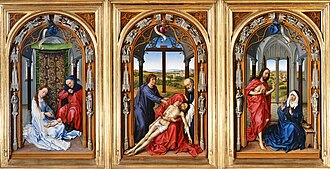 Miraflores Altarpiece - Rogier van der Weyden (1443)
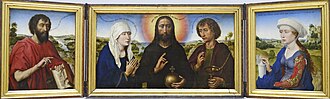 Braque Triptych - Rogier van der Weyden (1452)
Dipinti di artisti collegati
 Arnolfini Portrait - Jan van Eyck (1434)
 Ghent Altarpiece - Jan van Eyck (1432)
 Annunciation - Hans Memling (1480s)
 Scenes from the Passion of Christ - Hans Memling (1470)
 The Garden of Earthly Delights - Hieronymus Bosch
 Ship of Fools - Hieronymus Bosch (1500s)
 The Hunters in the Snow - Pieter Bruegel the Elder (1565)
 Netherlandish Proverbs - Pieter Bruegel the Elder (1551)