St. Francis Borgia Helping a Dying Impenitent
Francisco Goya · 1788
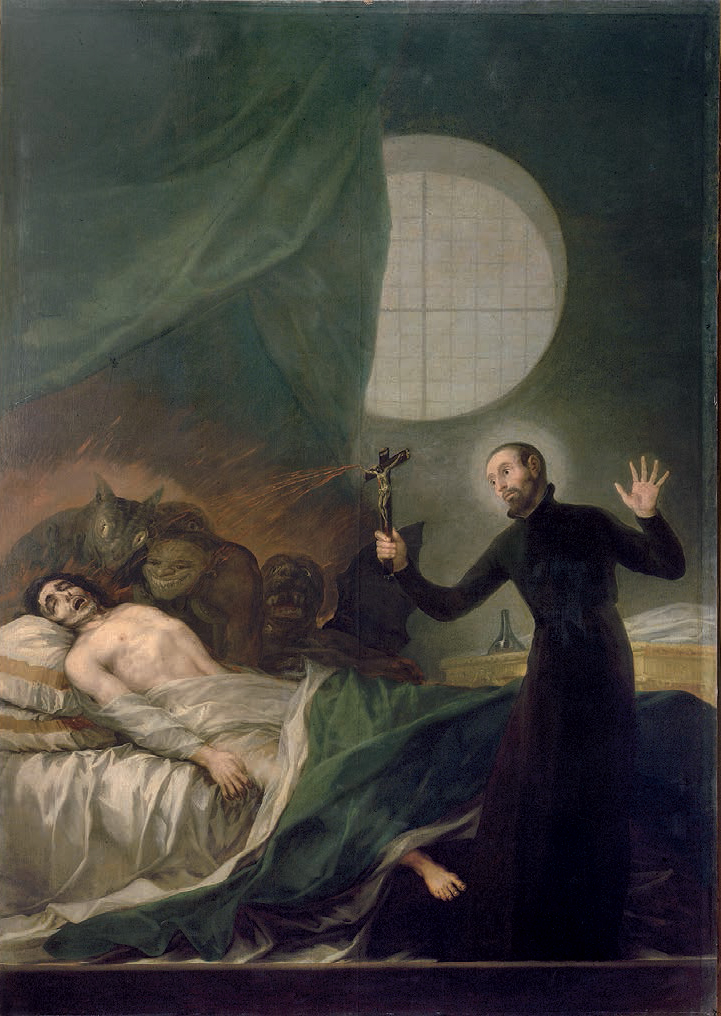
A saint holds up a crucifix to a dying man who will not confess, while grotesque creatures wait for his soul. In 1788 Goya painted one of his first truly terrifying pictures for a cathedral chapel.
The story behind the painting
Goya painted the picture in 1788, commissioned by the ninth Duke of Osuna for his chapel in Valencia Cathedral. The theme is rooted in traditional popular imagery which, as far back as Gonzalo de Berceo's Miracles of Our Lady, tells of the struggle between heavenly and demonic forces for the soul of a dying person. The saint is Francis Borgia, and the dying man refuses the sacrament, which turns the scene into a contest for his soul.
What to look for
Francis Borgia holds out a crucifix, trying to persuade the dying man to confess, while grotesque beings, probably demons, wait to take his soul. The lighting is sharply contrasted. The man's deathly rigidity shows in a dramatic grimace and a theatrical light in yellows and whites, the same tones as the aura around the saint's head, set against warm greens. The caricatured figures in the background are said to represent fear.
Meaning and intent
This is one of the first paintings that can be placed in the eighteenth century aesthetic of the Terrible, which Anton Raphael Mengs linked to the style of Michelangelo. Goya goes beyond what his contemporaries called the Sublime Terrible. Pedro de Silva, another contemporary, wrote that the viewer sees the terrible signs of a soul violently shaken by cruel remorse for its crimes and the desperate certainty of its coming damnation.
Legacy
For these reasons the French Wikipedia article counts it among the most original religious paintings. Its small size, 29 by 38 cm, contrasts with the force of the scene. The work is linked to Valencia Cathedral, where the duke's chapel stood, and it is still recorded there. Pedro de Silva's reaction shows that viewers of Goya's own time already felt its power. The scene of saint, dying man and demons stays in the memory long after.
Lo sapevi?
- Painted in 1788 for the ninth Duke of Osuna.
- Made for his chapel in Valencia Cathedral.
- Demons wait for the soul of the dying man.
- An early example of the aesthetic of the Terrible.
L'artista
Francisco Goya (1746-1828)
Altre opere di Francisco Goya
 The Third of May 1808 - Francisco Goya (1814)
 La maja nuda - Francisco Goya (1800)
 Saturn Devouring His Son - Francisco Goya (1819)
 La famiglia di Carlo IV - Francisco Goya (1800)
 The Clothed Maja - Francisco Goya (1800)
 Il 2 maggio 1808 a Madrid - Francisco Goya (1814)
 Cane semiaffondato - Francisco Goya (1819)
 Il sabba delle streghe - Francisco Goya (1820s)
Dipinti di artisti collegati
 Wanderer above the Sea of Fog - Caspar David Friedrich (c. 1818)
 The Abbey in the Oakwood - Caspar David Friedrich (1800s)
 Liberty Leading the People - Eugène Delacroix (1830)
 Death of Sardanapalus - Eugène Delacroix (1827)
 The Fighting Temeraire - J. M. W. Turner (1839)
 Rain, Steam and Speed - The Great Western Railway - J. M. W. Turner (1844)
 The Blue Boy - Thomas Gainsborough (1770)
 Mr and Mrs Andrews - Thomas Gainsborough (1748)