Shepherd playing a Dulzaina
Francisco Goya · 1786
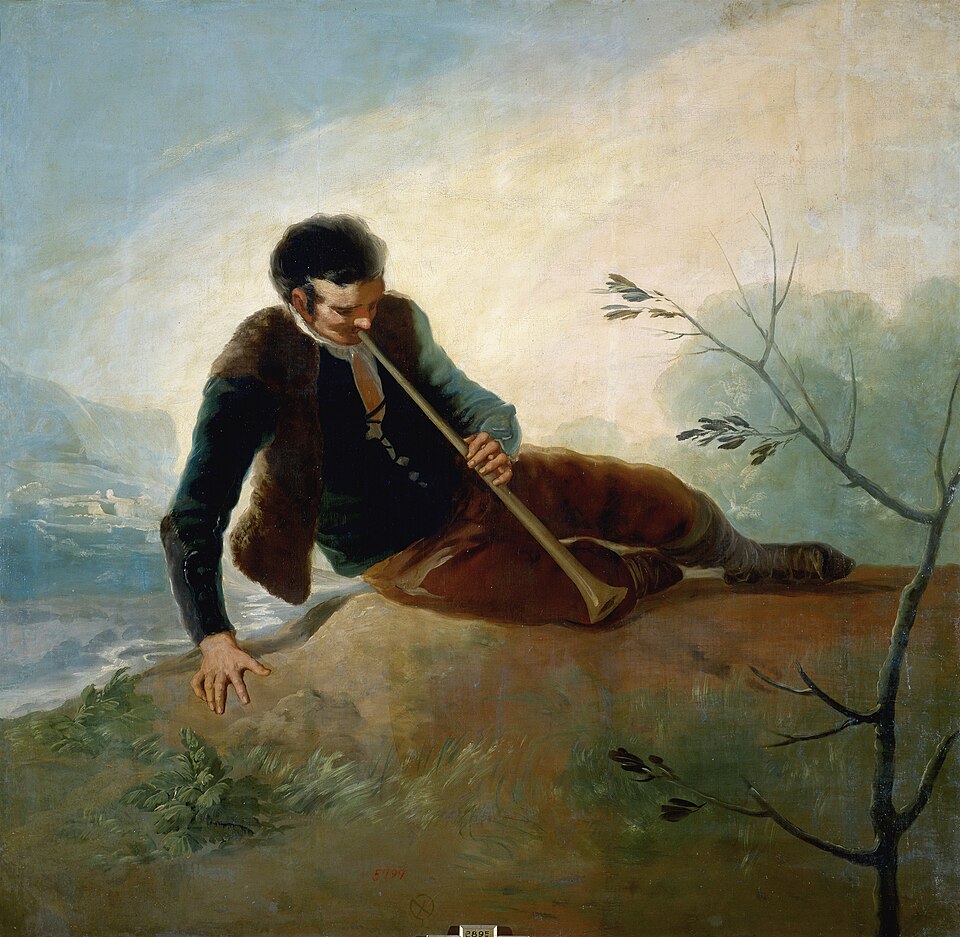
A shepherd lies on a little hill, playing his reed pipe under a thinning tree. Goya painted him as a design for a royal tapestry, and the canvas then vanished for decades into a palace basement.
The story behind the painting
Goya painted this canvas in 1786 to 1787 as a cartoon, a full-size model for a tapestry. It belongs to his fifth series of cartoons, all made for the dining room of the Prince of Asturias, the future Charles IV, and his wife Maria Luisa of Parma, at the Pardo Palace. The series included The Flower Girls, The Threshing Floor, The Grape Harvest, The Snowstorm, The Injured Mason and other country scenes. In the room, this shepherd hung beside the Hunter by a Spring, the two framing The Flower Girls.
What to look for
It is a country scene: a shepherd musician lies stretched on a small mound, playing the dulzaina, a reed pipe. The picture is conceived with an upward perspective, so we look up at him against the sky. As a side panel, like The Parasol or The Drinker, it uses the triangular arrangement typical of Neoclassicism. Notice the shallow landscape and the sparse leaves on the tree. Together they give the scene an autumn feeling, a quiet pause in the open air with only the music for company.
Meaning and intent
The cartoon is steeped in the Italian taste of its time, especially the customs of Venice and Bologna, cities Goya had visited in 1771, when he worked on his Italian Notebook. It may have been placed near the tapestry of The Grape Harvest, which was dedicated to autumn. The autumnal mood of the bare tree matches the place it was meant to hold in the palace. It is less a portrait of a real shepherd than an elegant picture of country leisure, made to decorate the walls where a prince would dine.
Legacy
After its tapestry was woven, the canvas was considered lost until 1869, when Gregorio Cruzada Villaamil discovered it in the basement of the Royal Palace in Madrid. By orders of 19 January and 9 February 1870 it was handed over to the Museo del Prado, where it hangs in room 94. It was first listed in the Prado catalogue in 1876. Wikipedia dates the work to 1786 to 1787, while Wikidata gives 1786. Today visitors can see this once forgotten design for a wall hanging as a painting in its own right.
Lo sapevi?
- A tapestry cartoon painted in 1786-1787 for the Pardo Palace.
- Made for the dining room of the future Charles IV.
- Found in 1869 in the basement of the Royal Palace, Madrid.
- In the Museo del Prado since 1870.
L'artista
Francisco Goya (1746-1828)
Altre opere di Francisco Goya
 The Third of May 1808 - Francisco Goya (1814)
 La maja nuda - Francisco Goya (1800)
 Saturn Devouring His Son - Francisco Goya (1819)
 La famiglia di Carlo IV - Francisco Goya (1800)
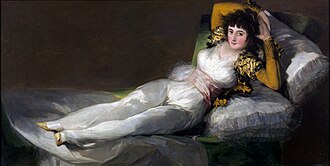 The Clothed Maja - Francisco Goya (1800)
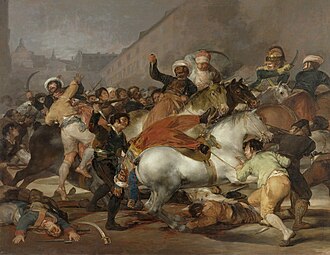 Il 2 maggio 1808 a Madrid - Francisco Goya (1814)
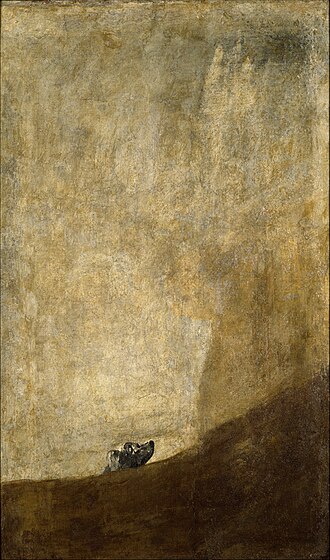 Cane semiaffondato - Francisco Goya (1819)
 Il sabba delle streghe - Francisco Goya (1820s)
Dipinti di artisti collegati
 Wanderer above the Sea of Fog - Caspar David Friedrich (c. 1818)
 The Abbey in the Oakwood - Caspar David Friedrich (1800s)
 Liberty Leading the People - Eugène Delacroix (1830)
 Death of Sardanapalus - Eugène Delacroix (1827)
 The Fighting Temeraire - J. M. W. Turner (1839)
 Rain, Steam and Speed - The Great Western Railway - J. M. W. Turner (1844)
 The Blue Boy - Thomas Gainsborough (1770)
 Mr and Mrs Andrews - Thomas Gainsborough (1748)