Self-Portrait
Titian · 1562
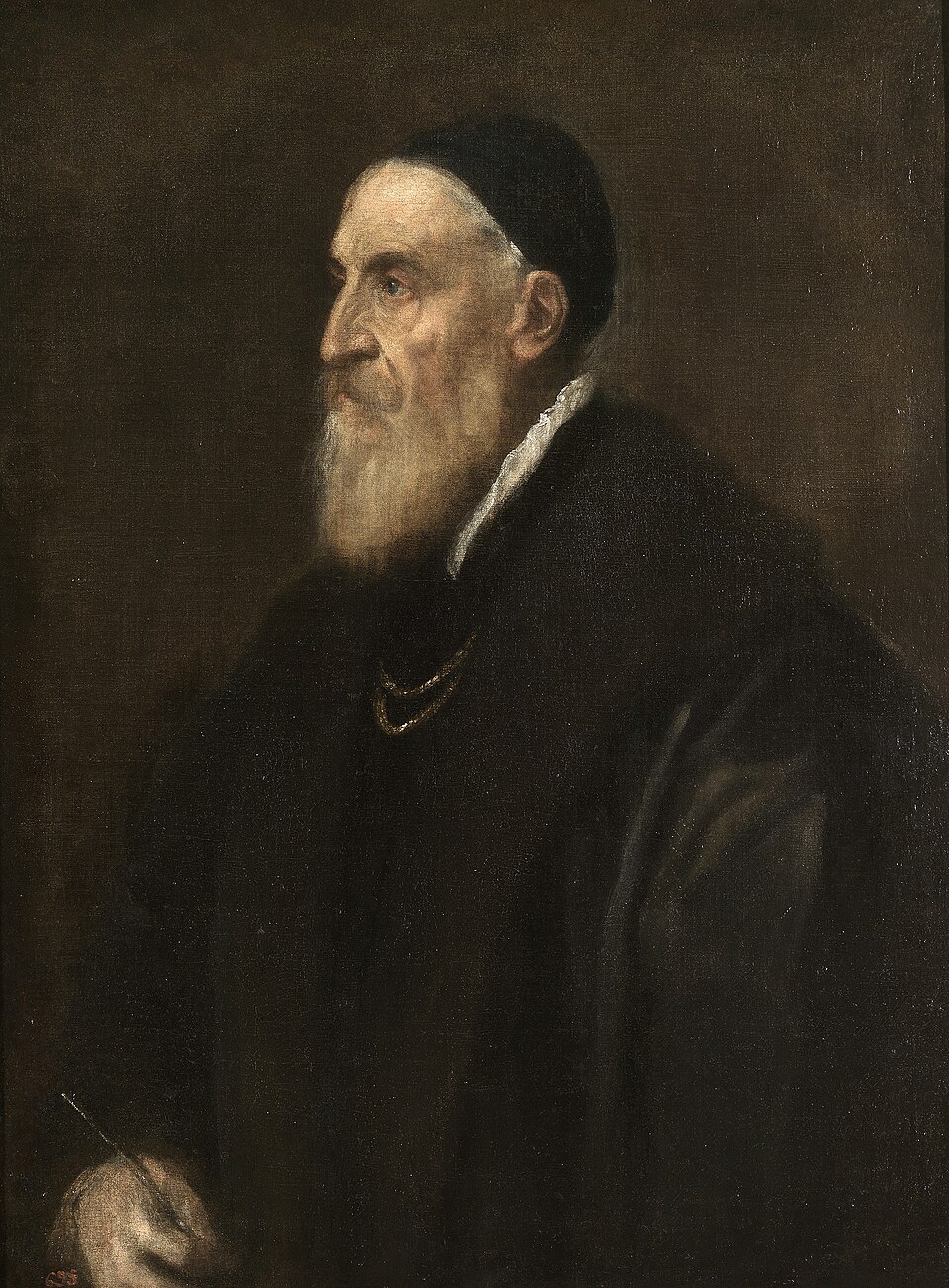
Old, gaunt and lost in thought, Titian turns in profile and quietly holds a brush. Few painters before him had shown themselves so plainly as painters, and Velazquez and Goya would follow.
The story behind the painting
This is the later of Titian's two surviving self-portraits. Wikipedia dates it to about 1560, while Wikidata gives 1562; either way, Titian was over seventy. Vasari noted that by then he was successful and wealthy enough not to depend on commissions, and Titian was keenly aware of how others saw him, keeping public knowledge of his life to a minimum. Unlike his earlier, alert and confident self-portrait in Berlin, this one is a realistic and unflattering picture of the effects of old age. It is held in the Museo del Prado in Madrid.
What to look for
Titian is shown in profile, dressed in simple but expensive clothes, staring into the middle distance. In the lower left corner he holds a paintbrush. The colours are deep, rich blacks and browns, with small touches of white around the face and hair, at the neckline and on his chain. The flat background sends the eye to his sharp features: the high forehead, hooked nose, long beard and penetrating, deep-set eyes. His command of paint and shade here marks a high point of his late period. The canvas measures 86 by 65 cm.
Meaning and intent
He looks remote, aged and gaunt, yet the portrait conveys dignity, authority and the mark of a master. The brush asserts his status as a famous painter, an element missing from the Berlin portrait, and makes this one of the earliest self-portraits in Western art where the artist directly presents himself as a painter. The picture seems meant to shape how others saw him, drawing attention both to his great age and, through fine clothes and the profile view, then reserved for the most noble, to his rank. The physical charisma of the Berlin picture is replaced by authority.
Legacy
Titian's influence made this work the start of a line of self-portraits by later artists. Velazquez in Las Meninas of 1656 and Goya in Charles IV of Spain and His Family of 1800 to 1801 both painted themselves in the act of painting. Titian also put a similar image of himself, wearing a skull cap, into The Virgin and Child with Saints Titian and Andrew, which he meant for his tomb in Pieve di Cadore. Today the portrait hangs in the Prado in Madrid, where its quiet authority still speaks first through the brush in his hand.
Lo sapevi?
- The later of Titian's two surviving self-portraits.
- Dated about 1560 by Wikipedia and 1562 by Wikidata.
- One of the earliest self-portraits where the artist shows himself as a painter.
- Held in the Museo del Prado, Madrid.
L'artista
Titian (1488-1576)
Museo del Prado · Venetian school · self-portrait · Titian
Altre opere di Titian
 Venus of Urbino - Titian (1538)
 Assumption of the Virgin - Titian (1510s)
 Sacred and Profane Love - Titian (1510s)
 Equestrian Portrait of Charles V - Titian (1548)
 Flora - Titian (1517)
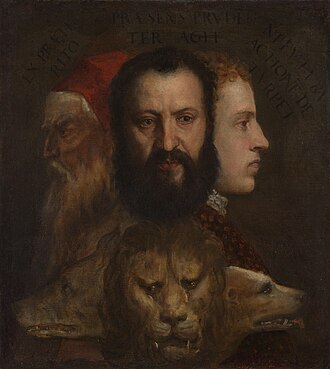 Allegory of Prudence - Titian (1550)
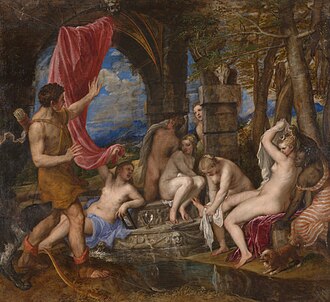 Diana and Actaeon - Titian (1550s)
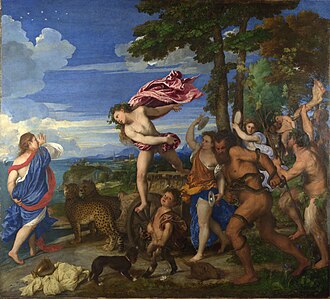 Bacchus and Ariadne - Titian (1520s)
Dipinti di artisti collegati
 Last Supper - Jacopo Tintoretto (1563)
 Miracle of the Slave - Jacopo Tintoretto (1540s)
 The Wedding at Cana - Paolo Veronese (1560s)
 The Feast in the House of Levi - Paolo Veronese (1573)