Seashore with fisherman
Caspar David Friedrich · 1800s
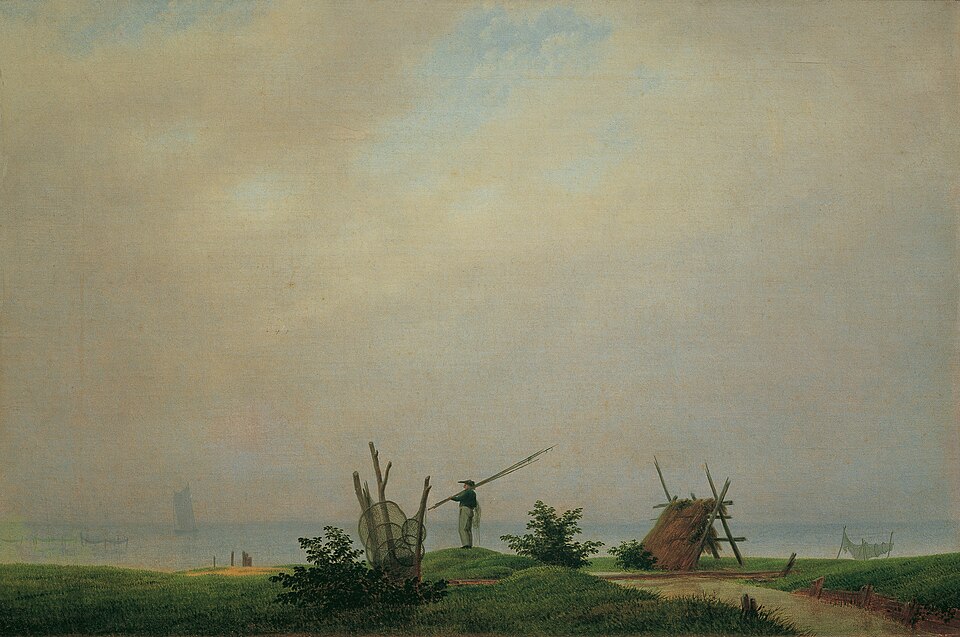
A lone fisherman stands on a green mound, poles on his shoulder, before a lake dissolving into mist. With this small canvas Caspar David Friedrich began his life as a painter in oils.
The story behind the painting
The painting is dated around 1807; Wikidata gives only the 1800s. With its pair, Seashore in Fog, it is considered the earliest oil painting Friedrich made in Dresden. Despite the title, the water is a lake: three inscribed drawings made around 1805 at the Tollensesee near Neubrandenburg place the scene on its north shore, and Kurt Wilhelm-Kästner and Friedrich Scheven identified the lake's outflow into the Oberbach. In 1808 it was bought by the Count of Medem, through Friedrich's painter friend Gerhard von Kügelgen, whose wife was related to the Medem family. The count knew the Tollensesee landscape well, having visited nearby Hohenzieritz Castle in 1795 in the entourage of the future Queen Louise of Prussia.
What to look for
A fisherman stands on a grassy mound, carrying poles used to steer boats between the fish traps, with a bundle of trap lines over his right arm. Traps hang to dry left and right. The bank is cut by the lake's brownish outflow, edged with wooden fascines and crossed by a plank leading to a half-thatched reed hut. Mist rises from the lake into high fog that opens at the top to a little blue sky; a sailboat is barely visible. The horizon, as if drawn with a ruler, leaves five-sixths of the picture to the sky. The outflow sits on the golden section, and the strong green of the bank glows against the pale water and haze, even tinting the fisherman's clothes.
Meaning and intent
Helmut Börsch-Supan reads the picture through vanitas symbols: the green strip of shore is the limited earthly world, the sea an image of eternity, and the fisherman with his tools embodies the conditions of earthly life, so the painting speaks of longing for death and human transience. Werner Hofmann looks instead at its structure and sees a fog picture describing the suspended state of human existence. The dense blend of water and sky makes the clouds seem like the lake's rising vapour, a realm of the uncertain set against the bright reality of the shore.
Legacy
The picture gets little attention, yet it marks a turning point. With it Friedrich began painting in oils, adapting steps from his sepia drawings to gain transparency of colour. Its radical division of space anticipates The Monk by the Sea, which can be seen as a constructive negative of this picture, emptied of objects and colour. After the Medem family, it went to the Dresden dealer Paul Rusch, then to the banker Hugo Simon in 1925, was auctioned in Lucerne in 1939 and exchanged to a Vienna gallery. The source says it was given to the Kunsthistorisches Museum in 1953 and is now shown at the Belvedere. It is listed in the Lost Art database of cultural property possibly seized under Nazi persecution.
Lo sapevi?
- Dated around 1807, among Friedrich's earliest oil paintings.
- Shows the north shore of the Tollensesee near Neubrandenburg.
- Its composition anticipates The Monk by the Sea.
- Now shown at the Belvedere in Vienna with its pair, Seashore in Fog.
L'artista
Caspar David Friedrich (1774-1840)
landscape painting · Belvedere
Altre opere di Caspar David Friedrich
 Wanderer above the Sea of Fog - Caspar David Friedrich (c. 1818)
 The Abbey in the Oakwood - Caspar David Friedrich (1800s)
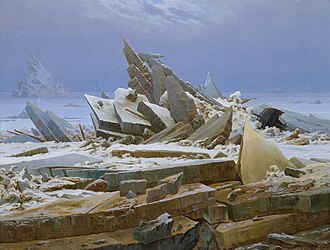 The Sea of Ice - Caspar David Friedrich (1820s)
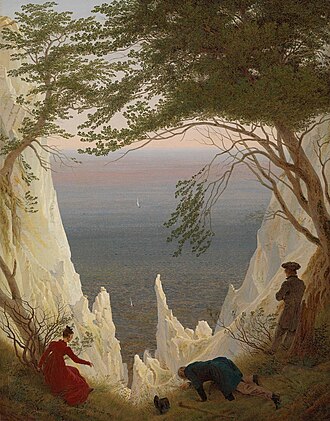 Chalk Cliffs at Ruegen - Caspar David Friedrich (1818)
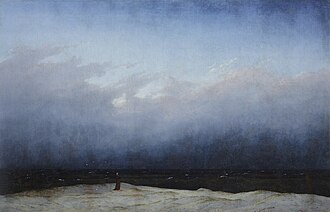 The Monk by the Sea - Caspar David Friedrich (1808)
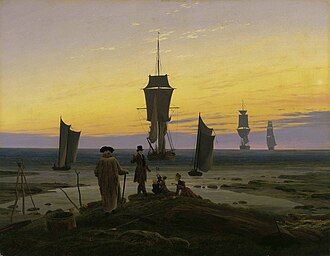 Life stages - Caspar David Friedrich (1834)
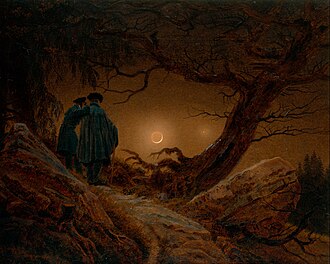 Two men contemplating the Moon - Caspar David Friedrich (1810s)
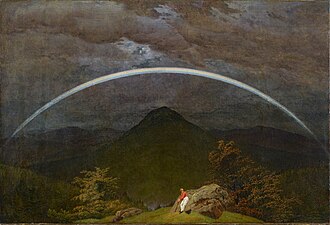 Mountain Landscape with Rainbow - Caspar David Friedrich (1809)
Dipinti di artisti collegati
 The Third of May 1808 - Francisco Goya (1814)
 La maja nuda - Francisco Goya (1800)
 Liberty Leading the People - Eugène Delacroix (1830)
 Death of Sardanapalus - Eugène Delacroix (1827)
 The Fighting Temeraire - J. M. W. Turner (1839)
 Rain, Steam and Speed - The Great Western Railway - J. M. W. Turner (1844)
 The Blue Boy - Thomas Gainsborough (1770)
 Mr and Mrs Andrews - Thomas Gainsborough (1748)