Mountain Landscape with Rainbow
Caspar David Friedrich · 1809
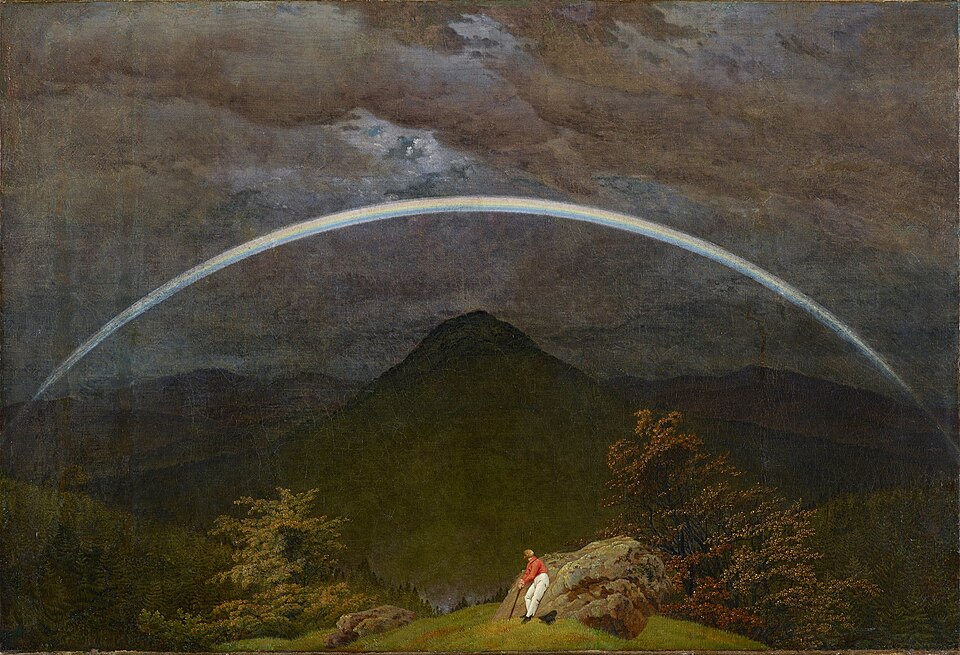
A lone traveller leans on a rock and gazes into a dark mountain valley, while a pale rainbow arches above. Look twice: no real sun or moon could make that rainbow. Friedrich painted not the world as it is, but the world as it is felt.
The story behind the painting
Caspar David Friedrich painted this landscape after travelling through Germany and along the shores of the Baltic Sea in 1809. Wikipedia dates the work 1809 to 1810, while Wikidata gives 1809. Friedrich was a devout Protestant and one of the leading figures of German Romanticism, which prized emotion, spirituality and individual experience. He wrote that the artist's law is feeling, and urged painters to close the physical eye and see the painting with the spiritual eye. He was deeply moved by the pastor and poet Ludwig Gotthard Kosegarten, who preached that God could be experienced personally through nature, using imagery of the same Baltic coast where Friedrich had grown up in Pomerania.
What to look for
In the foreground stands a Rückenfigur, a figure with his back to us, a motif Friedrich would later make famous in Wanderer above the Sea of Fog. This one has features much like the painter's own: a blond man with bushy facial hair. Wikidata even lists the work as a self-portrait. Because his gaze is hidden, we look with him. Notice how small he is against the landscape. Then look at the light. The sun lights the man, while the moon shines through clouds above the rainbow, yet neither is in a position to cause it, since a rainbow appears only when its light source is behind the viewer. The bright figure stands sharply against the dark valley.
Meaning and intent
The impossible rainbow is the key. It tells us this is a subjective, inner experience of nature, and also a religious sign. The contrast between the lit foreground and the dark valley may stand for two planes of existence, the spiritual and the physical. The rainbow joins them. According to Peter Russell it may allude to the rainbow after Noah's flood, the covenant between God and humanity. Raymond Lee suggests that its pale colours are a symbol of God's peace and promise set against a valley of death. Even the rock the traveller leans on may carry meaning, since Friedrich elsewhere used rocks, as in Cross in the Mountains, to stand for the firmness of Christian faith.
Legacy
In 1810 the painting was bought, together with other pictures, by Duke Carl August of Saxe-Weimar, a sign that Friedrich's new kind of landscape was finding admirers. Around this time the poet Heinrich von Kleist spoke of a distinct Kosegartian effect in Friedrich's work, and he was recognised as a trailblazer of Romantic art. Today Mountain Landscape with Rainbow hangs in the Museum Folkwang in Essen, Germany. It remains a quiet early statement of the ideas that would define Friedrich: the lone figure seen from behind, nature as a mirror of the soul, and light that follows feeling and faith rather than physics.
Lo sapevi?
- Inspired by Friedrich's travels in 1809.
- Wikipedia dates it 1809-1810; Wikidata gives 1809.
- The rainbow could not be caused by either light source shown.
- Bought in 1810 by Duke Carl August of Saxe-Weimar; now in the Museum Folkwang, Essen.
L'artista
Caspar David Friedrich (1774-1840)
man · landscape painting · Romanticism · self-portrait · tree · rock · mountain · herb
Altre opere di Caspar David Friedrich
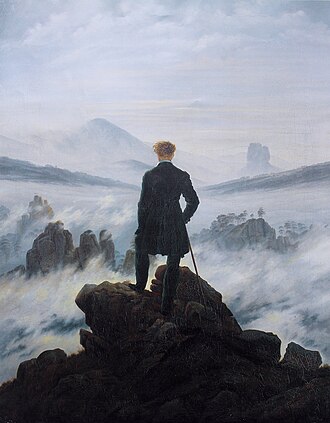 Wanderer above the Sea of Fog - Caspar David Friedrich (c. 1818)
 The Abbey in the Oakwood - Caspar David Friedrich (1800s)
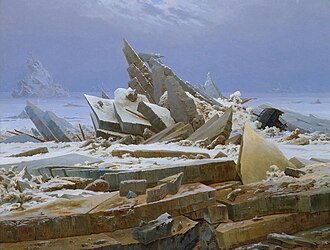 The Sea of Ice - Caspar David Friedrich (1820s)
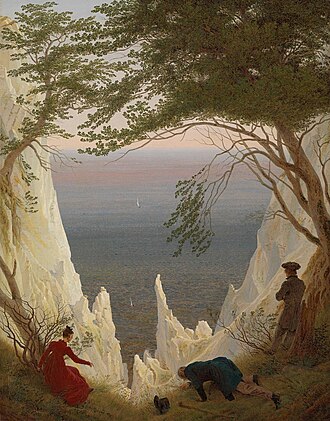 Chalk Cliffs at Ruegen - Caspar David Friedrich (1818)
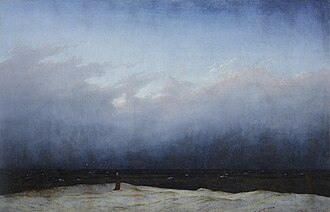 The Monk by the Sea - Caspar David Friedrich (1808)
.jpg) Life stages - Caspar David Friedrich (1834)
Life stages - Caspar David Friedrich (1834)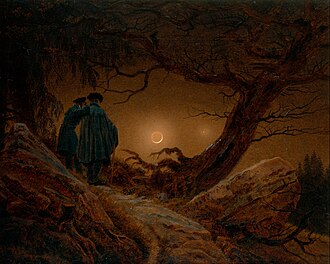 Two men contemplating the Moon - Caspar David Friedrich (1810s)
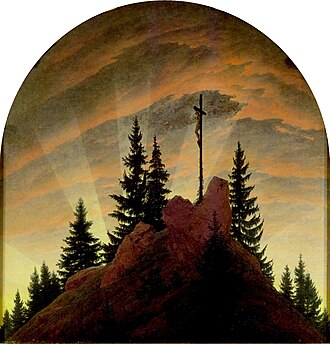 Altarpiece Tetschen - Caspar David Friedrich (1807)
Dipinti di artisti collegati
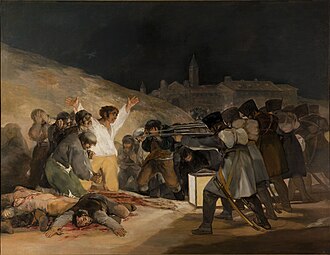 The Third of May 1808 - Francisco Goya (1814)
.jpg) La maja nuda - Francisco Goya (1800)
La maja nuda - Francisco Goya (1800)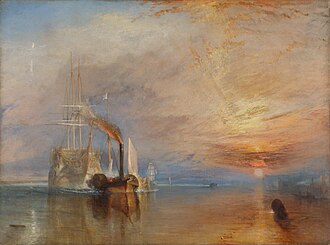 The Fighting Temeraire - J. M. W. Turner (1839)
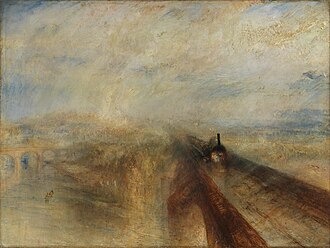 Rain, Steam and Speed - The Great Western Railway - J. M. W. Turner (1844)