Portrait of Doña Isabel de Porcel
Francisco Goya · 1800s
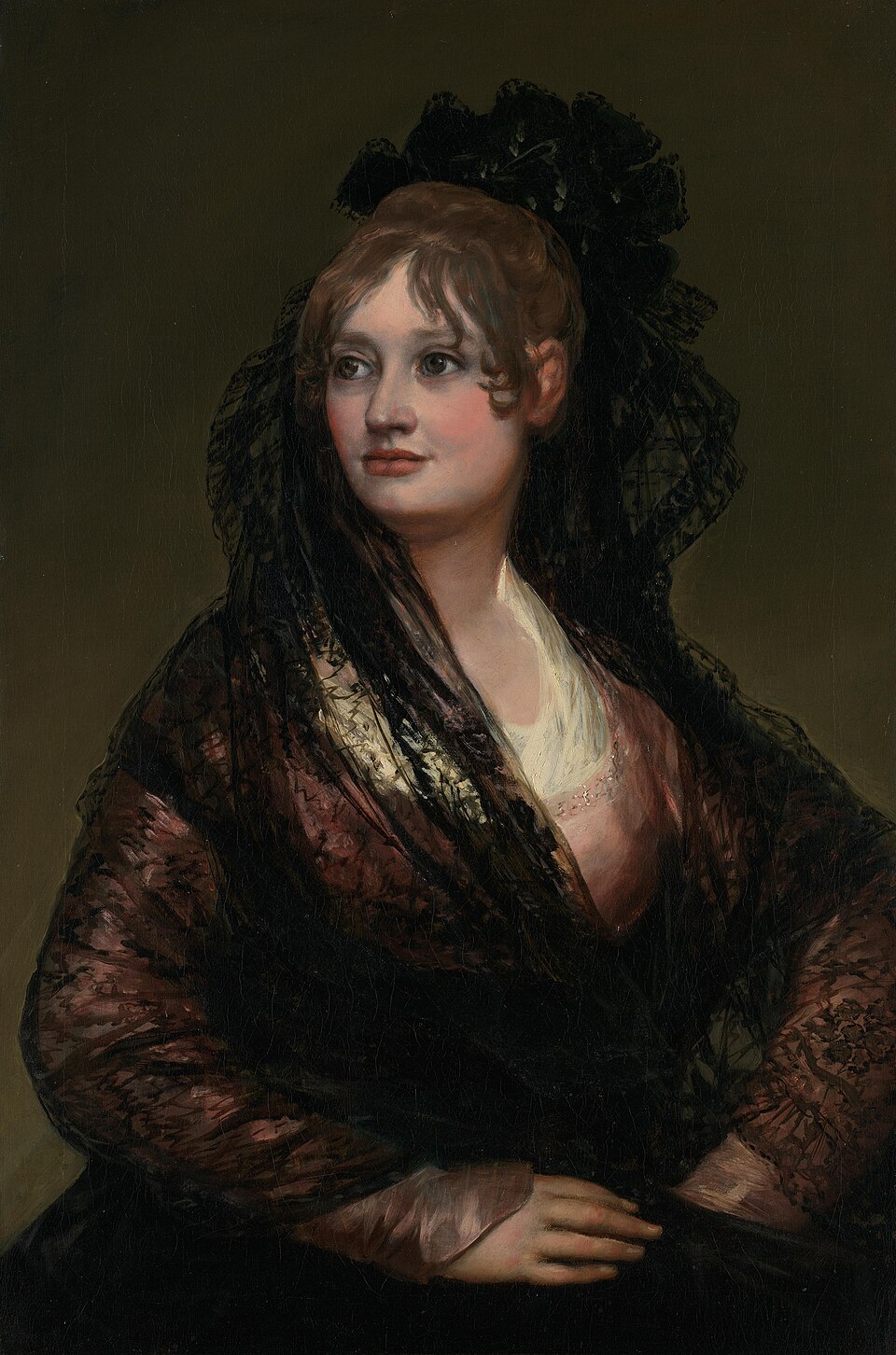
Hands on her hips, eyes turned away, a young woman from Ronda wears the dress of Madrid's street fashion with the poise of an aristocrat.
The story behind the painting
Francisco Goya painted this oil on canvas around 1805; Wikidata simply dates it to the 1800s. The sitter is Isabel Lobo Velasco de Porcel, born at Ronda around 1780, the second wife of Antonio Porcel, who was 25 years her senior. Antonio was a liberal and an associate of Manuel Godoy, whose friend Gaspar Melchor de Jovellanos brought Porcel into contact with Goya, a neighbour. The portrait is said to have been the artist's gift in return for the couple's hospitality. Goya also painted Antonio, in a much larger canvas that was not a matching pair; that portrait was lost when the Jockey Club in Buenos Aires burned during a riot in 1953.
What to look for
This is a half-length portrait. Isabel wears a white shirt and a black mantilla, the typical Spanish dress of the maja. Notice how decisively her arms are set akimbo, hands on hips, an emblem of her confidence. Her eyes and hair are light brown and her skin pale. Her body turns slightly to the left, while her head turns the other way to balance it. There are no props or secondary objects: Goya builds realism and depth from the figure alone. And unlike most of his sitters, she does not look at us, but toward the viewer's left.
Meaning and intent
The costume is a statement. Around this time, wealthy Spanish "people of fashion" often adopted the styles of the urban majos and majas, lower-class dandies of the city, as in Goya's famous clothed Maja. Yet here the richness of the fabrics and Isabel's ladylike bearing give the picture an aristocratic elegance. The result is a portrait that plays with social roles: a lady dressed as a maja, assured and self-possessed. Her averted gaze adds a note of independence, as if she is attending to something beyond the frame rather than posing for us.
Legacy
The portrait belongs to the National Gallery in London. It found a wider audience on television when it was used in several episodes of the BBC's 1967 serialisation of The Forsyte Saga. Its story is not entirely settled, however: some scholars have recently cast doubt on its attribution to Goya. For now it remains admired for its directness, its confident pose and the way it captures a fashionable Spanish moment in one striking figure.
Lo sapevi?
- Painted around 1805 (Wikidata: 1800s); 82 × 55 cm.
- Sitter: Isabel Lobo Velasco de Porcel, born at Ronda around 1780.
- Collection: National Gallery, London.
- Some scholars have recently questioned the attribution to Goya.
L'artista
Francisco Goya (1746-1828)
woman · portrait · National Gallery · sitting · dress
Altre opere di Francisco Goya
 The Third of May 1808 - Francisco Goya (1814)
.jpg) La maja nuda - Francisco Goya (1800)
La maja nuda - Francisco Goya (1800).jpg) Saturn Devouring His Son - Francisco Goya (1819)
Saturn Devouring His Son - Francisco Goya (1819) La famiglia di Carlo IV - Francisco Goya (1800)
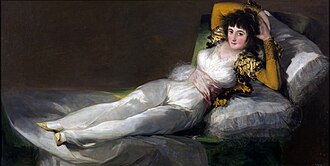 The Clothed Maja - Francisco Goya (1800)
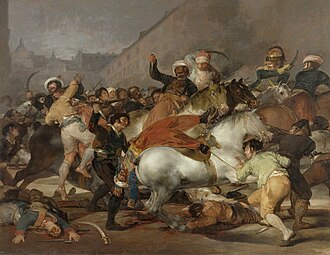 Il 2 maggio 1808 a Madrid - Francisco Goya (1814)
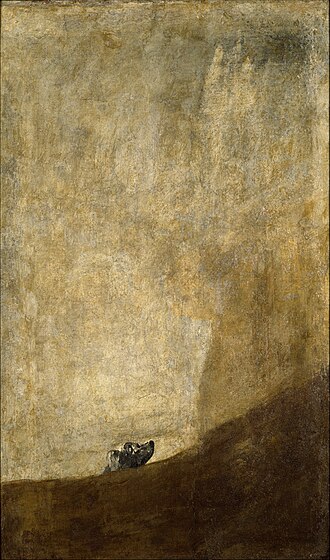 Cane semiaffondato - Francisco Goya (1819)
 Il sabba delle streghe - Francisco Goya (1820s)