Portrait of a man of the family Lespinette
Hans Memling · 1487
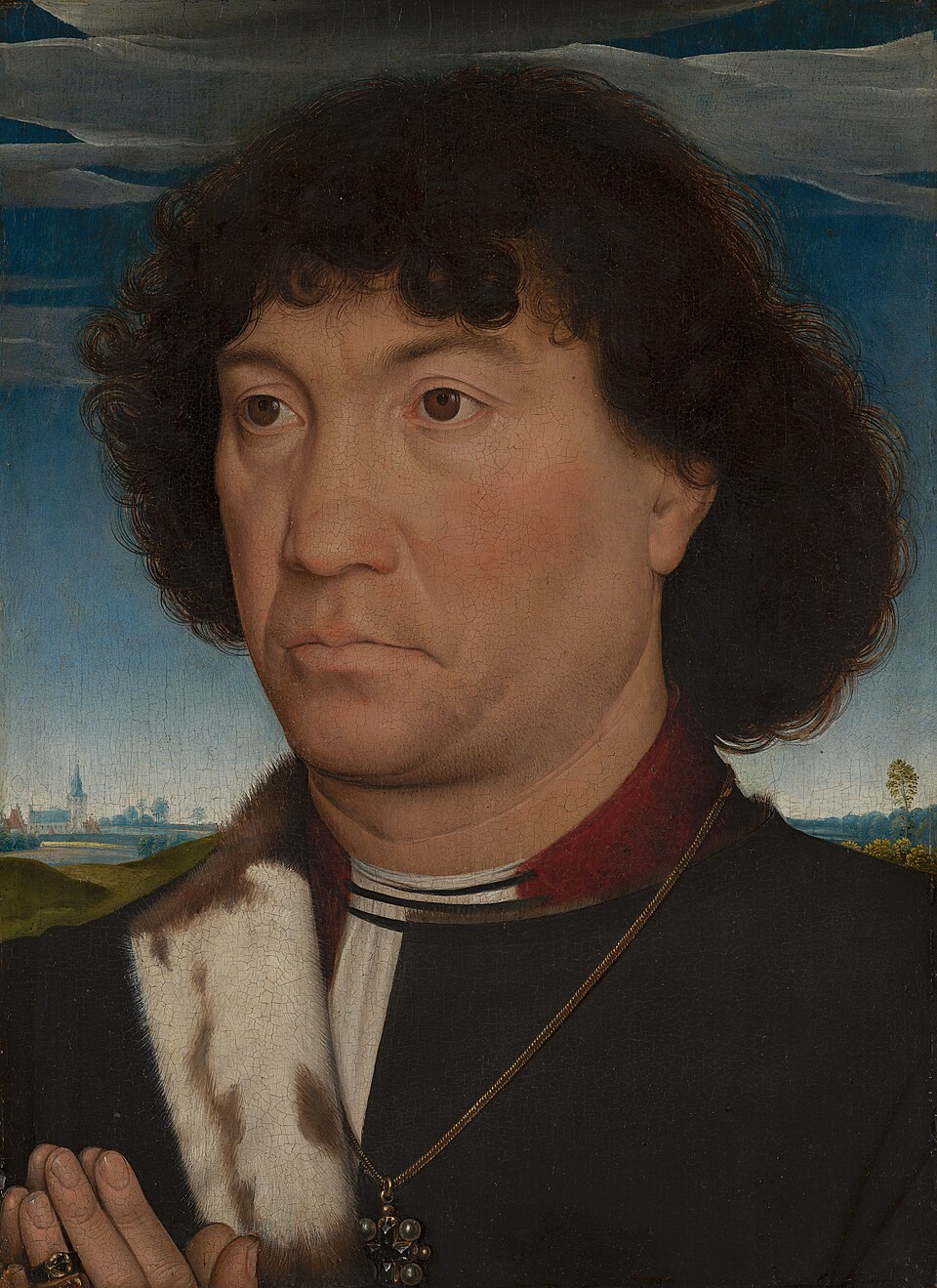
A man prays so close to us that his face fills almost the whole panel, and a tiny church shows just above his shoulder. He once knelt before a Virgin who has since been lost. Even his name is still argued over.
The story behind the painting
Hans Memling painted this man at prayer before a landscape around 1480 to 1485; tree-ring dating gives about 1476 as the earliest possible date, and about 1482 is the most likely. Wikidata gives 1487. The portrait was originally the right wing of a devotional diptych whose left wing, now lost, probably showed the Virgin and Child, as in Memling's Diptych of Maarten van Nieuwenhove. The man is clearly addressing his prayer to a figure who is no longer there. The panel is about 30.1 by 22.3 cm.
What to look for
More than in other Memling portraits, the sitter dominates: his fleshy face, hair and chest fill almost the whole surface, and even his joined hands, in the lower left corner, are cut off. The viewpoint is so low that the flat landscape with its little church barely rises above his shoulders. Light from the right models the face, and the hair stands out against the blue sky. Two rings set with stones, a jewelled cross on a gold chain, and a dark coat with white lynx fur speckled brown show his high standing.
Meaning and intent
The striking framing makes one think the panel was cut on all sides, but only the right side was shortened; the unpainted edge survives at right, top and bottom. Infrared study found no underdrawing except for the hands, which were first placed further right. The clouds and part of the blue sky around the hair were added later and are clearly not by Memling. On the back is a coat of arms, visible when the diptych was closed, painted over an older one whose relief can still be felt through the repaint.
Legacy
Whether the original arms belong to the Lespinette family is debated. Rietstap's armorial describes the Lespinette falcon with bells at its talons, and apart from those bells the arms are almost identical to those of the De Visen family, also from Franche-Comté. The man may therefore be Charles de Visen, chamberlain and familiar of Charles the Bold, the view argued in detail by Borchert. The panel was bought at the 1894 sale of Sir Andrew Fountaine's collection at Christie's as a work by Antonello da Messina, given to the Dutch state in 1895, and recognised as Memling's in 1896. It is in the Mauritshuis.
Lo sapevi?
- Painted by Hans Memling around 1480 to 1485, most likely about 1482.
- Right wing of a devotional diptych whose Virgin panel is lost.
- Sitter debated: Lespinette family or Charles de Visen.
- Sold in 1894 as an Antonello da Messina; in the Mauritshuis since 1895.
L'artista
Hans Memling (1435-1494)
religious art · portrait · man · Early Netherlandish painting · sky · black hair · Mauritshuis · necklace · rural area · ring · prayer
Altre opere di Hans Memling
 Annunciation - Hans Memling (1480s)
 Scenes from the Passion of Christ - Hans Memling (1470)
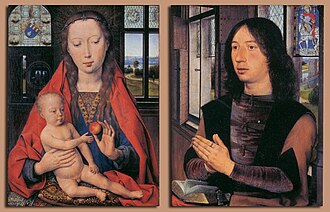 Diptych of Maarten van Nieuwenhove - Hans Memling (1487)
 St John Altarpiece - Hans Memling (1479)
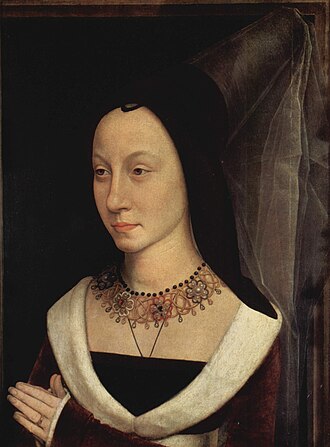 Portrait of Maria Portinari - Hans Memling (1470)
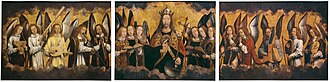 Christ with singing and music-making Angels - Hans Memling (1480s)
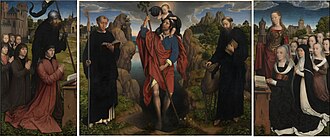 Moreel Triptych - Hans Memling (1484)
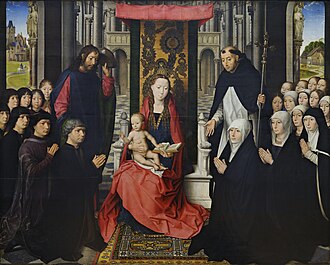 Madonna of Jacob Floreins - Hans Memling (1485)
Dipinti di artisti collegati
 The Descent from the Cross - Rogier van der Weyden (1440s)
 Portrait of a Lady - Rogier van der Weyden (1460)
 Arnolfini Portrait - Jan van Eyck (1434)
 Ghent Altarpiece - Jan van Eyck (1432)
 The Garden of Earthly Delights - Hieronymus Bosch
 Ship of Fools - Hieronymus Bosch (1500s)
 The Hunters in the Snow - Pieter Bruegel the Elder (1565)
 Netherlandish Proverbs - Pieter Bruegel the Elder (1551)