Christ with singing and music-making Angels
Hans Memling · 1480s
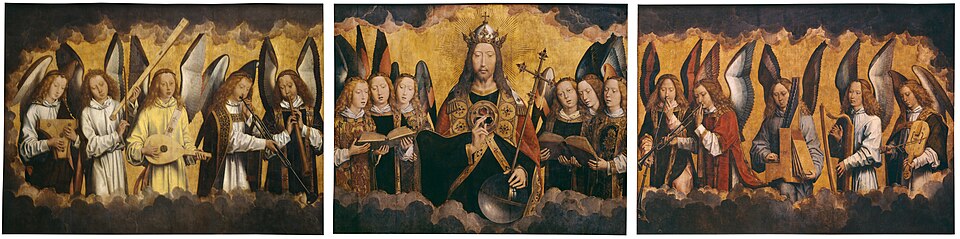
Christ crowned on gold, between sixteen life-size angels who sing and play lute, harp, trumpet and organ. Memling's panels were abandoned for four centuries in Spain; their restoration in Antwerp took sixteen years.
The story behind the painting
In 1487 the consuls of the Spanish merchants in Bruges, Pedro and Antonio de Nájera, commissioned Hans Memling, a painter of German origin active in Bruges, to decorate the organ of Santa María la Real in Nájera, the former pantheon of the kings of Navarre. The original altarpiece was huge, and its central panel showed the Assumption of the Virgin. Only three panels survive, probably from its upper tier, and some ornaments on the figures bear the arms of Castile and León. Note that this story covers those three surviving panels together, as they are now shown in Antwerp.
What to look for
Christ stands against a gold ground ringed by dark clouds. On his collar are the words Agyos Otheos, Holy God, and three stones on the clasp of his mantle evoke the Trinity. Crowned and holding a crystal orb topped by a cross, he blesses and looks down toward where the Virgin once was, with three singing angels on each side holding large songbooks. On the left wing angels play psaltery, tromba marina, lute, trumpet and shawm; on the right, straight trumpet, looped trumpet, portative organ, harp and fiddle. The panels are about 170 cm high, so the angels are life-size, cut off below the knee by clouds.
Meaning and intent
It is rare to see Christ surrounded by angel musicians. The scene was possibly inspired by Matthew 25, where the Son of Man comes in glory with all the angels and sits on his throne. Crown and orb show him ruling heaven and earth, and the music is the sound of that glory. Because the instruments are typical of the fifteenth century and painted with care, the panels also offer a vivid record of the music of Memling's own time, set on a scale meant to be seen high above a church organ.
Legacy
After being neglected for four centuries, the panels were bought in 1885 by an art dealer and sold to the Belgian government, which entrusted them to the Royal Museum of Fine Arts in Antwerp. A major restoration began in 2001 and took sixteen years, because of the vast surface and the complexity of the treatment. The panels have been described as an avant-garde work of Renaissance decorative art, and many replicas have been made. Wikidata gives the overall size as 164 by 636 cm and dates the work to the 1480s.
Lo sapevi?
- Commissioned in 1487 for the church of Santa María la Real in Nájera.
- Three surviving panels with sixteen life-size angels.
- Bought by the Belgian government in 1885; in the Royal Museum of Fine Arts, Antwerp.
- A restoration begun in 2001 lasted sixteen years.
L'artista
Hans Memling (1435-1494)
religious art · Early Netherlandish painting · Royal Museum of Fine Arts Antwerp · Vlaamse Kunstcollectie
Altre opere di Hans Memling
 Annunciation - Hans Memling (1480s)
 Scenes from the Passion of Christ - Hans Memling (1470)
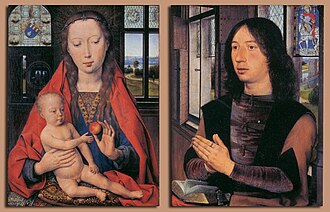 Diptych of Maarten van Nieuwenhove - Hans Memling (1487)
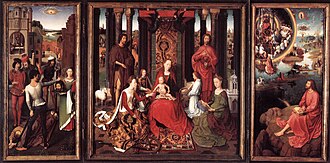 St John Altarpiece - Hans Memling (1479)
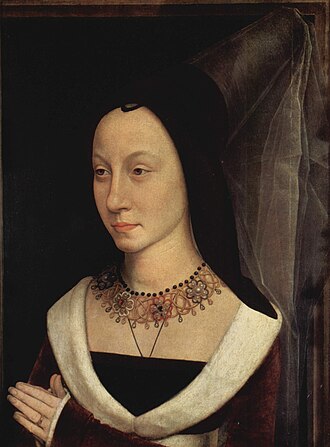 Portrait of Maria Portinari - Hans Memling (1470)
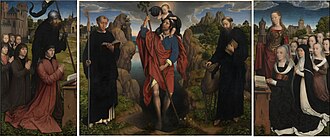 Moreel Triptych - Hans Memling (1484)
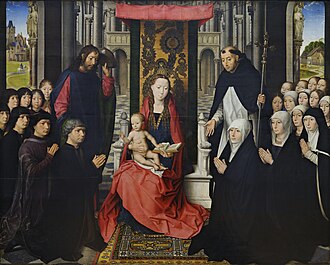 Madonna of Jacob Floreins - Hans Memling (1485)
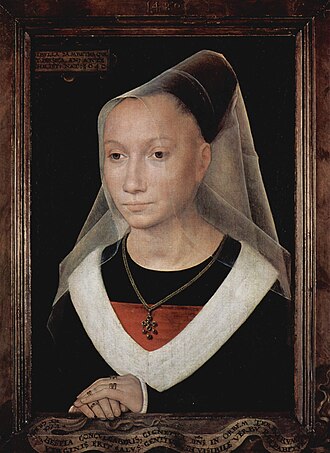 Sibylla Sambetha - Hans Memling (1480)
Dipinti di artisti collegati
 The Descent from the Cross - Rogier van der Weyden (1440s)
 Portrait of a Lady - Rogier van der Weyden (1460)
 Arnolfini Portrait - Jan van Eyck (1434)
 Ghent Altarpiece - Jan van Eyck (1432)
 The Garden of Earthly Delights - Hieronymus Bosch
 Ship of Fools - Hieronymus Bosch (1500s)
 The Hunters in the Snow - Pieter Bruegel the Elder (1565)
 Netherlandish Proverbs - Pieter Bruegel the Elder (1551)