Perseus and Andromeda
Titian · 1550s
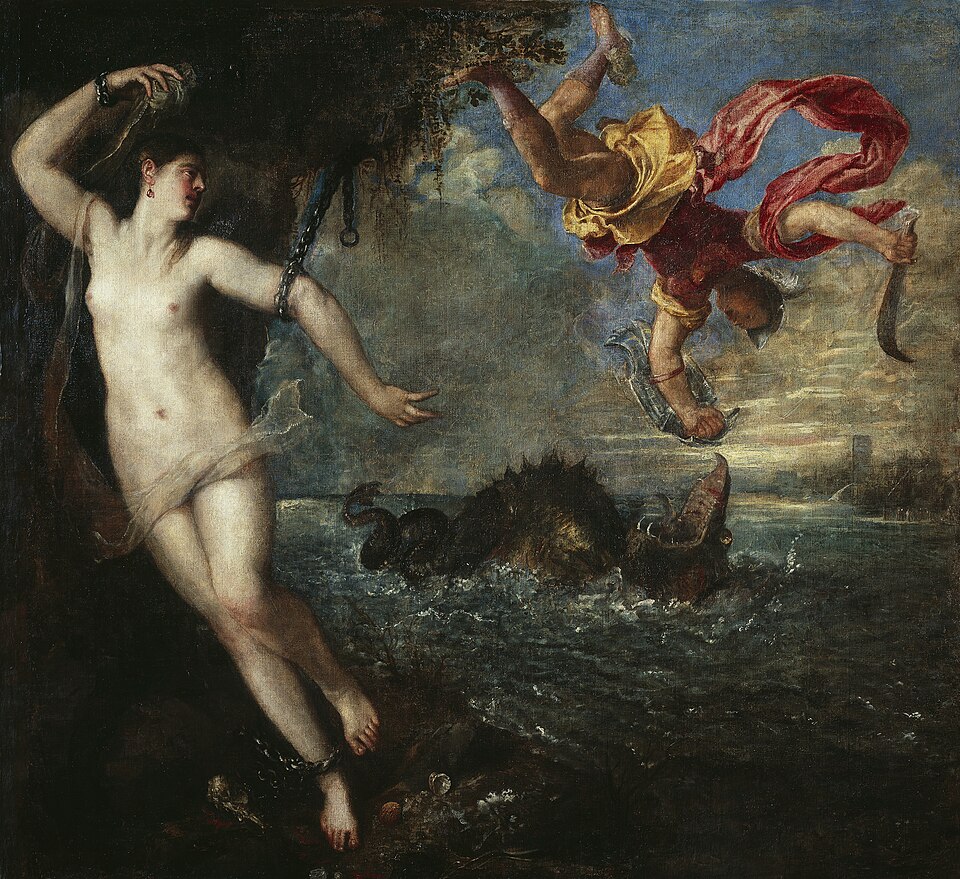
Perseus dives from the sky toward a sea monster while Andromeda, chained to a cliff, twists away in fear. Titian painted it for Philip II of Spain, and the canvas then wandered across half of Europe.
The story behind the painting
Titian painted Perseus and Andromeda in 1554 to 1556 as part of his poesie, a series of mythological paintings for King Philip II of Spain drawn from Ovid's Metamorphoses, all featuring female nudes. In a letter sent with Venus and Adonis, Titian promised another different view in a Perseus and Andromeda and a Jason and Medea. The Jason and Medea was apparently abandoned, and The Rape of Europa became the companion piece instead. Wikidata simply gives the 1550s. Philip received the painting at Ghent in September 1556, yet in 1574 Titian said he had still not been paid for it.
What to look for
Perseus flies through the air to fight the sea monster sent to kill Andromeda, who is chained to a cliff as a sacrifice. He has already wounded the beast on the shoulder. He carries a curved sword from Mercury and a shield from Minerva, and wears winged boots and a winged helmet. Andromeda stands among seashells and coral; Ovid describes her as looking like a statue and as having wept, and Titian shows both. Her parents are probably on the far shore by a city. Look closely: earlier stages, traced by x-rays and infrared, can still be glimpsed with the naked eye.
Meaning and intent
The story comes from Ovid, Book IV. Queen Cassiope boasted that she and her daughter Andromeda were more beautiful than the sea nymphs, so Poseidon sent a monster to ravage Ethiopia, and Andromeda was offered as a sacrifice. Perseus, returning from killing Medusa, kills the monster and marries her. Titian probably read Ovid in simplified Italian versions, which may explain some differences, or he may simply have told the tale freely. The composition changed many times: Andromeda first stood on the right, Perseus' limbs, sword and shield moved, and the monster once rose higher from the water.
Legacy
It is the only one of the poesie to leave the Spanish royal collection before Philip's death in 1598, replaced by a careful copy now in Gerona. It may have gone to Antonio Pérez or to the Leoni family, later belonged to Anthony van Dyck, then the Earl of Northumberland, then passed to Paris and the Orleans Collection, and finally to London. It was probably the one described as damaged in 1605 and seems to have been cut down on all sides; Wikipedia gives 175 by 189.5 cm, while Wikidata gives 183.3 by 199.3 cm. One scholar, Rearick, thinks it is a second version. It is now in the Wallace Collection.
Lo sapevi?
- Painted 1554 to 1556 for Philip II as one of Titian's poesie.
- Based on Ovid's Metamorphoses, Book IV.
- X-rays reveal many changes in the composition.
- Now in the Wallace Collection, London.
L'artista
Titian (1488-1576)
mythological painting · sky · sea · Wallace Collection · dragon
Altre opere di Titian
.jpg) Venus of Urbino - Titian (1538)
Venus of Urbino - Titian (1538) Assumption of the Virgin - Titian (1510s)
FXD.jpg) Sacred and Profane Love - Titian (1510s)
Sacred and Profane Love - Titian (1510s) Equestrian Portrait of Charles V - Titian (1548)
 Flora - Titian (1517)
 Allegory of Prudence - Titian (1550)
 Diana and Actaeon - Titian (1550s)
 Bacchus and Ariadne - Titian (1520s)
Dipinti di artisti collegati
 Last Supper - Jacopo Tintoretto (1563)
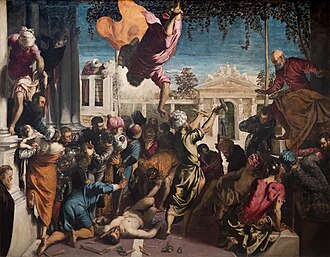 Miracle of the Slave - Jacopo Tintoretto (1540s)
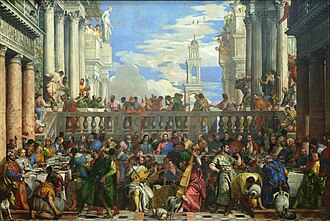 The Wedding at Cana - Paolo Veronese (1560s)
.jpg) The Feast in the House of Levi - Paolo Veronese (1573)
The Feast in the House of Levi - Paolo Veronese (1573)