Pear Tree
Gustav Klimt · 1903
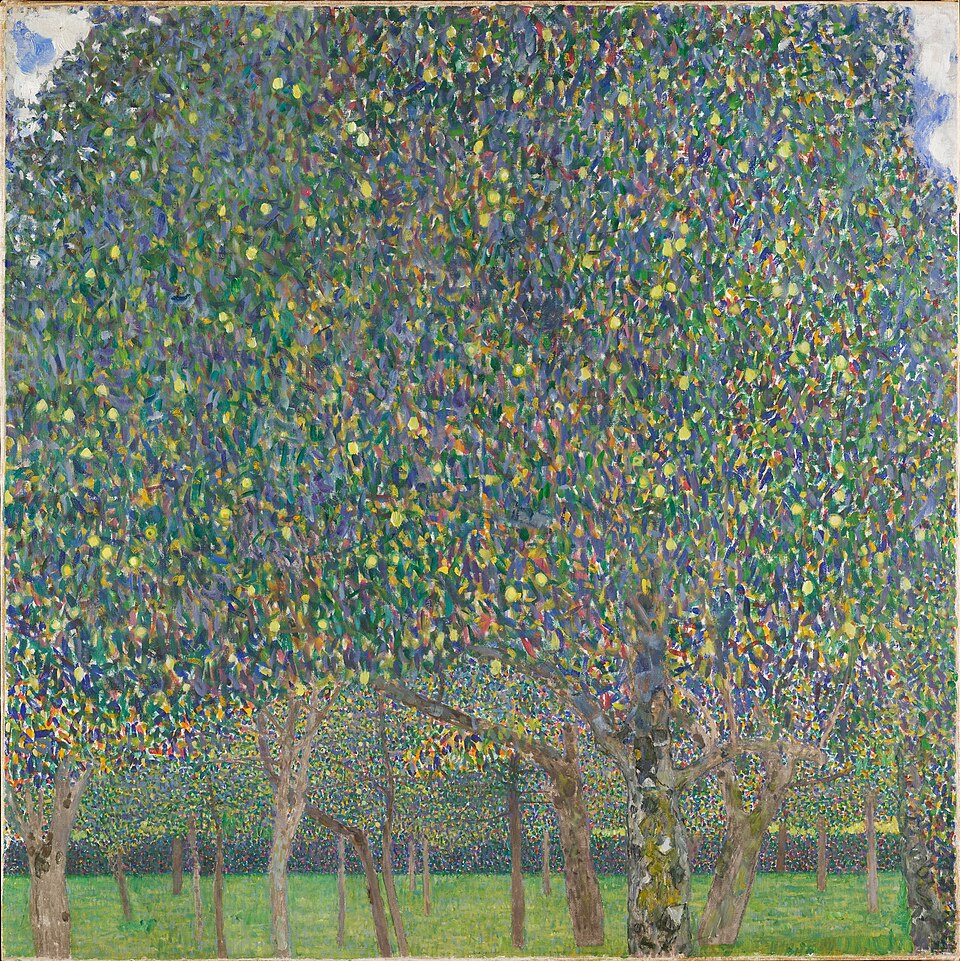
A pear tree in full bloom fills almost the whole square canvas, its leaves and blossoms set down dab by dab like a shimmering mosaic. Klimt began it by Lake Attersee in 1903, gave it to Emilie Flöge, and kept on painting it.
The story behind the painting
Around the turn of the century Klimt was open to new influences, and pointillism was shaping his landscapes. At the 1903 Vienna Secession exhibition he saw works by Cézanne, Monet, Seurat, Gauguin and Van Gogh in person. Pear Tree was probably begun in August 1903 while he stayed at Litzlberg on Lake Attersee, and finished in his Vienna studio for his retrospective at the 18th Secession exhibition, which opened on 14 November 1903. It is among the first landscapes in his pointillist-influenced late style.
What to look for
The canvas is square, 101 by 101 cm, rather than the usual wide landscape format, a choice linked to the square viewfinder Klimt used to pick his motifs around the Attersee. Separate dabs of paint stand for leaves, blossoms and fruit. The branches merge into a thick canopy, and the sky shows only in the upper corners. A distant hedge closes off the orchard. Look at the left side: the paint there is noticeably denser than in the centre or on the right, which is attributed to Klimt's later reworking.
Meaning and intent
The flat, flickering field of colour recalls both post-impressionist painting and Byzantine mosaics. Stephan Koja sees the foliage echoing the patterned surfaces of Klimt's golden phase, and notes how standing beneath the trees we seem to look into the orchard; in works like this, he says, a painted mosaic spreads across the canvas like a carpet. Karen Wilkin sees here the seeds of Klimt's later landscapes: repeated strokes, inventive greens, blues and yellows, the square format and a hidden geometric order. The critic Ludwig Hevesi praised its colour, saying Klimt had taken Divisionism his own way.
Legacy
Klimt gave the painting to his muse, Emilie Louise Flöge, in 1903, yet kept working on it, probably until his death. By 1933 it belonged to Otto Kallir's Neue Galerie in Vienna, which moved to New York by 1940; that summer it appeared in Kallir's exhibition Saved from Europe. In 1956 Kallir gave it to the Fogg Museum at Harvard. Today it is on permanent display in the Busch-Reisinger Museum, part of the Harvard Art Museums.
Lo sapevi?
- Probably begun at Lake Attersee in August 1903.
- Painted on a square canvas, 101 by 101 cm.
- Given to Emilie Flöge in 1903, but reworked by Klimt later.
- In the Busch-Reisinger Museum at Harvard.
Wikipedia · Wikidata · Wikipedia
L'artista
Gustav Klimt (1862-1918)
Altre opere di Gustav Klimt
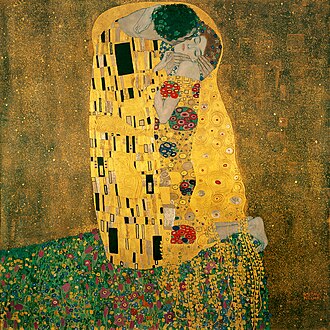 The Kiss - Gustav Klimt (1907-1908)
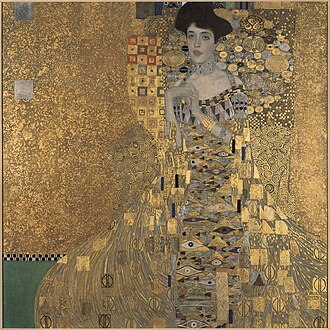 Portrait of Adele Bloch-Bauer I - Gustav Klimt (1907)
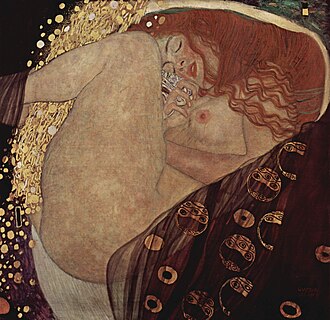 Danaë - Gustav Klimt (1907)
.jpg) Judith I - Gustav Klimt (1901)
Judith I - Gustav Klimt (1901)%20Google%20Art%20Project.jpg) The Three Ages of Woman - Gustav Klimt (1905)
The Three Ages of Woman - Gustav Klimt (1905)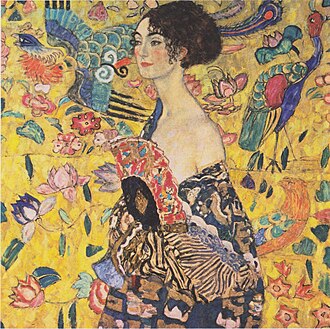 Woman With a Fan - Gustav Klimt (1917)
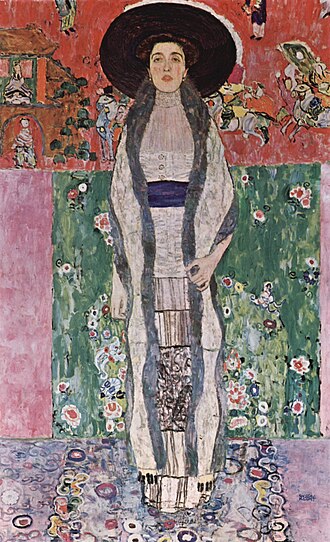 Adele Bloch-Bauer II - Gustav Klimt (1912)
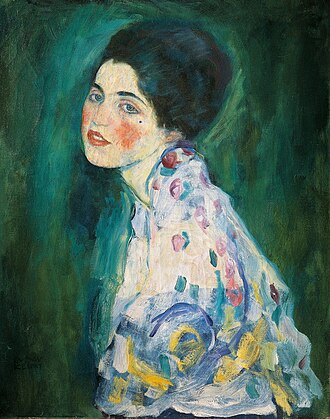 Portrait of a Lady - Gustav Klimt (1910s)