Pagagnotti Triptych
Hans Memling · 1480
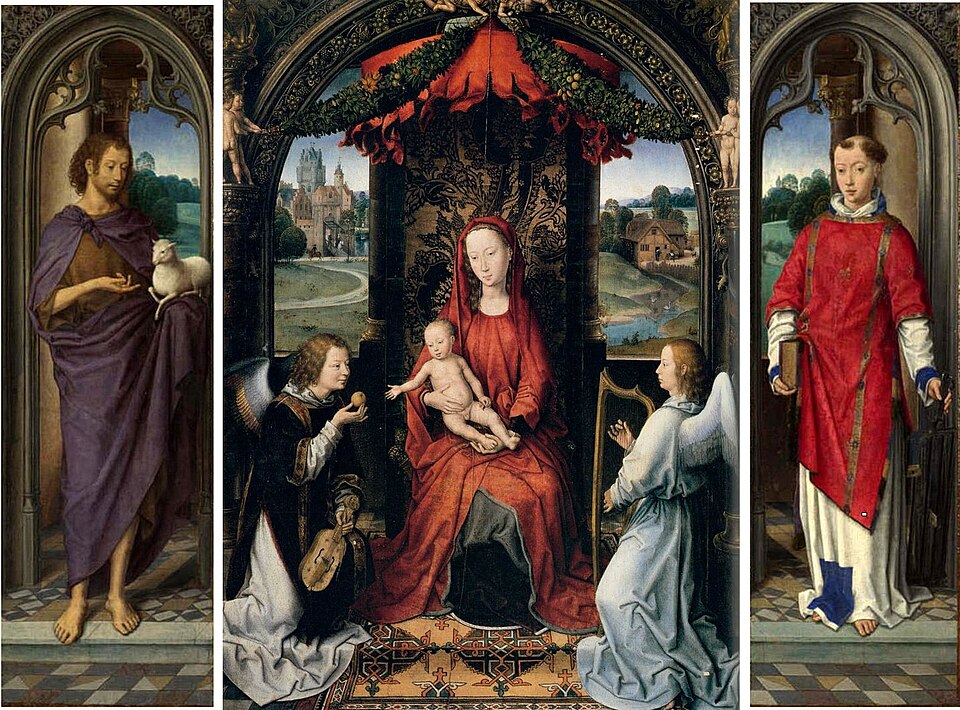
Close the wings of this small altarpiece and you find nine pale cranes resting under an evening sky, one holding a stone in its claw to keep watch. Inside, Memling's Virgin sits in an Italian dream of columns and garlands. For centuries no one knew the panels belonged together.
The story behind the painting
In the 15th century Italian collectors prized Netherlandish painting, and Bruges, with its Medici bank branch, sent many works south. Memling attracted southern bankers and merchants by blending Netherlandish and Italian manners. Around 1480 he painted this triptych, most likely for Benedetto Pagagnotti, a Florentine churchman whose family were close to the Medici. Perhaps at the client's request, he added Italian touches such as garlands and putti. Later the triptych was taken apart: the central Virgin and Child with Two Angels went to the Uffizi in Florence, the two wings to the National Gallery in London.
What to look for
Inside, Mary sits enthroned with the Child under red swags, two angels with instruments kneeling before her. Gilded twisted columns carry tiny sculptures of Samson killing the lion and Cain slaying Abel. On the arch, a grape vine and ivy curl around two pairs of snails and a lizard, which Paula Nuttall called a tour de force of observation. The left wing shows John the Baptist with his lamb, the right Saint Lawrence in a red dalmatic, rare in Memling's work. Outside, the cranes stand beneath red and white chevrons; whether Memling or his workshop painted them is undecided.
Meaning and intent
The guarding crane, grus vigilans, comes from a classical story: one bird holds a stone while the flock sleeps, and if it dozes the falling stone wakes the others. It is an emblem of vigilance, placed directly under the coat of arms. Such a landscape on the outer wings is unusual, since Netherlandish doors were normally painted in grey to imitate statues of saints. The arches inside are decorative rather than a boundary between heaven and earth. Nuttall called the whole work a tour de force, pictorially, technically and conceptually.
Legacy
Florentine artists copied the landscapes. As early as 1483 Filippino Lippi borrowed the mill with a man carrying a sack of flour, and Fra Bartolomeo repeated the mill and parts of the Saint Lawrence landscape around 1497; a tondo by Biagio d'Antonio quotes the wings too. Those copies helped the art historian Michael Rohlmann in 1995 to reunite the separated panels, by matching their sizes, the floor tiles and steps running across all three, and the coat of arms. A similar triptych exists by the Master of the Legend of Saint Ursula.
Lo sapevi?
- Painted around 1480, probably for Benedetto Pagagnotti.
- Central panel in the Uffizi, wings in the National Gallery, London.
- Reunited on paper by Michael Rohlmann in 1995.
- Its landscapes were copied by Filippino Lippi and Fra Bartolomeo.
L'artista
Hans Memling (1435-1494)
religious art · National Gallery · Early Netherlandish painting · Uffizi Gallery
Altre opere di Hans Memling
 Annunciation - Hans Memling (1480s)
 Scenes from the Passion of Christ - Hans Memling (1470)
 Diptych of Maarten van Nieuwenhove - Hans Memling (1487)
 St John Altarpiece - Hans Memling (1479)
 Portrait of Maria Portinari - Hans Memling (1470)
 Christ with singing and music-making Angels - Hans Memling (1480s)
 Moreel Triptych - Hans Memling (1484)
 Madonna of Jacob Floreins - Hans Memling (1485)
Dipinti di artisti collegati
 The Descent from the Cross - Rogier van der Weyden (1440s)
 Portrait of a Lady - Rogier van der Weyden (1460)
 Arnolfini Portrait - Jan van Eyck (1434)
 Ghent Altarpiece - Jan van Eyck (1432)
 The Garden of Earthly Delights - Hieronymus Bosch
 Ship of Fools - Hieronymus Bosch (1500s)
 The Hunters in the Snow - Pieter Bruegel the Elder (1565)
 Netherlandish Proverbs - Pieter Bruegel the Elder (1551)