Our Lady of the Pillar
Francisco Goya · 1769
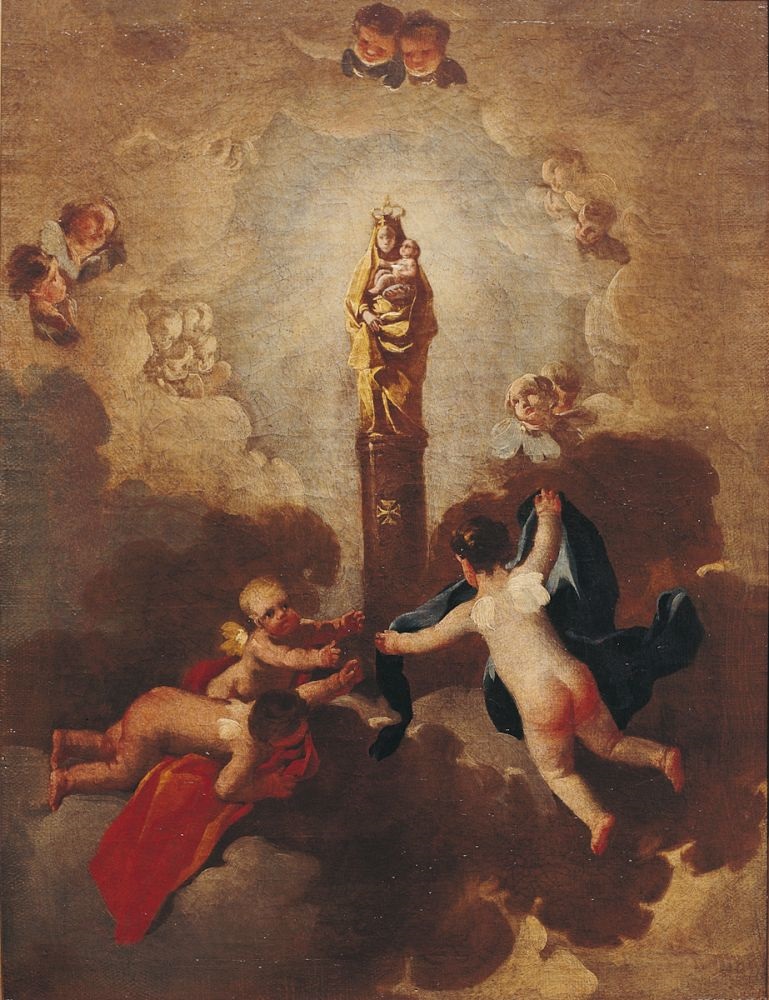
A small, glowing image of the Virgin and Child, painted by a young Goya in Zaragoza. He loved this subject so much that he once wrote it was almost the only thing his house needed.
The story behind the painting
Goya painted this religious oil during his early years as a painter in Zaragoza, the city in Aragon where devotion to the Virgin of the Pillar runs deep. The French Wikipedia article places it in those years, between 1775 and 1780, while Wikidata gives the date 1769, so the exact year is uncertain. Together with Triple Generation and the Apparition of the Virgin of the Pillar to Saint James, it is counted among the most important canvases of Goya's youth, made long before the court portraits and dark visions he is famous for today.
What to look for
It is a very luminous picture, and the sources hear in it an echo of Bartolomé Esteban Murillo. The Virgin is wrapped in a beam of light and holds the Child in her arms in a strikingly natural, realistic pose. Around her, angels in blues and reds carry palms, the sign of martyrdom, painted in the way that is typical of Goya's angels. The panel is small, about 56 by 42 cm, so look closely at how much warmth and movement fits into it. Its style is very close to Goya's paintings for the Aula Dei charterhouse and the Basilica of the Pillar.
Meaning and intent
Goya had a great devotion to the Virgin, which was common in Aragon, and the source says this canvas was made almost for his own personal worship. In July 1780 he wrote to his friend Martin Zapater that for his house he did not need much furniture: with the picture of Our Lady of the Pillar, a table, five chairs, a stove, a wineskin, a small guitar, a grill and a lamp, everything else was superfluous. Few lines show so tenderly what a painting could mean to the man who made it.
Legacy
The Zaragoza Museum acquired the painting in 1926, together with Goya's Death of Saint Francis Xavier. The purchase had been approved at a meeting on 11 November 1925, and the plan was to use the works to celebrate the centenary of Goya's death in 1928, with an exhibition of his works and of objects recalling the art of his time. Art historians also see the picture as a forerunner of Goya's later canvas Regina Martirum, so this modest devotional image stands at the start of a path he kept walking. It remains in Zaragoza, the city where it was made.
Lo sapevi?
- Painted by Goya in his early Zaragoza years; dated 1769 by Wikidata, 1775-1780 by Wikipedia.
- About 56 x 42 cm, kept in the Zaragoza Museum.
- Goya wrote in 1780 that this picture was nearly all his house needed.
- Acquired by the museum in 1926 for the 1928 Goya centenary.
L'artista
Francisco Goya (1746-1828)
Altre opere di Francisco Goya
 The Third of May 1808 - Francisco Goya (1814)
 La maja nuda - Francisco Goya (1800)
 Saturn Devouring His Son - Francisco Goya (1819)
 La famiglia di Carlo IV - Francisco Goya (1800)
 The Clothed Maja - Francisco Goya (1800)
 Il 2 maggio 1808 a Madrid - Francisco Goya (1814)
 Cane semiaffondato - Francisco Goya (1819)
 Il sabba delle streghe - Francisco Goya (1820s)
Dipinti di artisti collegati
 Wanderer above the Sea of Fog - Caspar David Friedrich (c. 1818)
 The Abbey in the Oakwood - Caspar David Friedrich (1800s)
 Liberty Leading the People - Eugène Delacroix (1830)
 Death of Sardanapalus - Eugène Delacroix (1827)
 The Fighting Temeraire - J. M. W. Turner (1839)
 Rain, Steam and Speed - The Great Western Railway - J. M. W. Turner (1844)
 The Blue Boy - Thomas Gainsborough (1770)
 Mr and Mrs Andrews - Thomas Gainsborough (1748)