Mata Mua
Paul Gauguin · 1892
%20-%20Google%20Art%20Project.jpg)
Two women sit beneath a huge tree, one playing the flute, while beyond them others dance around the statue of a moon goddess. Gauguin called it Mata Mua, In Olden Times, a hymn to a Tahiti he feared was already gone.
The story behind the painting
Paul Gauguin settled in Tahiti in 1891, hoping to find creative inspiration in a culture untouched by Western civilisation. According to the French Wikipedia article, he found only traces of a legendary past that was bound to disappear. He painted Mata Mua in 1892 as part of his Tahitian cycle. Back in France, he organised an exhibition to sell his Tahitian paintings, which were not understood. Mata Mua was first shown at his solo exhibition at the Galerie Durand-Ruel in 1893, and in 1895 it was put up for sale at the Hotel Drouot to fund his second and last voyage to Oceania.
What to look for
An enormous tree trunk stands at the centre and splits the picture in two, like a doorpost. On the right, two young women sit calmly, one playing the flute and the other listening. On the left, a kind of religious ceremony unfolds: a group of women dance around a statue of Hina, goddess of the moon. The landscape is dense, lush and almost stifling, closed off by pink and violet mountains around the valley. The colours are arbitrary, flat, pure and intense, chosen to strengthen expression rather than to copy nature.
Meaning and intent
The article calls Mata Mua a hymn to life in the primitive simplicity the French artist longed for. Painted in clear, clean colours, without the slightest claim to naturalism, it is also an elegy for a golden age that had passed. The title itself, In Olden Times, looks backwards. The women worship Hina in a valley that seems sealed off from the world, which is exactly what Gauguin had hoped to find and, the article says, did not. The painting holds that dream and that loss together.
Legacy
Gustave Fayet bought the painting at the 1895 sale and showed it with other Gauguins from his collection at the Salon d'Automne in Paris in 1903. It later passed through the Paul Rosenberg gallery to Gilbert Fuller of Boston and then the Dreyfus family. In 1989 Baron Hans Thyssen-Bornemisza bought it at Sotheby's jointly with his business partner Jaime Ortiz Patiño, and later acquired the partner's share. In 1999 Carmen Cervera, the baron's widow, deposited it at the Thyssen-Bornemisza Museum in Madrid as a renewable loan, where it hangs today.
Lo sapevi?
- Oil on canvas, 1892, 91 by 69 cm.
- Painted during Gauguin's first stay in Tahiti.
- First shown at the Galerie Durand-Ruel in 1893.
- On loan to the Thyssen-Bornemisza Museum in Madrid since 1999.
L'artista
Paul Gauguin (1848-1903)
genre art · landscape painting · Post-impressionism · Thyssen-Bornemisza Museum
Altre opere di Paul Gauguin
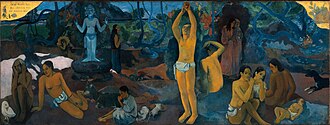 Where Do We Come From? What Are We? Where Are We Going? - Paul Gauguin (1897-1898)
%201889.jpg) Cristo giallo - Paul Gauguin (1889)
Cristo giallo - Paul Gauguin (1889)%201892%2C%20oil%20on%20canvas%2C%20101%20x%2077%20cm.jpg) When Will You Marry? - Paul Gauguin (1892)
When Will You Marry? - Paul Gauguin (1892)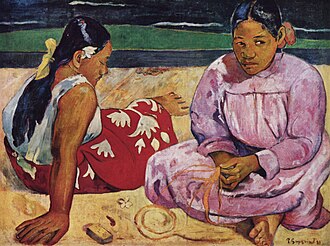 Donne di Tahiti - Paul Gauguin (1890)
.jpg) Vision After the Sermon - Paul Gauguin (1888)
Vision After the Sermon - Paul Gauguin (1888)Manaò tupapaú - Paul Gauguin (1892)
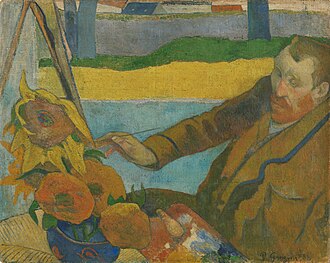 Vincent van Gogh Painting Sunflowers - Paul Gauguin (1888)
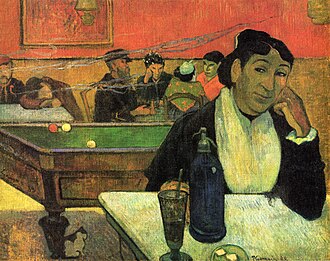 The Night Café in Arles - Paul Gauguin (1888)
Dipinti di artisti collegati
 The Starry Night - Vincent van Gogh (1889)
.jpg) Café Terrace at Night - Vincent van Gogh (1888)
Café Terrace at Night - Vincent van Gogh (1888) Dance at Le Moulin de la Galette - Pierre-Auguste Renoir (1876)
 Luncheon of the Boating Party - Pierre-Auguste Renoir (1881)