Maja and Celestine on the balcony
Francisco Goya · 1808
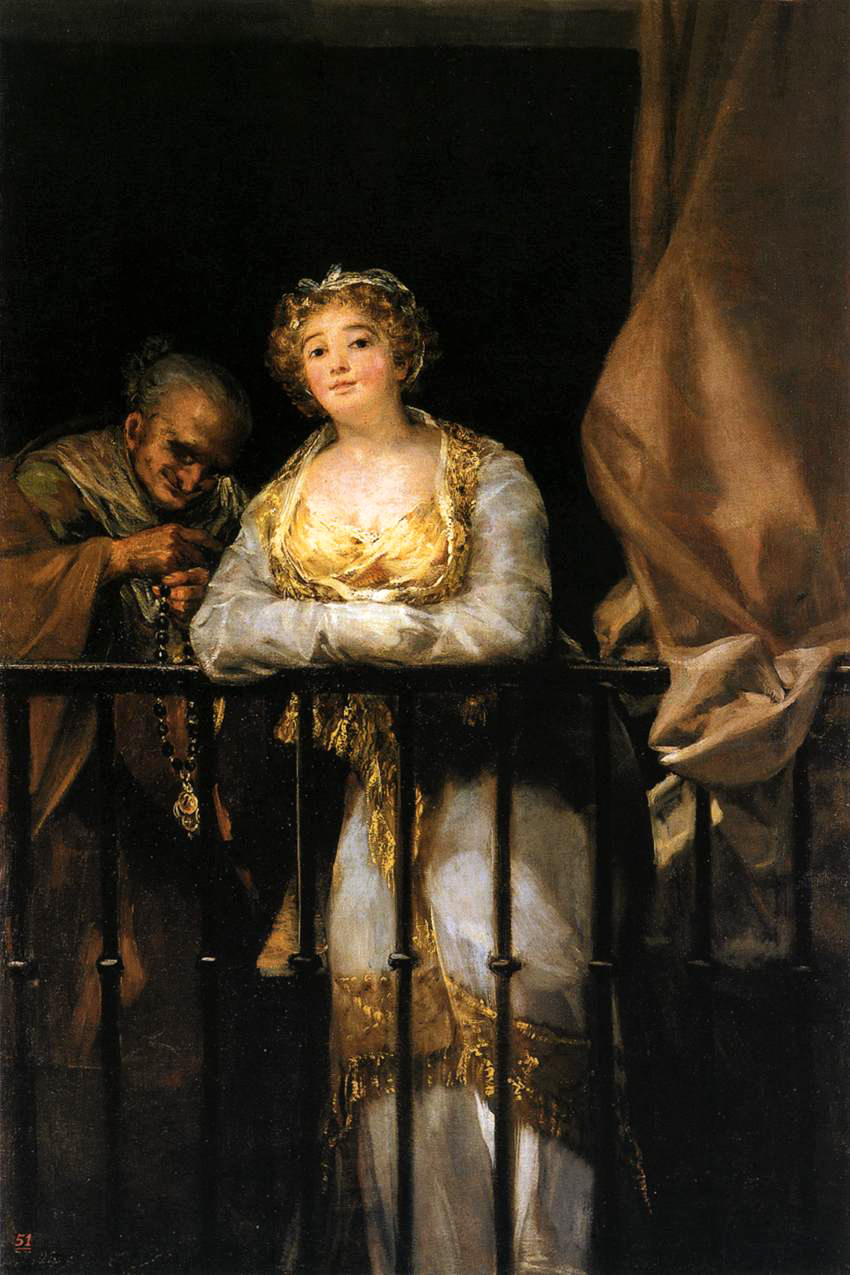
A beautiful young woman leans on a balcony and smiles at us. Behind her, in the half-dark, an old woman watches. Goya set beauty and its dark shadow side by side on one canvas.
The story behind the painting
Majas and majos were a classic theme for Goya. Here he returns to the subject of his Majas on a Balcony, showing aristocratic ladies dressed in popular style, as in his Portrait of the Duchess of Alba in black of 1797. The painting, an oil on canvas of about 166 by 108 cm, is held in a private collection in Palma de Mallorca. Wikidata dates it to 1808, and its Spanish title is Maja y celestina en un balcon.
What to look for
The young woman's dress is richly embroidered, which Goya renders with short, quick brushstrokes, while the veils are drawn with soft lines. Beside the maja, the old woman is sinister and obscure. The contrast in style between the two figures is so strong that they seem like two states of the same person, compared in the source to Dr Jekyll and Mr Hyde, or to the wolf and the grandmother in Little Red Riding Hood.
Meaning and intent
Celestina is a character created by Fernando de Rojas, an old woman seeking a rich man for her daughter, described in the source as a witch in search of young blood. With her, the picture stops being a simple genre scene and becomes a criticism of Spanish society. At the time, a woman at her balcony was called a ventanera, a nickname linked to prostitution. In the eighteenth century, women's claims for freedom included speaking freely and uncovering ankles or hair.
Legacy
From darkness, the source notes, Goya never returned to full light. Paintings of this period all combine light and dark elements, marking a break between the sunlit canvases of his early career and the later years dominated by shadows, which culminated in the Black Paintings. Here the maja on her balcony still belongs to the light, while the old woman behind her already belongs to the shadows that would take over his later work.
Lo sapevi?
- Painted by Goya around 1808, per Wikidata.
- Held in a private collection in Palma de Mallorca.
- Celestina is a character from Fernando de Rojas.
- A companion in theme to Majas on a Balcony.
L'artista
Francisco Goya (1746-1828)
woman · portrait · genre art · 1795-1820 in Western fashion · curtain · drapery · balcony · balustrade · elderly people · majo / maja
Altre opere di Francisco Goya
 The Third of May 1808 - Francisco Goya (1814)
.jpg) La maja nuda - Francisco Goya (1800)
La maja nuda - Francisco Goya (1800).jpg) Saturn Devouring His Son - Francisco Goya (1819)
Saturn Devouring His Son - Francisco Goya (1819) La famiglia di Carlo IV - Francisco Goya (1800)
 The Clothed Maja - Francisco Goya (1800)
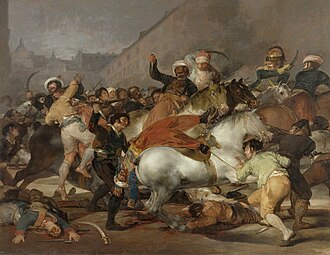 Il 2 maggio 1808 a Madrid - Francisco Goya (1814)
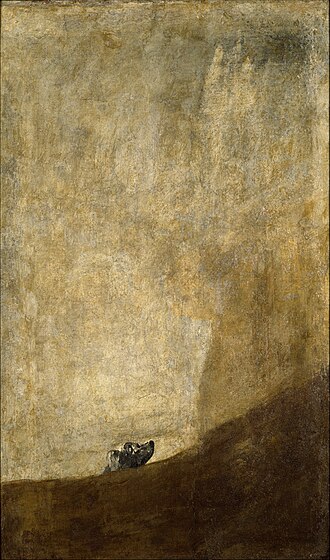 Cane semiaffondato - Francisco Goya (1819)
 Il sabba delle streghe - Francisco Goya (1820s)
Dipinti di artisti collegati
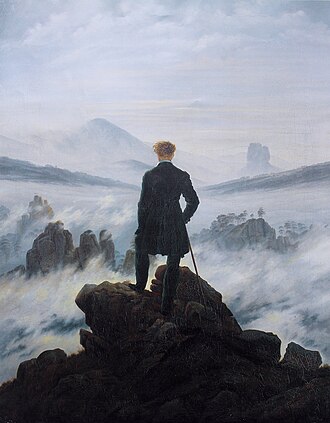 Wanderer above the Sea of Fog - Caspar David Friedrich (c. 1818)
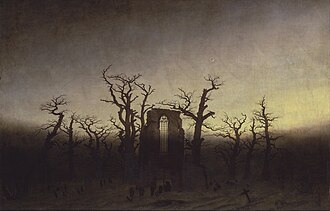 The Abbey in the Oakwood - Caspar David Friedrich (1800s)
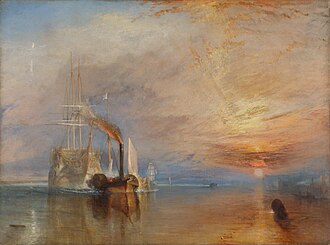 The Fighting Temeraire - J. M. W. Turner (1839)
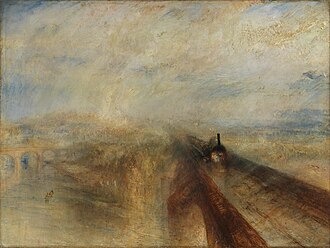 Rain, Steam and Speed - The Great Western Railway - J. M. W. Turner (1844)
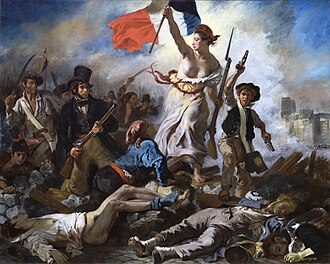 Liberty Leading the People - Eugène Delacroix (1830)
 Death of Sardanapalus - Eugène Delacroix (1827)