Lying female nude
Lovis Corinth · 1915
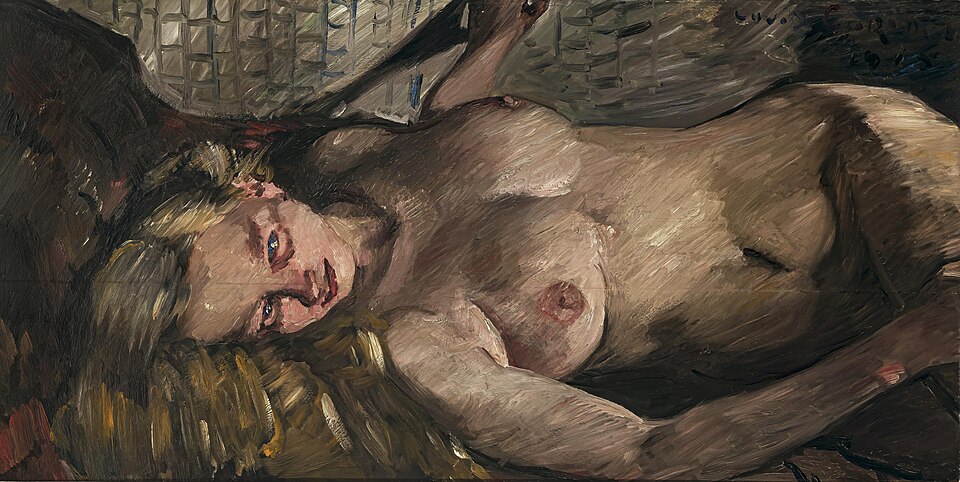
A young woman with loose blond hair lies on a dark sofa and looks straight at the painter. Corinth made her in 1915, just after his first stroke; the painting was later seized by the Nazi regime and returned to its owner's heirs only in 2023.
The story behind the painting
Lovis Corinth painted this nude in 1915, shortly after a holiday in Italy to recover from a first stroke. He had drawn and painted several versions of Joseph and Potiphar's Wife, three in 1914 and another in 1915, so the theme was on his mind and was then his central nude subject; for at least the second version he evidently used the same model as here. The picture is catalogued as BC 660. According to the catalogue raisonné it was first with the Galerie Fritz Gurlitt in Berlin, run by Wolfgang Gurlitt, and by 1923 at the latest it belonged to the Jewish pharmacist and collector Oskar Skaller in Berlin.
What to look for
In a wide landscape format, a young woman lies on a sofa, seen from the front. Her head rests on the hinted armrest at the left and her body crosses the picture down to the thighs just below the hip. Her long blond hair is spread around her head, and her blue eyes look directly at the viewer and the painter. Her shoulders lie on her back, while her hips turn to the side with closed legs, and shadow hides the lap. Behind her are the dark, barely outlined sofa and a hinted wallpaper. It is painted in oil on wood with clearly visible brushstrokes, and the signature above the hip almost disappears into the black background.
Meaning and intent
For the sale of the painting, Barbara Vinken of the Ludwig Maximilian University of Munich linked it to the Joseph and Potiphar's Wife series. She wrote that here only the flesh speaks, threatening and full of desire, and that the woman's eyes seem to glow with a foretaste of the expected ecstasy. In her view this is neither a smooth, sugary Venus of the kind Zola mocked in Cabanel's Birth of Venus of 1863, nor the cool regularity of marble statues. The visible brushstrokes stress reality and matter. Where the Bible story tells of a struggle between the sexes, Corinth, freed from any narrative, lets the flesh speak for itself.
Legacy
Skaller lent the picture to a Corinth exhibition at the Berlin Nationalgalerie in 1923, and it was offered at auction several times between 1927 and 1932 without selling. In April 1941 the Gestapo seized his property after he was stripped of citizenship; Skaller and his wife Lea had emigrated to South Africa in 1939. On 16 July 1942 the Berlin lawyer and collector Conrad Doebbecke bought it through the public auctioneer Bernhard Schlüter, on the instruction of the Berlin-Moabit tax office, and kept it until his death in 1954. In 2023 it was restituted to Skaller's heirs and then sold at auction in Munich to a private collection.
Lo sapevi?
- Painted by Lovis Corinth in 1915, oil on wood (BC 660).
- Owned by the Jewish collector Oskar Skaller by 1923.
- Seized by the Gestapo in 1941 and sold in 1942.
- Restituted to Skaller's heirs in 2023.
L'artista
Lovis Corinth (1858-1925)
Altre opere di Lovis Corinth
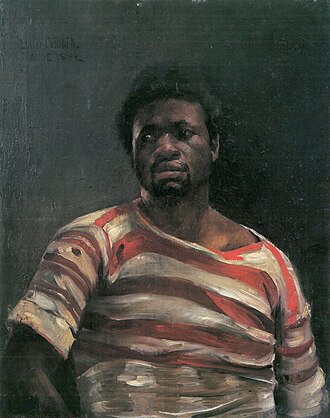 Black Othello - Lovis Corinth (1884)
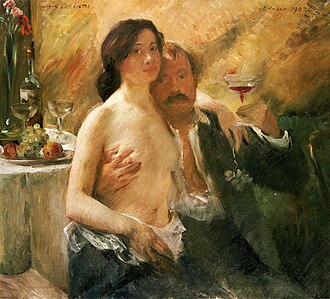 Self portrait with his wife Charlotte Berend-Corinth and a sekt glass - Lovis Corinth (1902)
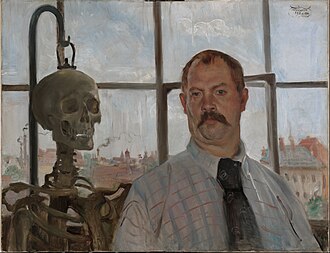 Self-portrait with Skeleton - Lovis Corinth (1896)
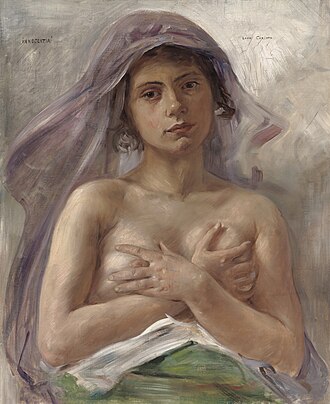 Innocentia - Lovis Corinth (1890)
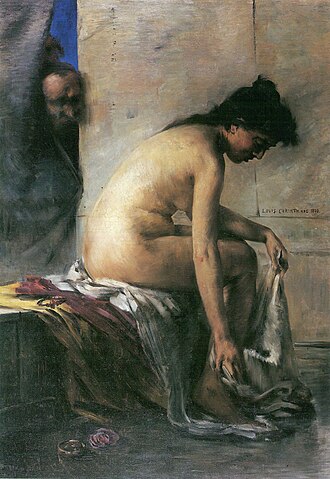 Susanna in the Bath - Lovis Corinth (1890)
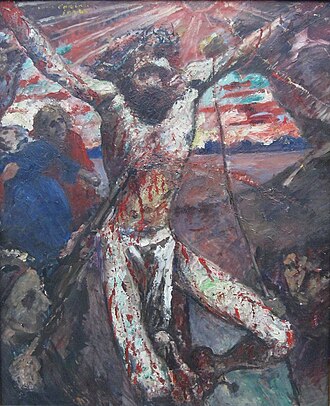 The Red Christ - Lovis Corinth (1922)
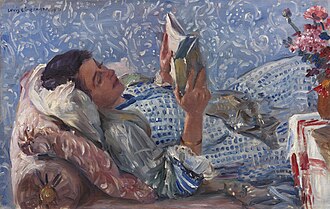 Reading Woman - Lovis Corinth (1911)
 Carmencita - Lovis Corinth (1924)