Carmencita
Lovis Corinth · 1924
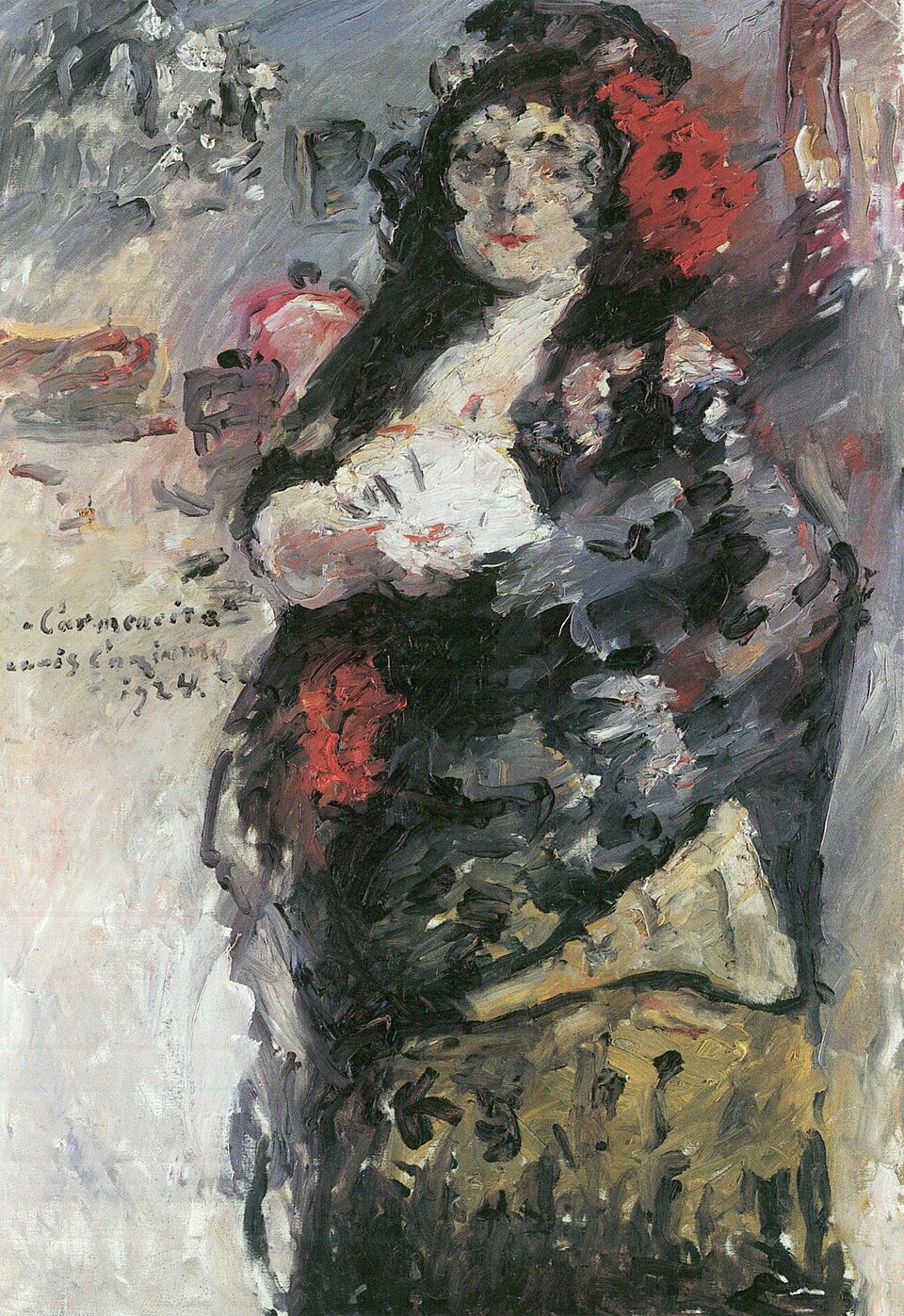
After a costume party in Berlin, Lovis Corinth painted his wife Charlotte as a Spanish lady in black lace, red flowers in her hair, Carmen playing in the room. It became his last portrait of her.
The story behind the painting
On 28 February 1924 the Berlin Secession held a costume party. Charlotte Berend-Corinth wore a Spanish costume, and shortly afterwards the scene was recreated in the family's private living room: a bright chandelier gave a festive atmosphere, and Bizet's opera Carmen played in the background. A surviving photograph shows Charlotte in the costume, posing for her husband. The oil on canvas that came out of these sessions belongs to Lovis Corinth's expressionist phase, and it was the last portrait he painted of his wife.
What to look for
Charlotte, then 44, stands almost life-size in a three-quarter-length view, pushed to the right so that she fills nearly two thirds of the width and the full height of the canvas, about 130 by 90 cm. She turns slightly but looks straight at us. Red flowers sit in her dark hair and at her waist; one hand rests on her hip, the other holds a white fan against her low neckline. In her own words: black lace over yellow silk, a burning chandelier and bright red furniture behind. Look at the left arm, where the black turns transparent into blue, violet and dark red.
Meaning and intent
The brushwork is quick and rough, so the motif dissolves while colour takes over. The black of costume and hair lies over the yellow-green silk and, in Andrea Bärnreuther's words, burns into it like fire; the red flowers pop out of the painting together with the red lips. Bärnreuther also notes how the fan and neckline emphasise the bust. Carl Georg Heise felt the picture made Charlotte look matronly strong, in a way that in no way matched her real appearance. The signature on the left edge reads Carmencita, Lovis Corinth, 1924.
Legacy
Corinth died in 1925, and the painting stayed with Charlotte. When she moved to the United States in 1939, it travelled with her art collection. In 1959 Ernst Holzinger acquired it for the Städel Museum in Frankfurt am Main, where it has remained ever since. Charlotte herself described it in the catalogue raisonné of her husband's paintings, so this last portrait of her carries both his hand and her voice: painted, as she wrote, after a costume party in Berlin, on Klopstockstrasse.
Lo sapevi?
- Painted in 1924 after a Berlin Secession costume party on 28 February.
- Lovis Corinth's last portrait of his wife Charlotte Berend-Corinth.
- Charlotte took it to the United States in 1939.
- Acquired by the Städel Museum in 1959.
L'artista
Lovis Corinth (1858-1925)
woman · portrait · Städel Museum · Charlotte Berend-Corinth
Altre opere di Lovis Corinth
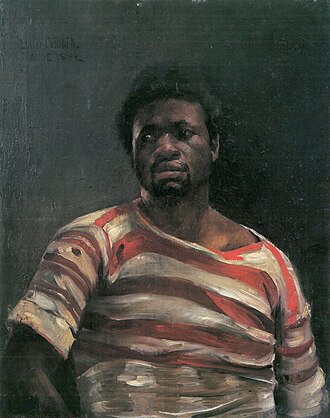 Black Othello - Lovis Corinth (1884)
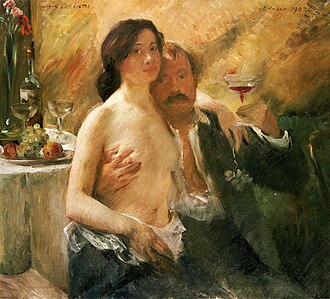 Self portrait with his wife Charlotte Berend-Corinth and a sekt glass - Lovis Corinth (1902)
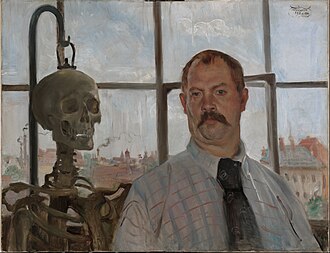 Self-portrait with Skeleton - Lovis Corinth (1896)
 Innocentia - Lovis Corinth (1890)
 Susanna in the Bath - Lovis Corinth (1890)
 The Red Christ - Lovis Corinth (1922)
 Reading Woman - Lovis Corinth (1911)
 Self-portrait with a Tyroler hat - Lovis Corinth (1913)