Infanta Margarita Teresa in a Blue Dress
Diego Velázquez · 1659
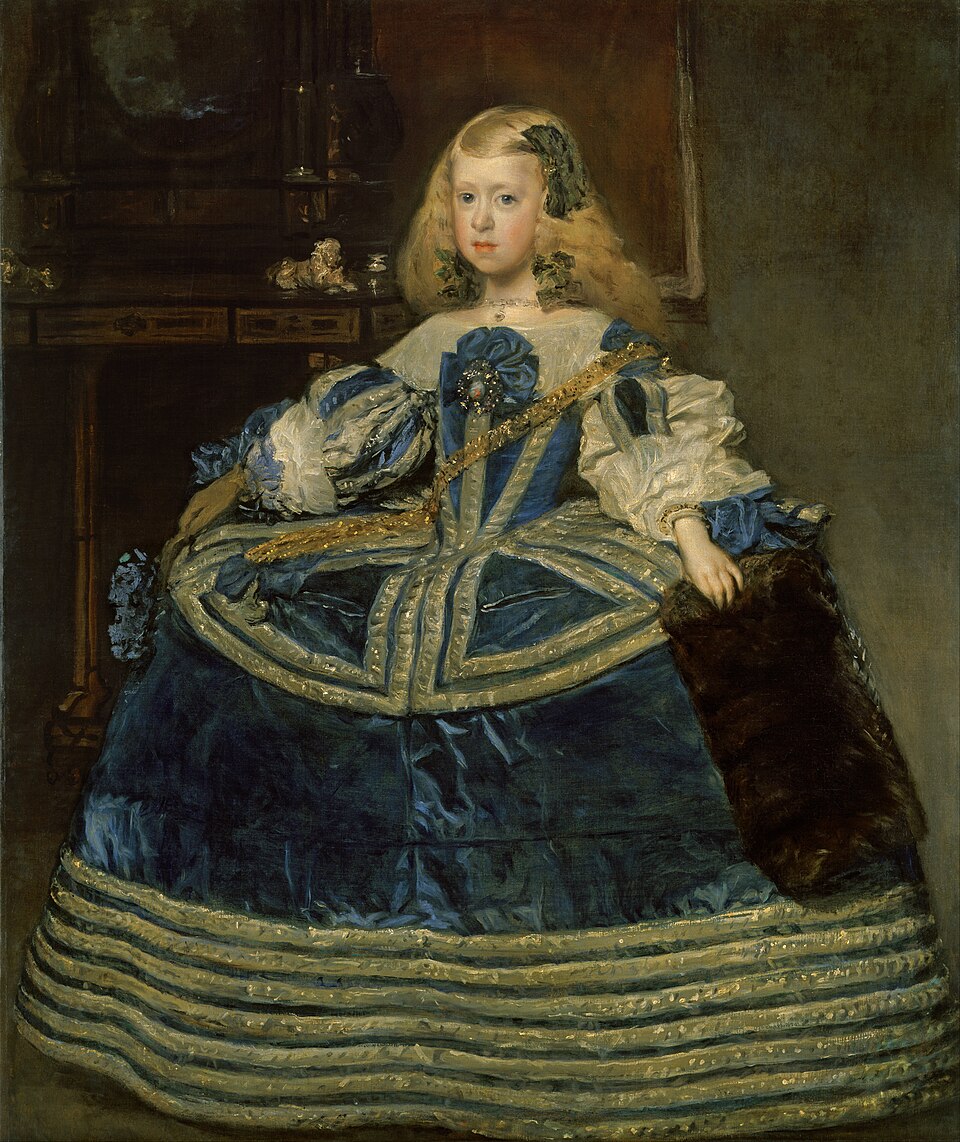
An eight-year-old princess stands in a vast dress of blue and silver, serious beyond her years. Velázquez painted her a year before his death, for a fiancé who lived far away in Vienna.
The story behind the painting
This portrait was one of Diego Velázquez's last paintings, made in 1659, a year before he died. Its sitter is Margaret Theresa of Spain, the same little infanta who appears at the centre of his Las Meninas of 1656. Velázquez painted her several times, on different occasions, so that the portraits trace her childhood. They had a practical purpose. The infanta was promised to her uncle Leopold I, Holy Roman Emperor, whom she would marry at fifteen, and the pictures were sent to Vienna to show him what his young fiancée looked like. Here she is eight years old, painted in oil on a canvas 127 centimetres high and 107 wide.
What to look for
Stand back first, then step closer. Velázquez used loose brushstrokes that come together into a clear image only from a certain distance; up close, the silver trim dissolves into marks of paint. The infanta faces us with a solemn expression. Her blue silk dress is edged with silver in the Spanish fashion of the time, and its most striking feature is the huge spread of the crinoline, widened further by the trimmed borders and the broad lace collar. In one hand she holds a brown fur muff. Her pale face is lit by the blue and silver around it. Behind her, a high console table stands before a round mirror.
Meaning and intent
This is a portrait made to travel and to introduce. It had to present the infanta as a royal bride, and Velázquez shows her pretty and appealing yet composed and grave, a child already carrying the dignity of her station. The great dress is a sign of rank as much as clothing, nearly filling the lower half of the picture. The fur muff in her hand may have been a present from Vienna, a small hint of the bond the painting was meant to strengthen. And the loose, shimmering handling of paint lets silk and silver seem alive, a late demonstration of the painter's freedom.
Legacy
Infanta Margarita Teresa in a Blue Dress is one of the best-known portraits Velázquez ever painted. Having been sent to Vienna, it remains there today in the Kunsthistorisches Museum. The museum holds two other Velázquez paintings, Infanta Maria Teresa and Portrait of Prince Philip Prospero, but this portrait of Margarita is possibly the best of the three. For visitors who know Las Meninas, it offers a moving reunion: the same girl a few years older, alone now, standing still in blue and silver. It is a work by a master near the end of his life, painted for a child at the start of hers.
Lo sapevi?
- Oil on canvas, 1659, 127 × 107 cm (Wikidata, Wikipedia)
- One of Velázquez's last paintings, a year before his death (Wikipedia)
- Sent to Vienna for her future husband Leopold I (Wikipedia)
- Kunsthistorisches Museum, Vienna
L'artista
Diego Velázquez (1599-1660)
portrait · flower · Kunsthistorisches Museum
Altre opere di Diego Velázquez
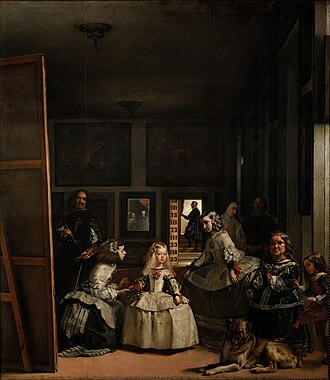 Las Meninas - Diego Velázquez (1656)
 The Surrender of Brea - Diego Velázquez (1635)
 Rokeby Venus - Diego Velázquez (1644)
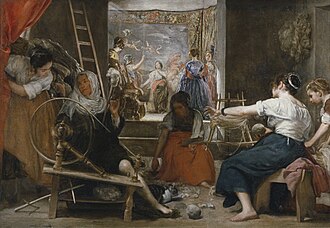 Las Hilanderas - Diego Velázquez
.jpg) Portrait of Innocent X - Diego Velázquez
Portrait of Innocent X - Diego Velázquez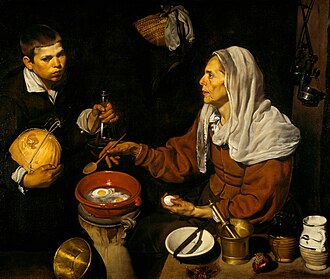 Old Woman Cooking Eggs - Diego Velázquez (1618)
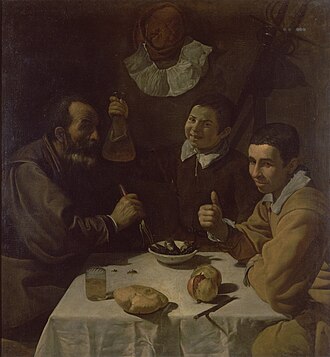 Il pranzo - Diego Velázquez (1617)
.jpg) Il trionfo di Bacco - Diego Velázquez (1628)
Il trionfo di Bacco - Diego Velázquez (1628)
Dipinti di artisti collegati
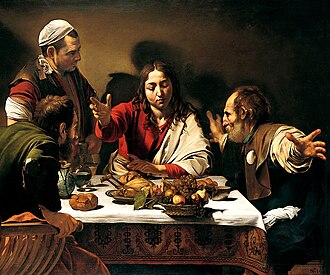 Supper at Emmaus - Caravaggio (1601)
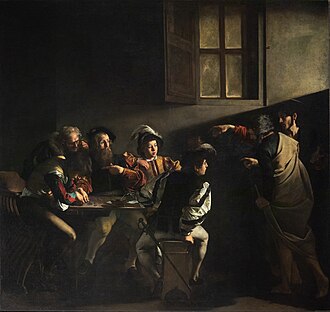 La vocazione di San Matteo - Caravaggio (1609)
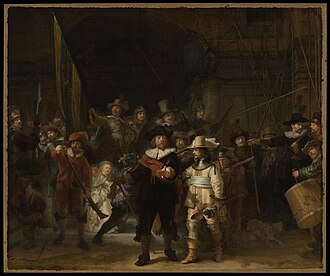 The Night Watch - Rembrandt van Rijn (1642)
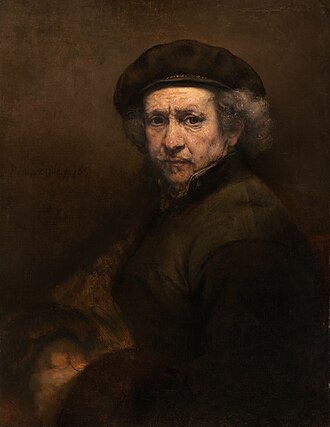 Self-Portrait - Rembrandt van Rijn (1659)
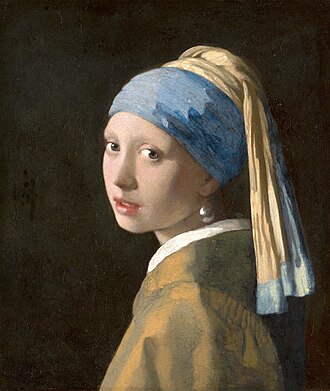 Girl with a Pearl Earring - Johannes Vermeer (1665)
 The Milkmaid - Johannes Vermeer (c. 1658)