Hercules's dog discovers tyrian purple
Peter Paul Rubens · 1636
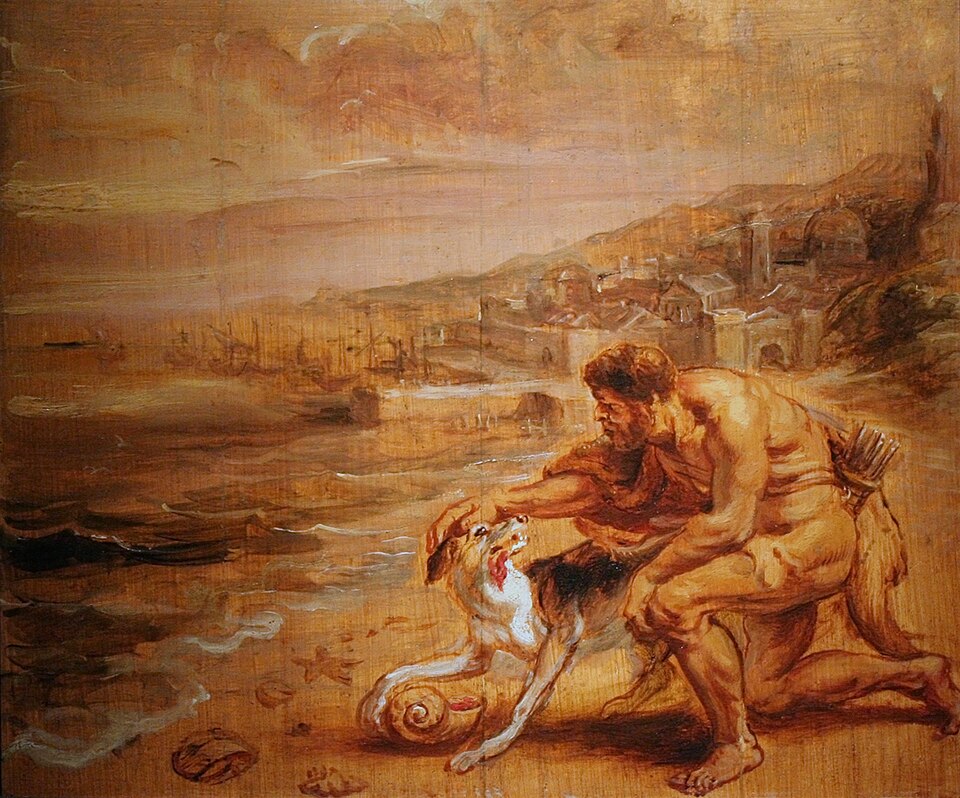
On a beach, Hercules's dog bites a sea shell and its mouth turns purple. In this small, quick oil sketch, Rubens told the myth of how the colour of emperors was discovered.
The story behind the painting
Around 1636, toward the end of his career, Rubens painted dozens of small oil sketches on panel for the decoration of the Torre de la Parada, a hunting lodge of the Habsburg kings of Spain. This one belongs to a cycle on Hercules. It is tiny, about 28.4 by 32.6 cm. From Rubens's sketch, Theodoor van Thulden made a finished painting in 1636 to 1638. The sources differ on where it is: the article first places it in the Museum of Fine Arts in A Coruña, then later says it is in the Prado.
What to look for
Hercules and his dog stand on the beach, and the dog's mouth is stained. Look at the shell: in the story it should be a spiny murex, the snail from which Tyrian purple was actually made, but Rubens painted a large smooth shell that looks like a nautilus. As a sketch, the panel shows Rubens thinking with the brush, setting out figures and the key moment quickly so that another painter could carry the composition to full size.
Meaning and intent
The tale comes from the Onomasticon of Julius Pollux, a second-century Graeco-Roman sophist. Hercules and his dog were walking on the beach to court a nymph named Tyros; the dog bit a sea snail and its blood dyed the dog's mouth purple. The nymph demanded a gown of that colour, and so purple dye was born. Some attribute the myth to Melqart, a god of Tyre identified with Heracles. Royal purple clothed emperors, and the cycle alludes to the Habsburgs and the wealth they gained from the conquest of Peru.
Legacy
By showing Hercules's travels to Phoenicia, the picture also recalls the old warning, attributed to the Phoenicians, to stay within the Pillars of Hercules, and the Habsburgs' own passage beyond that limit. The sketch is now in the Musée Bonnat in Bayonne, alongside other Herculean works, such as Piero di Cosimo's drawing of Hercules and the Hydra and Charles Le Brun's Hercules killing Diomedes. Giorgio Vasari painted the same subject for the Studiolo of Francesco I de' Medici in the Palazzo Vecchio, with a similar hint at his patron's wealth.
Lo sapevi?
- An oil sketch for the Torre de la Parada, the Spanish Habsburg hunting lodge.
- Based on a myth told by Julius Pollux.
- Rubens painted a nautilus-like shell instead of a murex.
- Now in the Musée Bonnat, Bayonne.
L'artista
Peter Paul Rubens (1577-1640)
mythological painting · dog · Heracles
Altre opere di Peter Paul Rubens
 The Elevation of the Cross - Peter Paul Rubens (1609)
 The Rape of the Daughters of Leucippus - Peter Paul Rubens (1618)
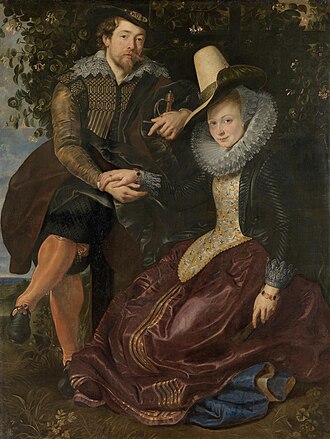 Rubens and Isabella Brant in the honeysuckle bower - Peter Paul Rubens (1600s)
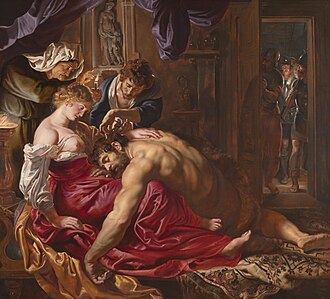 Samson and Delilah - Peter Paul Rubens (1600s)
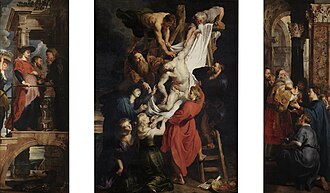 The Descent from the Cross - Peter Paul Rubens (1611)
 Head of Medusa - Peter Paul Rubens (1618)
 Helena Fourment in a Fur Robe - Peter Paul Rubens (1638)
 The Garden of Love - Peter Paul Rubens (1632)
Dipinti di artisti collegati
 The Starry Night - Vincent van Gogh (1889)
 Café Terrace at Night - Vincent van Gogh (1888)
 Supper at Emmaus - Caravaggio (1601)
 La vocazione di San Matteo - Caravaggio (1609)
 Las Meninas - Diego Velázquez (1656)
 The Surrender of Brea - Diego Velázquez (1635)
 Saint Francis in Meditation - Francisco de Zurbarán (1639)
 The Immaculate Conception - Francisco de Zurbarán (1661)
 Charles I in Three Positions - Anthony van Dyck (1635)
 Charles I (1600-1649) with M. de St Antoine - Anthony van Dyck (1636)
 The Night Watch - Rembrandt van Rijn (1642)
 Self-Portrait - Rembrandt van Rijn (1659)