Fatata Te Moua
Paul Gauguin · 1892
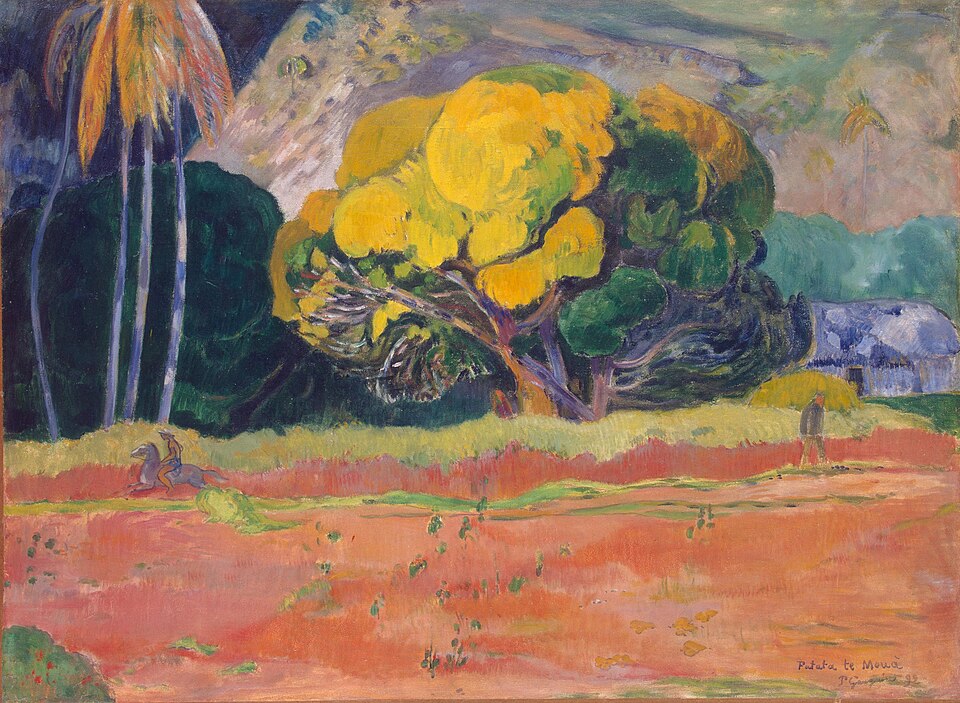
A great tree stands in the middle of a blazing Tahitian landscape, and only a rider and a walking man pass beneath it. Long called The Big Tree, Gauguin's own title means At the Foot of the Mountain.
The story behind the painting
Gauguin lived on Tahiti from 1891 to 1893, searching for the natural simplicity and harmony he felt had disappeared from modern European life. In the capital Papeete he soon found that the traditional way of life had vanished with the arrival of Europeans, so he settled at Mataiea, a village on the south coast of the island. There he painted many pictures of the landscape and of life on the island, among them Fatata te Mouà in 1892. Troubled by money worries, he was forced to return to France in 1893.
What to look for
Gauguin renders the Tahitian landscape in large areas of bright, vivid colour. Look for the only two human beings in the scene, a rider on horseback and a man walking; they are small beside the land around them. A large tree takes the central place in the picture, and here it is painted fairly faithfully, as Gauguin saw it. The same tree appears again in many other paintings, such as Mata Mua and Nave Nave Moe. Let your eye travel from the tree to the mountain behind it, which gives the picture its true title.
Meaning and intent
According to the Swedish anthropologist Bengt Danielsson, who wrote a book on Gauguin's stay on Tahiti, the near emptiness of the scene matches reality: the island's population had fallen sharply because of colonisation. So the calm of the picture also carries a quiet loss. In Gauguin's later works the same tree took on a strong symbolic charge and came to refer to Hina, the goddess of the moon. Here it is still simply a tree. The painting was long known as The Big Tree, but the correct translation of the title Gauguin himself gave it is At the Foot of the Mountain.
Legacy
The painting was shown in 1893 in an exhibition at Paul Durand-Ruel's gallery. In 1895 Gauguin left it for safekeeping with his friend Georges Chaudet in Paris, and after Chaudet's death, around 1899, it passed to the dealer Ambroise Vollard. On 29 April 1908 the Moscow collector Ivan Morozov bought it. In 1918 it went to the Museum of New Western Painting in Moscow, which became part of the State Museum of New Western Art in 1923, and in 1948 it was transferred to the Hermitage in Saint Petersburg, where it has stayed ever since.
Lo sapevi?
- Painted at Mataiea, Tahiti, in 1892.
- Long known as The Big Tree.
- The same tree appears in Mata Mua and Nave Nave Moe.
- At the Hermitage since 1948.
L'artista
Paul Gauguin (1848-1903)
landscape painting · Hermitage Museum
Altre opere di Paul Gauguin
 Where Do We Come From? What Are We? Where Are We Going? - Paul Gauguin (1897-1898)
 Cristo giallo - Paul Gauguin (1889)
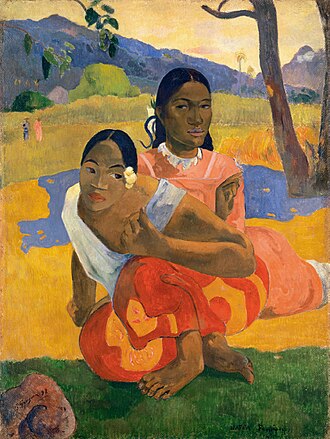 When Will You Marry? - Paul Gauguin (1892)
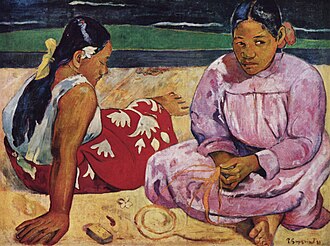 Donne di Tahiti - Paul Gauguin (1890)
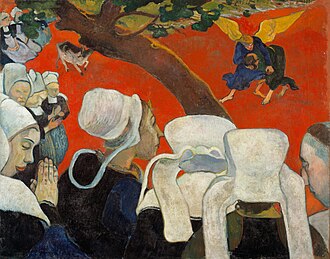 Vision After the Sermon - Paul Gauguin (1888)
Manaò tupapaú - Paul Gauguin (1892)
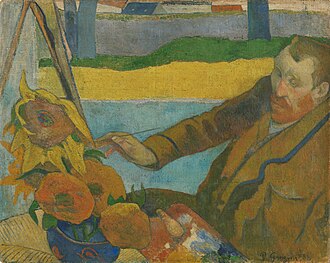 Vincent van Gogh Painting Sunflowers - Paul Gauguin (1888)
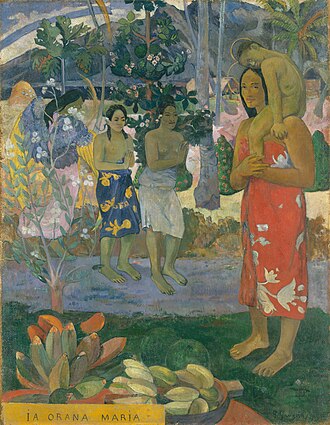 Ia Orana Maria - Paul Gauguin (1891)
Dipinti di artisti collegati
 The Starry Night - Vincent van Gogh (1889)
 Café Terrace at Night - Vincent van Gogh (1888)
 Walk on the mountain - Joaquín Sorolla (1909)
 Sad Inheritance - Joaquín Sorolla (1898)
 Les Grandes Baigneuses - Paul Cézanne (1900s)
 The Boy in the Red Vest - Paul Cézanne
 Dance at Le Moulin de la Galette - Pierre-Auguste Renoir (1876)
 Luncheon of the Boating Party - Pierre-Auguste Renoir (1881)
 At the Moulin Rouge - Henri de Toulouse-Lautrec (1892)
 La Toilette - Henri de Toulouse-Lautrec (1896)