David and Goliath
Titian · 1540s
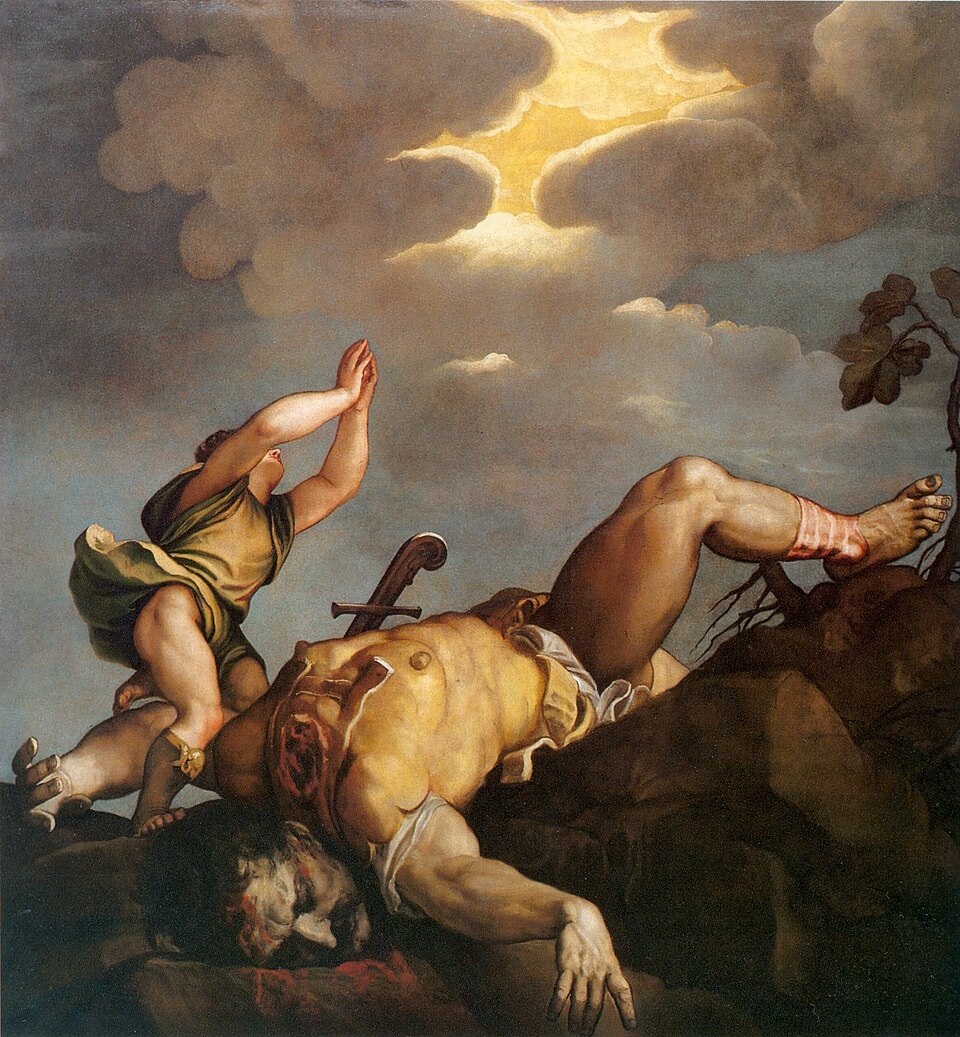
High on a sacristy ceiling in Venice, the giant Goliath lies stretched across the picture while the boy David raises his arms to heaven, and a ray of sunlight breaks through heavy clouds. Titian is the only artist known to have shown David praying after his victory.
The story behind the painting
Around the beginning of the 1540s Titian received many commissions from the brothers of Santo Spirito in Venice. David and Goliath was painted in about 1542 to 1544 for their church, together with Cain and Abel and Abraham and Isaac. In the seventeenth century the whole collection of Santo Spirito was moved to the basilica of Santa Maria della Salute, where the three pictures now sit in the ceiling of the sacristy, above the altar. Wikidata simply dates it to the 1540s.
What to look for
The setting is the same in all three pictures: brown soil, rocky cliffs, the feeling of mountain heights, and a gloomy sky heavy with clouds. Against it stand colossal, brownish-yellow human forms. Here, as the historian Georg Gronau describes, light lies aslant the outstretched body of the giant, which gives the strongest mass of colour, while above him the boy David raises his arms in gratitude, and the light from above seems almost solid as it touches them.
Meaning and intent
Gronau saw the three ceilings as scenes chosen to display passionate movement with only two or three figures, and wrote that for grandeur of conception Titian here comes close to Michelangelo, while the sombre colour scheme is his own. The art historian Madlyn Kahr notes that other artists showed David beheading Goliath or lifting the head in triumph, but only Titian painted him praying. She sees the key in Goliath's sword, which David is dedicating to God.
Legacy
The story it tells is short: Goliath challenged the army of Saul day after day, only David answered, and with a sling and pebbles he overcame him, so that the Philistines fled. The giant's famous sword was later the one David took with him when he fled from Saul. Titian's quiet prayer over that victory remains unique, and the painting still hangs in the Salute, where it was moved in the seventeenth century.
Lo sapevi?
- Painted about 1542 to 1544 for the church of Santo Spirito, Venice.
- One of three ceiling pictures with Cain and Abel and Abraham and Isaac.
- Now in the sacristy of Santa Maria della Salute.
- The only known depiction of David praying after defeating Goliath.
L'artista
Titian (1488-1576)
religious art · beheaded head · Santa Maria della Salute
Altre opere di Titian
 Venus of Urbino - Titian (1538)
 Assumption of the Virgin - Titian (1510s)
 Sacred and Profane Love - Titian (1510s)
 Equestrian Portrait of Charles V - Titian (1548)
 Flora - Titian (1517)
 Allegory of Prudence - Titian (1550)
 Diana and Actaeon - Titian (1550s)
 Bacchus and Ariadne - Titian (1520s)
Dipinti di artisti collegati
 Last Supper - Jacopo Tintoretto (1563)
 Miracle of the Slave - Jacopo Tintoretto (1540s)
 The Wedding at Cana - Paolo Veronese (1560s)
 The Feast in the House of Levi - Paolo Veronese (1573)