Coriolan supplié par sa famille
Nicolas Poussin · 1650s
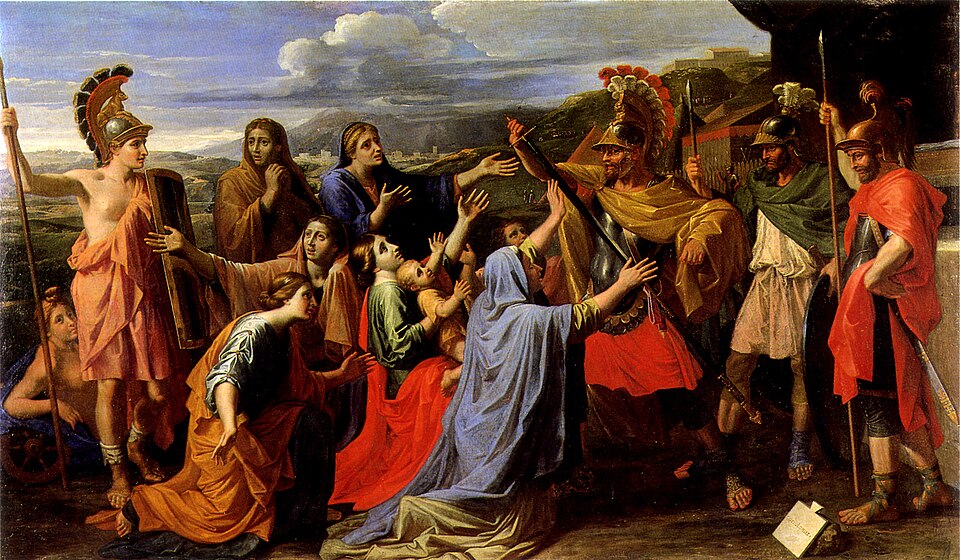
A Roman general in exile marches on his own city, and only his mother and wife can stop him. Poussin staged their plea like a tragedy. The canvas itself has survived a fire and a wartime bombing.
The story behind the painting
Nicolas Poussin painted this oil on canvas around 1652. Who commissioned it is not known, but it changed owners several times before the French Revolution. In 1794 it was seized from Simon-Charles Boutin, a treasurer of the Navy. Around 1803 to 1804 the French state sent it to Les Andelys, Poussin's home region, but it stayed in the prefecture building in Évreux until 1832. Sizes differ between sources: French Wikipedia gives 112 by 198.5 cm, Wikidata 177 by 198 cm.
What to look for
Thirteen figures spread across a long, complex composition. Poussin arranges them in the foreground like an ancient bas relief, and stages the scene like a theatre: outstretched arms, faces marked by distress, fury and determination. On the left are an allegory of Rome and the figure of Fortune, the Fortuna of the Roman people. At the bottom, at the foot of the figure on the right, a small painted label, a cartellino, carries the word CORIOLANUS. Look for the sword Coriolanus is putting away.
Meaning and intent
The subject comes from Livy's history of Rome and Plutarch's Parallel Lives. Coriolanus, a Roman general exiled after political rivalry, went over to the enemy and led the armies of the Volsci. He returned to take Rome, but his mother Veturia and his wife Volumnia, with their children, found him and begged him to spare the city. Moved, he sheathed his sword. The Volsci later put him to death for treason. Poussin paints the instant when family love wins over vengeance, knowing what it will cost.
Legacy
The painting has escaped destruction twice. It was moved to Les Andelys and kept first in the courthouse, and was saved on the night of 6 to 7 February 1860 when fire ravaged the building. It was then shown in the town hall and survived again when the town hall was bombed during the Second World War. It now belongs to the Musée Nicolas-Poussin in Les Andelys. Between 2019 and 2020 it travelled to Japan for an exhibition, and Japan funded the restoration of its Régence style frame, which is not the original.
Lo sapevi?
- Painted around 1652.
- Seized in 1794 and sent by the state to Les Andelys.
- Survived a fire in 1860 and a bombing in the Second World War.
- In the Musée Nicolas-Poussin, Les Andelys.
L'artista
Nicolas Poussin (1594-1665)
Altre opere di Nicolas Poussin
 The Adoration of the Golden Calf - Nicolas Poussin (1634)
 A Dance to the Music of Time - Nicolas Poussin (1630s)
 The Plague at Ashdod - Nicolas Poussin (1630)
 Et in Arcadia ego - Nicolas Poussin (1638)
 The Judgment of Solomon - Nicolas Poussin (1649)
 The Empire of Flora - Nicolas Poussin (1631)
 The Apparition of the Virgin to Saint James the Great - Nicolas Poussin (1620s)
 The Martyrdom of Saint Erasmus - Nicolas Poussin (1628)