Christ Crucified
Francisco Goya · 1780
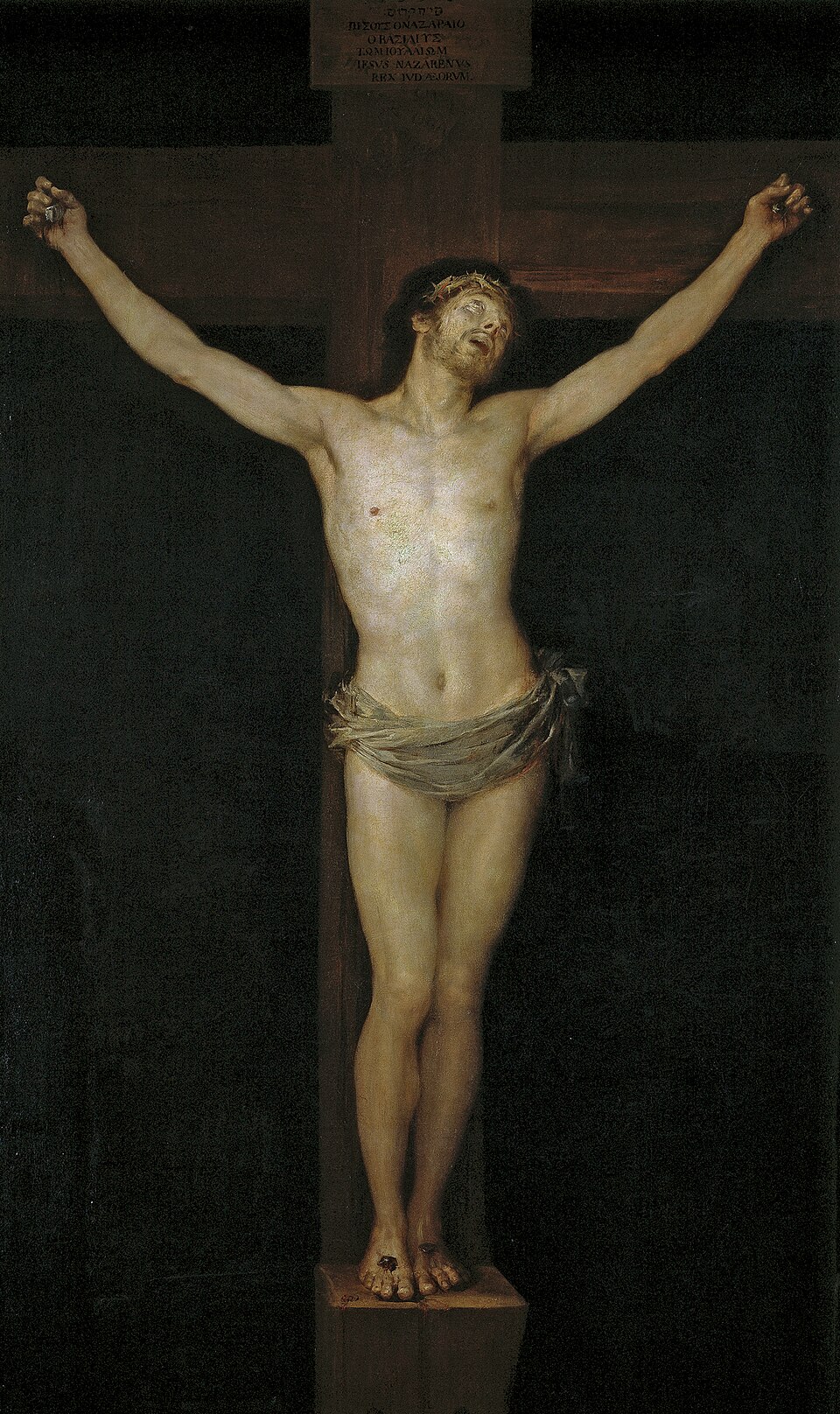
A pale body glows against pure black, the head lifted to the sky. Goya painted this calm crucifixion in 1780 to win his place among the academicians of Madrid.
The story behind the painting
In 1780 Francisco de Goya presented Christ Crucified to the Real Academia de Bellas Artes de San Fernando as his reception piece as an academic painter. It was a test of skill as much as an act of devotion. The Academy was then dominated by the neoclassicism of Anton Raphael Mengs, and Goya wanted to please its members. The subject allowed him to show his knowledge of anatomy, one of the hardest areas he could choose, by submitting a nude that Spanish tradition justified through its religious form. The canvas, about 255 by 154 cm, is now in the Prado.
What to look for
The black background with no landscape is borrowed from Velázquez's treatment of the subject, and the right leg pushed forward from Mengs. Goya also follows the rules laid down by Francisco Pacheco: four nails instead of three, supported feet, and a three-language inscription beginning IESUS NAZARENUS REX IUDEORUM. The light seems to come from Christ's bare chest and melts softly into the dark, hiding the underdrawing. Glazes in pearl grey and soft green-blue, touches of intense white, and a gentle classical S curve give the body life without stiffness.
Meaning and intent
Painted with loose, vibrant brushwork, Christ's head is lifted and leans to the left, looking dramatically upward, perhaps in a gesture of ecstasy as he says, My God, my God, why have you forsaken me. Yet the serenity of the whole avoids a pitiful feeling. By obeying the old rules, Goya lowered the drama and the blood usual in devotional images, so that attention would rest on the soft modelling. The pushed-forward leg, the slightly skewed hip and the tilted head are the small adjustments that classical canons demanded.
Legacy
His contemporaries admired the painting. In the twentieth century it fell out of fashion, when critics preferred to see Goya as a Romantic painter with little or no Catholic faith who paid scant attention to academic or religious painting. Later, postmodern scholarship looked again at Goya's work as a whole, in all its facets, and recognised this as a work in which he was still striving for professional prestige. Wikidata records that before the Prado the painting was held by the Museo de la Trinidad. It remains a rare chance to see the young Goya at his most careful.
Lo sapevi?
- Goya's reception piece for the Royal Academy of San Fernando, 1780.
- About 255 x 154 cm, now in the Prado.
- Follows Pacheco's rules: four nails, black background.
- Admired in its time, out of fashion in the 20th century.
L'artista
Francisco Goya (1746-1828)
religious art · Museo del Prado · Jesus Christ · crucifixion of Jesus · cross · Museo de la Trinidad
Altre opere di Francisco Goya
 The Third of May 1808 - Francisco Goya (1814)
 La maja nuda - Francisco Goya (1800)
 Saturn Devouring His Son - Francisco Goya (1819)
 La famiglia di Carlo IV - Francisco Goya (1800)
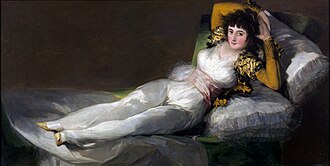 The Clothed Maja - Francisco Goya (1800)
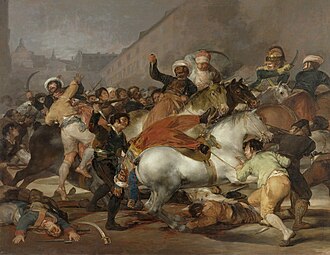 Il 2 maggio 1808 a Madrid - Francisco Goya (1814)
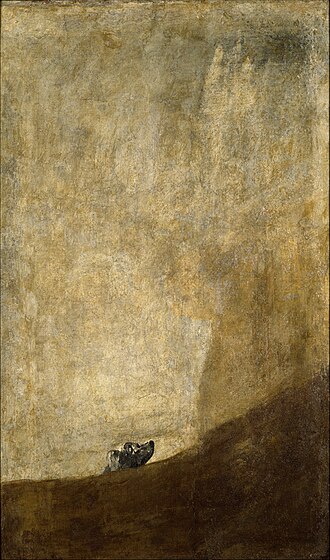 Cane semiaffondato - Francisco Goya (1819)
 Il sabba delle streghe - Francisco Goya (1820s)
Dipinti di artisti collegati
 Wanderer above the Sea of Fog - Caspar David Friedrich (c. 1818)
 The Abbey in the Oakwood - Caspar David Friedrich (1800s)
 Liberty Leading the People - Eugène Delacroix (1830)
 Death of Sardanapalus - Eugène Delacroix (1827)
 The Fighting Temeraire - J. M. W. Turner (1839)
 Rain, Steam and Speed - The Great Western Railway - J. M. W. Turner (1844)
 The Blue Boy - Thomas Gainsborough (1770)
 Mr and Mrs Andrews - Thomas Gainsborough (1748)