Annah the Javanese, or The Child-woman Judith Is Not Yet Breached
Paul Gauguin · 1894
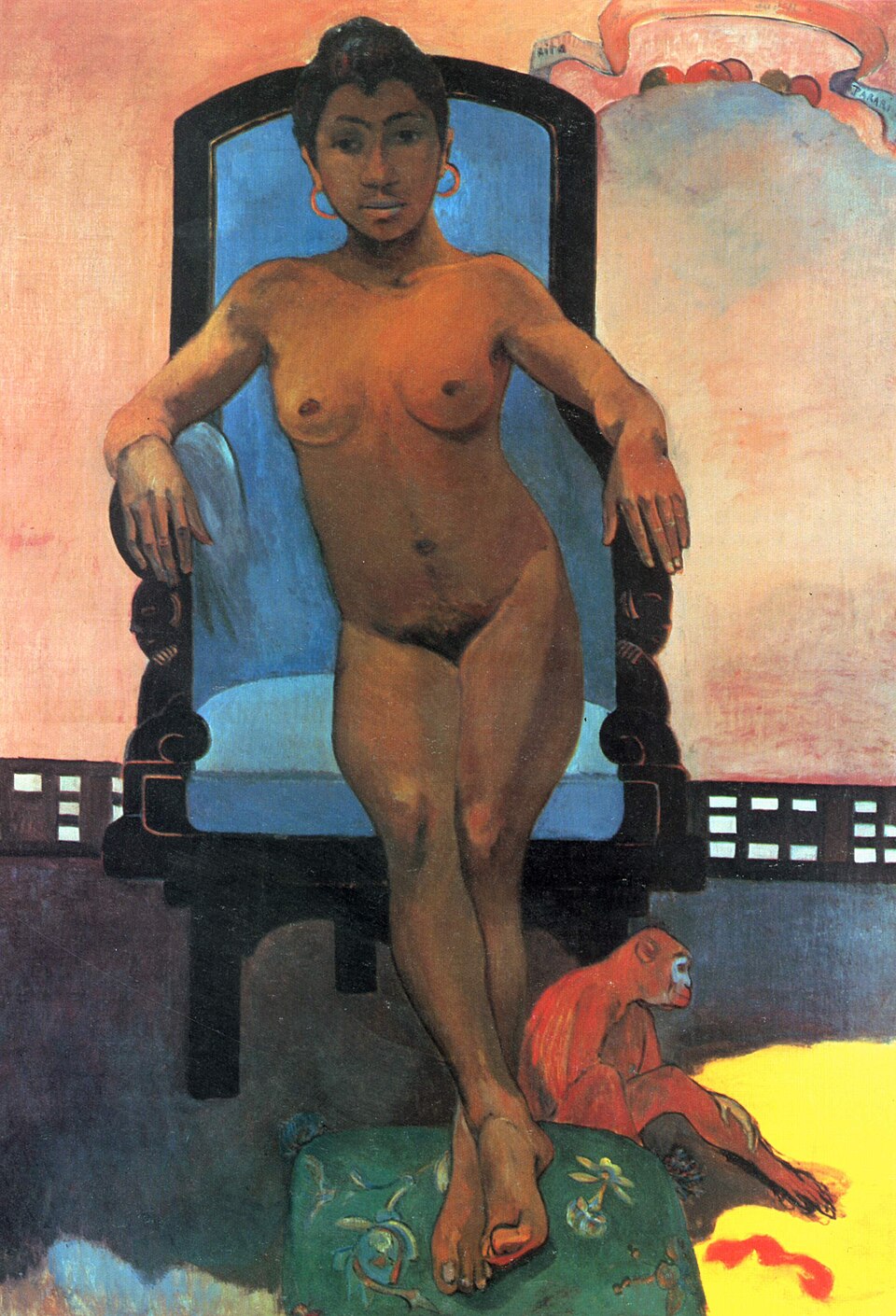
A young woman sits naked on a cobalt blue armchair like a throne, a monkey at her feet, looking straight at us. Gauguin painted Annah in Paris in 1894, and wrote in Tahitian on the wall a title about someone else.
The story behind the painting
In September 1893 Gauguin came back to Paris after his first stay in Tahiti, and in January 1894 he settled at 6 rue Vercingétorix, in southern Montparnasse. His model and lover was Annah, called the Javanese, a young woman of mixed and unknown origin and age. According to his dealer Ambroise Vollard, she had arrived in Paris with a label round her neck bearing the address of the opera singer Nina Pack, who took her as a maid and later dismissed her. Annah turned to Vollard, who thought of Gauguin. In April 1894 the couple, with a monkey named Taoa that Gauguin gave her, moved to Pont-Aven.
What to look for
Annah is naked except for earrings, seated with her arms on the armrests, legs crossed, her feet on an embroidered cushion beside the monkey. She leans slightly forward, tense and almost suspended, and meets our eyes. Her small frame and nudity contrast with the solemn chair and the bare setting. The colours are electric: a neutral pink wall, a cobalt armchair, a navy rug, a green cushion, all reflected in her dark skin. At the top right are the remains of a still life painted on the wall and a ribbon with a Tahitian inscription. The lower wall carries an oriental border.
Meaning and intent
The inscription has been read as Aita parari te tamari vahine Judith, meaning the child-woman Judith is not yet deflowered. Judith was the daughter of Gauguin's downstairs neighbours, the sculptor Ida Ericson and the musician William Molard. At thirteen she fell in love with Gauguin and was jealous of Annah, as she later told in her memoir. Gauguin seems to have wanted to paint her, but her mother refused. The painting suggests both innocence and sensuality: the monkey is a traditional symbol of promiscuity, and it is one of the first European nudes to show pubic hair. The source places this in a colonial discourse in which sexual permissiveness was imagined only with other races.
Legacy
On 25 May 1894, walking on the quay at Concarneau with Annah and the monkey, Gauguin clashed with mocking sailors and broke his ankle, which kept him immobile for two months. After a quarrel Annah went back to Paris and emptied the studio, except for the works on the walls. Nothing more is known of her beyond a few photographs taken in the studio of Alphonse Mucha, one perhaps showing her clothed in the same pose. Gauguin returned to Paris intending to leave for Tahiti for good. The painting, number 580 in the Wildenstein catalogue, is in a private collection in Switzerland.
Lo sapevi?
- Painted in Paris in 1894, after Gauguin's first stay in Tahiti.
- The Tahitian inscription names Judith Molard, not the model.
- Annah's later life is unknown.
- In a Swiss private collection, Wildenstein number 580.
L'artista
Paul Gauguin (1848-1903)
woman · portrait · nude · sitting · Post-impressionism · nudity · earring · breast
Altre opere di Paul Gauguin
 Where Do We Come From? What Are We? Where Are We Going? - Paul Gauguin (1897-1898)
%201889.jpg) Cristo giallo - Paul Gauguin (1889)
Cristo giallo - Paul Gauguin (1889)%201892%2C%20oil%20on%20canvas%2C%20101%20x%2077%20cm.jpg) When Will You Marry? - Paul Gauguin (1892)
When Will You Marry? - Paul Gauguin (1892) Donne di Tahiti - Paul Gauguin (1890)
.jpg) Vision After the Sermon - Paul Gauguin (1888)
Vision After the Sermon - Paul Gauguin (1888)Manaò tupapaú - Paul Gauguin (1892)
 Vincent van Gogh Painting Sunflowers - Paul Gauguin (1888)
 The Night Café in Arles - Paul Gauguin (1888)
Dipinti di artisti collegati
 The Starry Night - Vincent van Gogh (1889)
.jpg) Café Terrace at Night - Vincent van Gogh (1888)
Café Terrace at Night - Vincent van Gogh (1888) Dance at Le Moulin de la Galette - Pierre-Auguste Renoir (1876)
 Luncheon of the Boating Party - Pierre-Auguste Renoir (1881)