Aminadab
Michelangelo · 1511
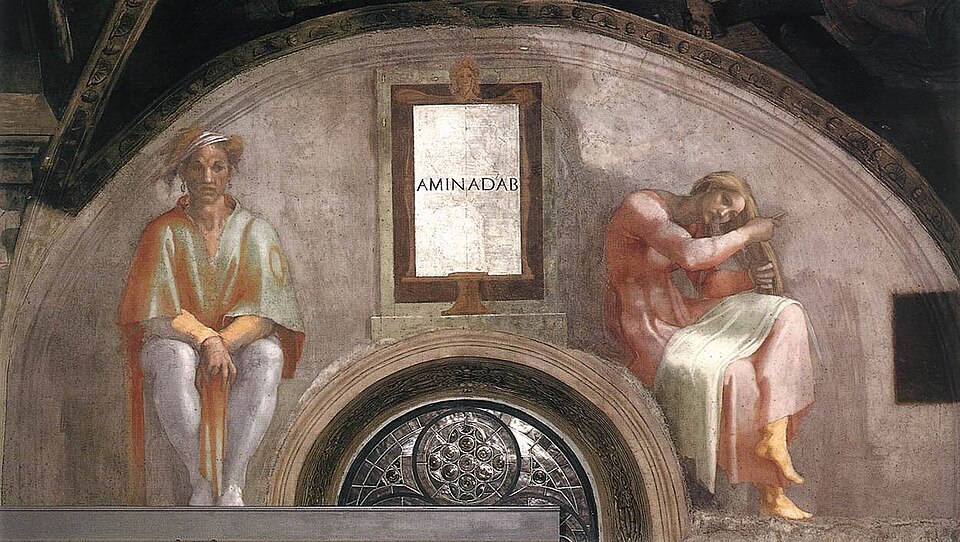
A man sits rigidly upright, hands clenched between his knees, while beside him a woman twists to comb her long blond hair. Michelangelo painted this lunette of Aminadab on the Sistine Chapel walls around 1511 to 1512, fast and with a sure hand.
The story behind the painting
The lunette of Aminadab is a fresco painted by Michelangelo around 1511 to 1512, part of the decoration of the Sistine Chapel commissioned by Pope Julius II together with the ceiling. The lunettes hold the series of the Ancestors of Christ and were painted in two phases, starting from the entrance wall opposite the altar. By summer 1511 the first half was done and the scaffolding had to be rebuilt in the other half. The second phase began in October 1511 and ended a year later, just in time for the unveiling on the eve of All Saints' Day 1512. Aminadab was probably the fourteenth of sixteen lunettes to be painted.
What to look for
Aminadab, a prince of the tribe of Judah, sits on the left, strictly frontal, back straight, feet together, hands tightly clasped between his knees. His strongly marked face, under a mass of raven hair tied with a white band, seems to betray great inner tension. He wears pendant earrings, a cloak shifting from red to pale green, and tight white trousers. The woman on the right turns toward us with crossed legs and a twisting torso, combing her long blond hair. Her clinging pink dress looks almost wet, a light green cloth lies on her thighs, and her shoes are bright yellow. Look at her foreshortened hand, the palm in shadow and the knuckles in light.
Meaning and intent
The lunettes follow the genealogy of Christ in the Gospel of Matthew, and the name AMINADAB is written in Roman capitals on the central plaque. In this second campaign the plaque is simpler, at the insistence of a pope who wanted the work finished quickly. The background is lighter and the figures larger, painted faster and more fluidly. The larger proportions are an optical device for people walking from the door to the altar, as in solemn processions, making the space seem bigger. The woman's pose was unusual for the time and was probably studied from life. Both figures appear as sketches in the so called Oxford notebook in the Ashmolean Museum.
Legacy
Speed left its marks: the plaster was often too fresh, the brushes scraped the surface and sometimes left bristles trapped in the mortar, and the woman's feet are barely sketched with a single stroke. A large darker repainting in the centre covers damage from water seepage. Its tone shows that by 1564, when Carnevali restored it, the lunettes were already badly darkened. They were among the most blackened parts of the chapel until their restoration in 1986, with striking results. Aminadab's pose spread widely and was taken up by many artists, including Giuseppe Valeriano for his Christ Mocked in the church of the Gesù. Two later lunettes on the altar wall were destroyed for the Last Judgment, so this is the last surviving one in order of painting.
Lo sapevi?
- Fresco painted around 1511 to 1512 in the Sistine Chapel.
- Probably the fourteenth of sixteen lunettes painted.
- Restored in 1986 after centuries of darkening.
- Aminadab's pose was copied by later artists.
L'artista
Michelangelo (1475-1564)
religious art · High Renaissance · Vatican Museums
Altre opere di Michelangelo
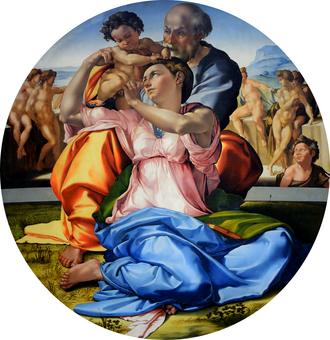 Doni Tondo - Michelangelo (1500s)
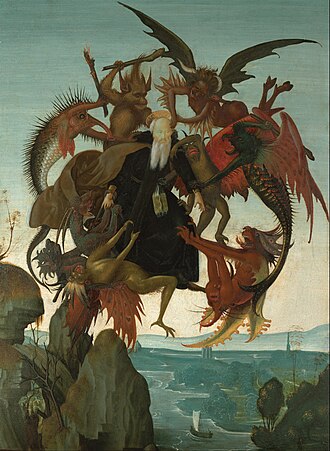 The Torment of Saint Anthony - Michelangelo (1487)
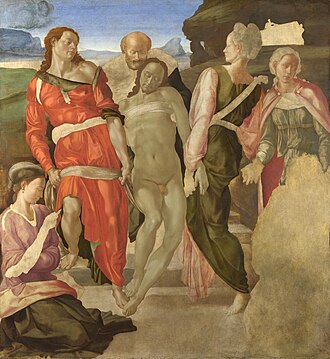 The Entombment - Michelangelo (1500s)
 Manchester Madonna - Michelangelo (1494)
 Leda and the Swan - Michelangelo (1530)
 The Deluge - Michelangelo (1508)
 The Sacrifice of Noah - Michelangelo (1508)
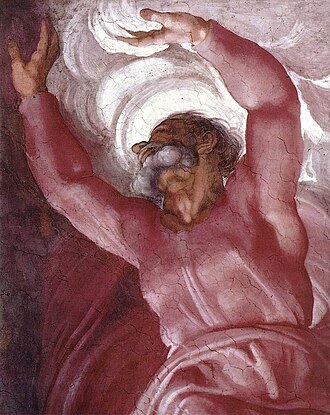 Separation of Light from Darkness - Michelangelo (1512)
Dipinti di artisti collegati
 Sistine Madonna - Raphael (1510s)
 La fornarina - Raphael
 Venus of Urbino - Titian (1538)
 Assumption of the Virgin - Titian (1510s)
 Mona Lisa - Leonardo da Vinci (1503-1519)
 Lady with an Ermine - Leonardo da Vinci (1490)
 Self-Portrait with Fur-Trimmed Robe - Albrecht Dürer (1500)
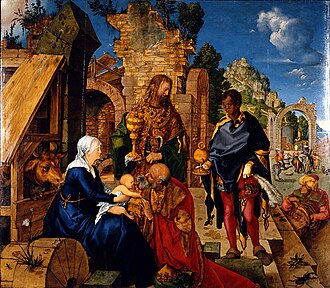 Adoration of the Magi - Albrecht Dürer (1504)
 The Birth of Venus - Sandro Botticelli (c. 1485)
 Primavera - Sandro Botticelli (1480s)
 The Garden of Earthly Delights - Hieronymus Bosch
 Ship of Fools - Hieronymus Bosch (1500s)