A Bacchanalian Revel Before a Term
Nicolas Poussin · 1630s
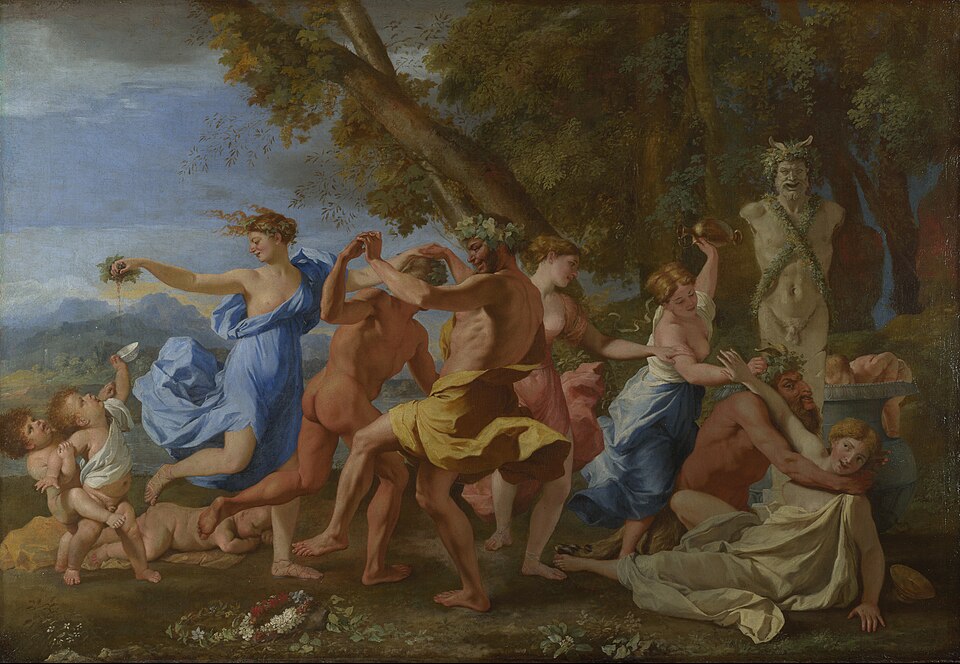
Nymphs and fauns dance in a ring while grape juice drips onto squabbling children, and beside a flower-decked statue a scuffle breaks out. Poussin, so often solemn, here allowed himself to laugh.
The story behind the painting
Poussin painted this bacchanal in the early 1630s. Wikipedia dates it 1632 to 1633, while Wikidata gives the 1630s. It shows the revels of the followers of Bacchus, the god of wine, around a term: a pillar topped by the bust of a woodland god, here adorned with flowers. Nymphs, fauns, a satyr and small bacchanalian children fill a clearing at the edge of a grove, about 98 by 143 cm of dancing, squabbling and sleep.
What to look for
At the centre, two nymphs and two fauns dance joyously in a ring. One nymph squeezes grape juice from her hand onto two boys struggling to catch it, while a third child, overcome, sleeps nearby. On the other side, before the flower-adorned term, a satyr tries to embrace a nymph who has fallen. Her companion grabs him by the horn and is about to strike him with an empty golden vase, held back by the fallen nymph and one of the dancers. A thick grove closes one side, and a rocky landscape in fine evening light opens the other.
Meaning and intent
The four dancers have been read as an emblem of the four seasons, turning in their round as the year turns. Writers have seen the picture very differently. In 1837 John Smith called it a chef d'oeuvre, a highly classic and poetical exposition of the mystic rites of the woodland god. Christopher Wright in 1985 instead considered it one of Poussin's few attempts at the genuinely humorous: the drunken child, the satyr grabbed by the horn, the raised golden vase.
Legacy
The painting passed through French collections in the 18th century: M. Randon de Boisset in 1777 and the Count de Vaudreuil in 1786. It reached London with Calonne in 1795, then belonged to Richard Walker and Lord Kinnaird. In 1826 Thomas Hamlet sold it to the National Gallery together with Titian's Bacchus and Ariadne and Christ appearing to Saint Peter by Carracci. It remains in the National Gallery in London.
Lo sapevi?
- Dated 1632-1633 by Wikipedia.
- About 98 x 143 cm.
- Entered the National Gallery in 1826 with Titian's Bacchus and Ariadne.
L'artista
Nicolas Poussin (1594-1665)
mythological painting · National Gallery
Altre opere di Nicolas Poussin
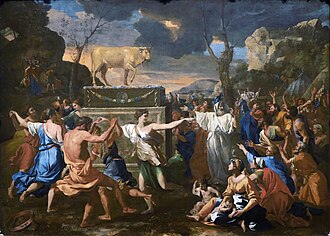 The Adoration of the Golden Calf - Nicolas Poussin (1634)
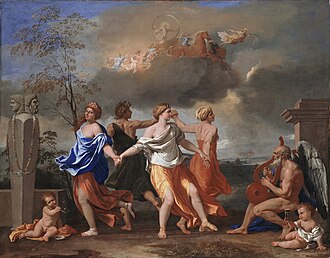 A Dance to the Music of Time - Nicolas Poussin (1630s)
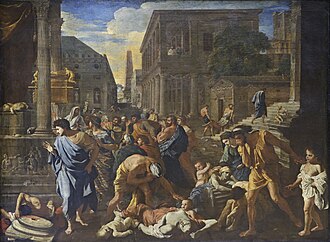 The Plague at Ashdod - Nicolas Poussin (1630)
.jpg) The Judgment of Solomon - Nicolas Poussin (1649)
The Judgment of Solomon - Nicolas Poussin (1649)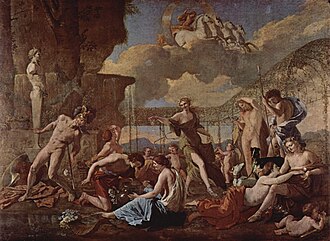 The Empire of Flora - Nicolas Poussin (1631)
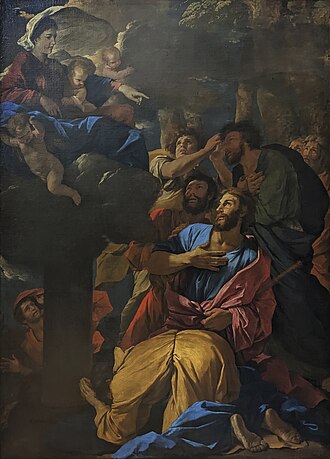 The Apparition of the Virgin to Saint James the Great - Nicolas Poussin (1620s)
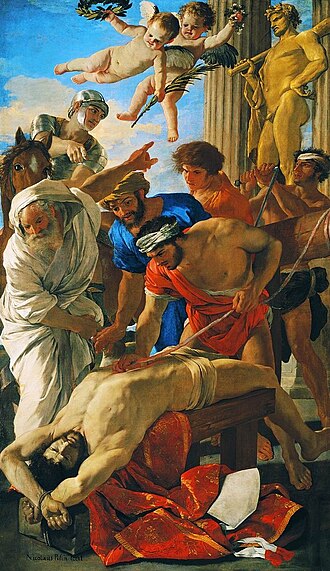 The Martyrdom of Saint Erasmus - Nicolas Poussin (1628)
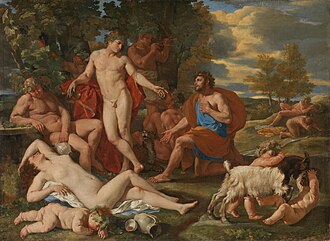 Midas and Bacchus - Nicolas Poussin (1630)