Albrecht Dürer
1471-1528
Albrecht Dürer, a goldsmith's son from Nuremberg, drew himself at thirteen and never stopped looking closely. His woodcuts and engravings carried his name across Europe while he was still in his twenties, and he became one of the great figures of the Northern Renaissance.
Origins
Dürer was born in Nuremberg on 21 May 1471, the third child and second son of Albrecht Dürer the Elder, a successful goldsmith who had come from Ajtós near Gyula in Hungary, and Barbara Holper, his master's daughter. The couple had eighteen children, and only three survived. The family name itself carries that Hungarian root: ajtó means door, the name began as Türer, or doormaker, and a door appears on the family coat of arms. Albrecht learned goldsmithing and drawing from his father, but his talent for drawing was so striking that at fifteen, in 1486, he was allowed to become an apprentice of Michael Wolgemut, the leading artist in Nuremberg. A silverpoint self-portrait dated 1484, made, as he later wrote, when he was a child, is one of the earliest surviving children's drawings of any kind. His godfather Anton Koberger became the most successful publisher in Germany.
Life and turning points
After his apprenticeship Dürer set out in 1490 on his Wanderjahre, the years of travel German apprentices took to learn from other masters. He hoped perhaps to work with the great engraver Martin Schongauer, but Schongauer died shortly before Dürer reached Colmar in 1492; his brothers welcomed the young man instead. On 7 July 1494, soon after returning home, Dürer married Agnes Frey in a match arranged while he was away. Within three months he left alone for Venice, sketching the Alps in watercolour on the way. Back in Nuremberg in 1495 he opened his own workshop. A second Italian journey from 1505 to 1507 brought the commission for the Feast of the Rosary for the German community in Venice. Returning by mid-1507, he stayed in Germany until 1520, and from 1512 Emperor Maximilian I was his patron. He died on 6 April 1528.
Style and technique
Dürer's fame rested above all on prints, which were easy to carry and made him known in the main artistic centres of Europe within a few years. His woodcuts were larger, more finely cut and more balanced than most German woodcuts before them, though it is now thought unlikely that he cut the blocks himself; he drew his designs onto the wood for specialist cutters. With the burin, a skill he probably first learned in his father's goldsmith shop, he widened the tonal range of engraving, as in the textured flesh of Adam and Eve (1504), the only engraving signed with his full name. Meetings with Italian artists and the Venetian Jacopo de' Barbari turned him toward perspective, anatomy and human proportion, a lifelong study. He also painted watercolours of nature with patient care, such as the Young Hare (1502) and the Great Piece of Turf (1503).
Stories and anecdotes
Dürer wrote that Giovanni Bellini was the oldest and still the best of the artists in Venice. When de' Barbari seemed unwilling to explain all he knew about proportion, Dürer simply began his own studies, which occupied him for the rest of his life. In the Feast of the Rosary he painted Pope Julius II and Emperor Maximilian I kneeling with their crowns removed, and placed himself at the upper right holding a note of his authorship. The famous Praying Hands, from around 1508, began as a study for an apostle in the Heller altarpiece. Not every story is gentle: his marriage was believed not to be a happy one, and in a letter to his friend Willibald Pirckheimer he called Agnes an old crow. Complaining that painting earned too little for the time it took compared with prints, he produced no paintings from 1513 to 1516.
Legacy
Dürer brought classical motifs and the nude into Northern art, drawing on what he learned from Italian artists and German humanists, and this has secured his place among the most important figures of the Northern Renaissance. His woodcut series, though more Gothic in style than the rest of his work, transformed what the medium could do, and his engravings showed how much light and shade a burin could hold. In 1513 and 1514 he made his three most famous engravings, among them Knight, Death and the Devil. His theoretical treatises on linear perspective and body proportion, grounded in mathematics, extended his influence beyond the workshop. Because he left autobiographical writings and was widely known by his mid-twenties, his life is unusually well documented, and his early self-portrait, often called his Opus One, links his whole body of work to his own searching gaze.
Lo sapevi?
- The name Dürer comes from a Hungarian word meaning doormaker, and a door appears on the family coat of arms.
- His 1484 silverpoint self-portrait is one of the earliest surviving children's drawings of any kind.
- Adam and Eve (1504) is the only existing engraving signed with his full name.
- The Praying Hands began as a study for an apostle in the Heller altarpiece.
German Renaissance · High Renaissance
Artisti collegati
Dipinti di Albrecht Dürer
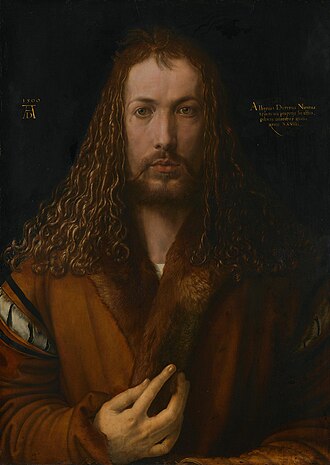 Self-Portrait with Fur-Trimmed Robe - Albrecht Dürer (1500)
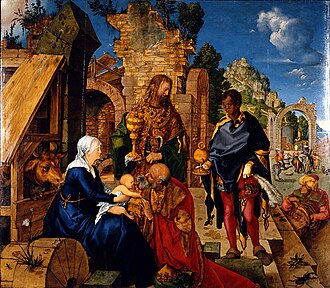 Adoration of the Magi - Albrecht Dürer (1504)
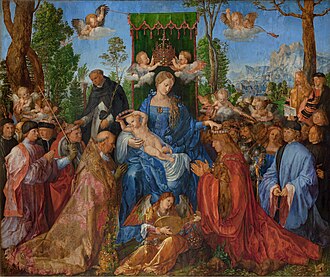 Feast of the Rosary - Albrecht Dürer (1506)
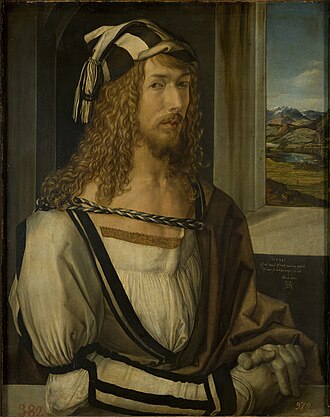 Self-Portrait - Albrecht Dürer (1498)
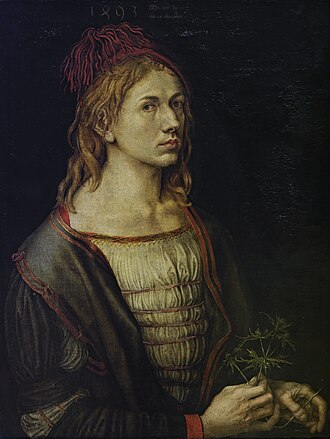 Portrait of the Artist Holding a Thistle - Albrecht Dürer (1493)
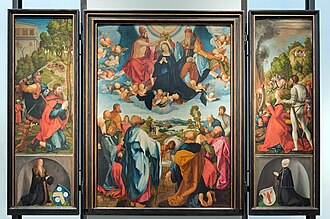 Heller Altarpiece - Albrecht Dürer (1500s)
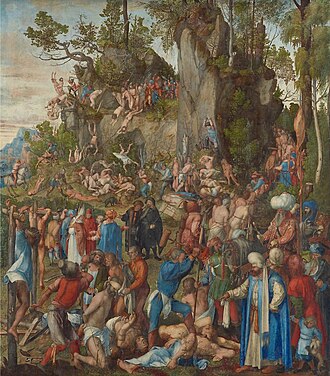 Martyrdom of the Ten Thousand - Albrecht Dürer (1508)
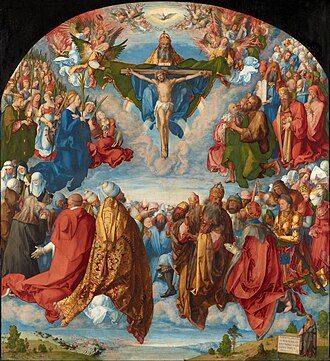 Adoration of the Trinity - Albrecht Dürer (1511)
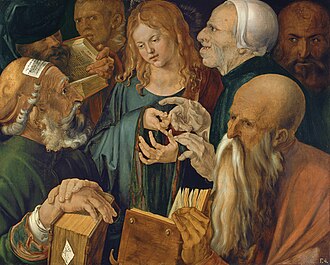 Christ Among the Doctors - Albrecht Dürer (1506)
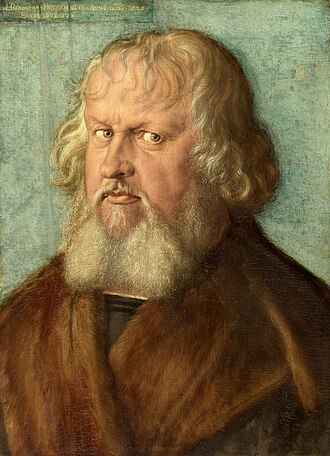 Portrait of Hieronymus Holzschuher - Albrecht Dürer (1526)
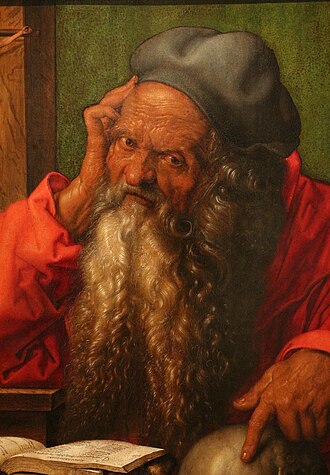 Saint Jerome in His Study - Albrecht Dürer (1521)
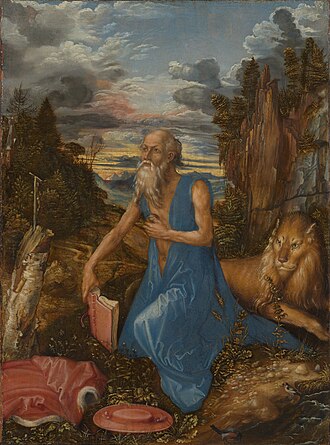 St. Jerome in the Wilderness - Albrecht Dürer (1496)
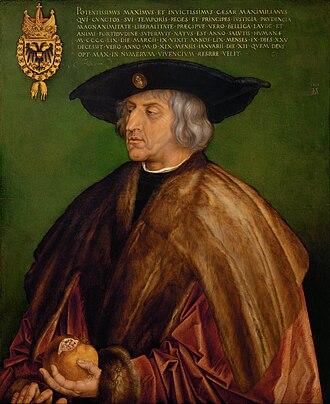 Emperor Maximilian I - Albrecht Dürer (1519)
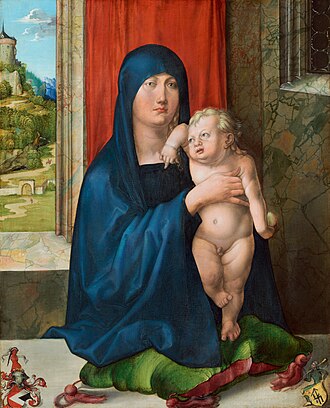 Haller Madonna - Albrecht Dürer (1490s)
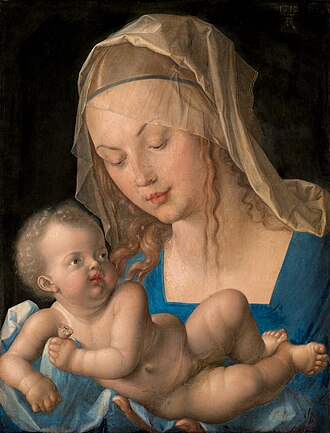 Mary and Child - Albrecht Dürer (1512)
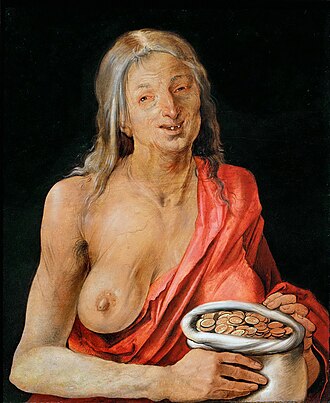 Avarice - Albrecht Dürer (1507)
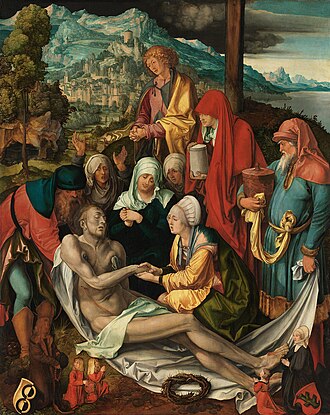 Lamentation of Christ - Albrecht Dürer (1500)
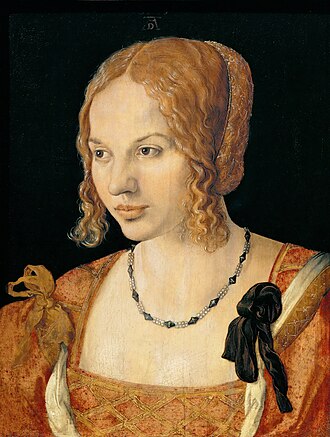 Portrait of a Venetian Woman - Albrecht Dürer (1505)
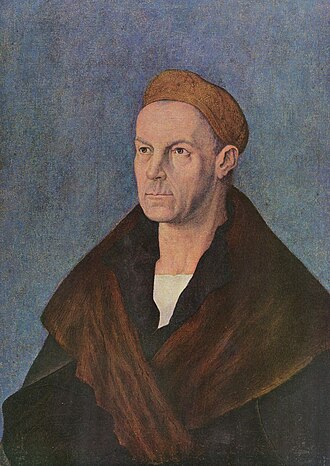 Portrait of Jakob Fugger the Rich - Albrecht Dürer (1520)
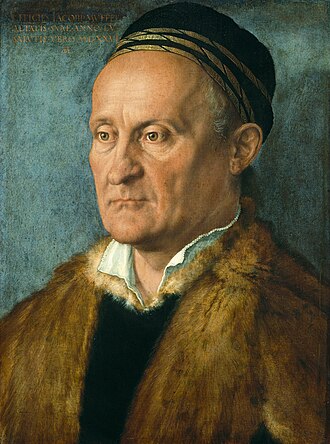 Portrait of Jakob Muffel - Albrecht Dürer (1526)
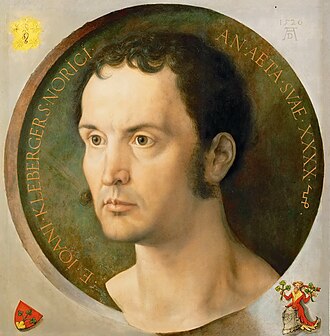 Portrait of Johann Kleberger - Albrecht Dürer (1526)
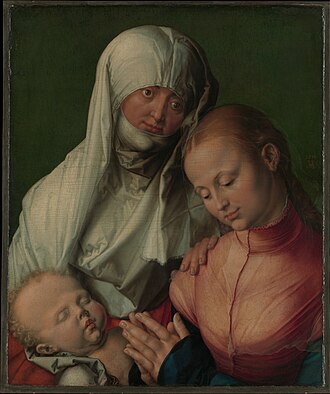 Virgin and Child with Saint Anne - Albrecht Dürer (1519)
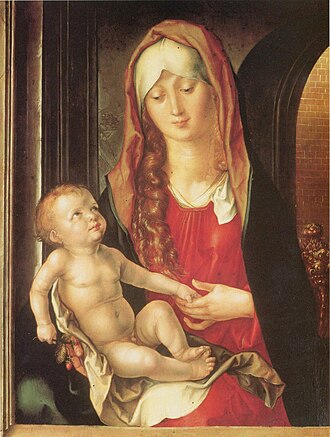 Bagnacavallo Madonna - Albrecht Dürer (1490s)
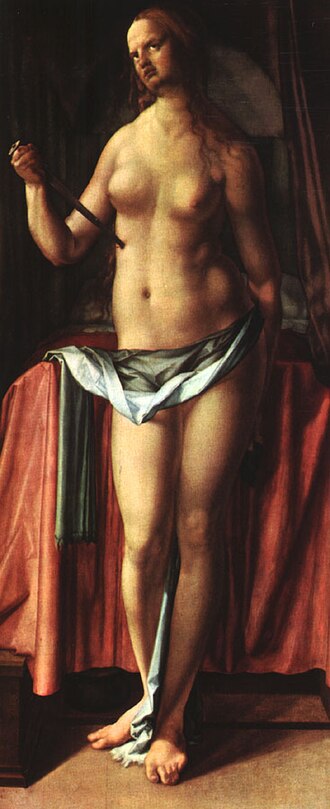 The Suicide of Lucretia - Albrecht Dürer (1518)
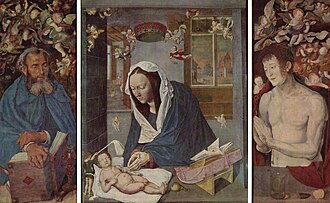 Dresden Altarpiece - Albrecht Dürer (1496)
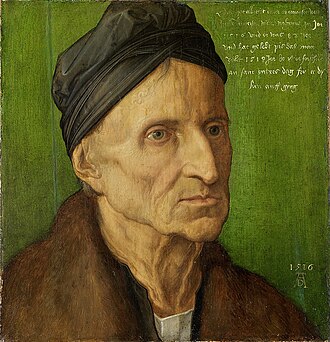 Portrait of the Nuremberg Painter Michael Wolgemut - Albrecht Dürer (1516)
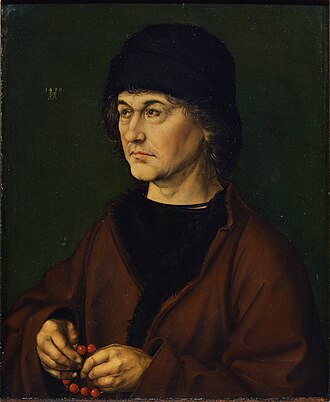 Portrait of the artist's father - Albrecht Dürer (1490)
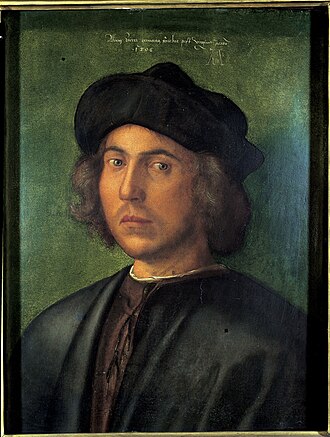 Portrait of a Young Man - Albrecht Dürer (1506)
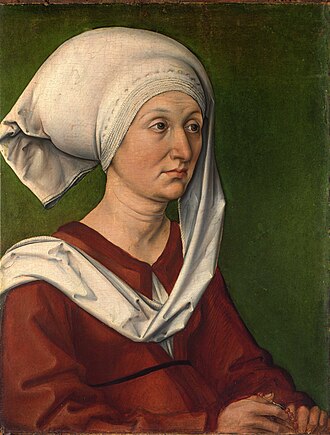 Portrait of Barbara Holper - Albrecht Dürer (1490)
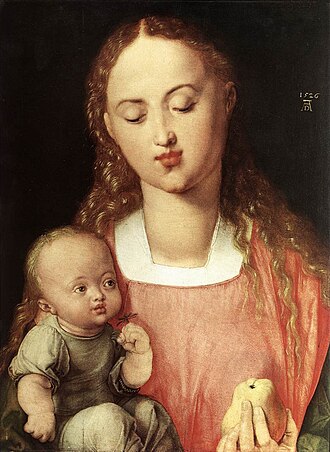 Madonna and Child - Albrecht Dürer (1526)
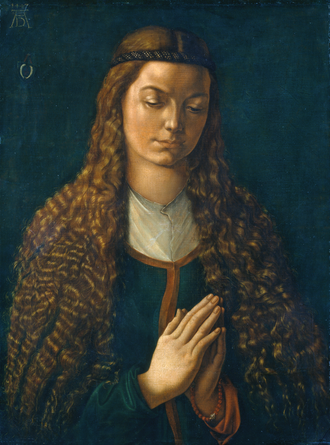 Portrait of a Young Fürleger with Loose Hair - Albrecht Dürer (1497)
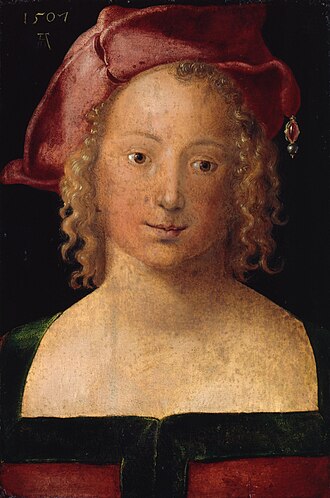 Portrait of a Young Woman with a (Red) Beret - Albrecht Dürer (1507)
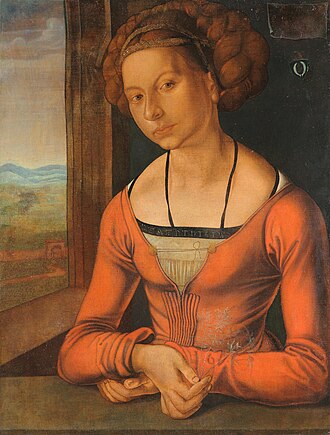 Portrait of a Young Woman with braided hair - Albrecht Dürer (1497)