The Suicide of Lucretia
Albrecht Dürer · 1518
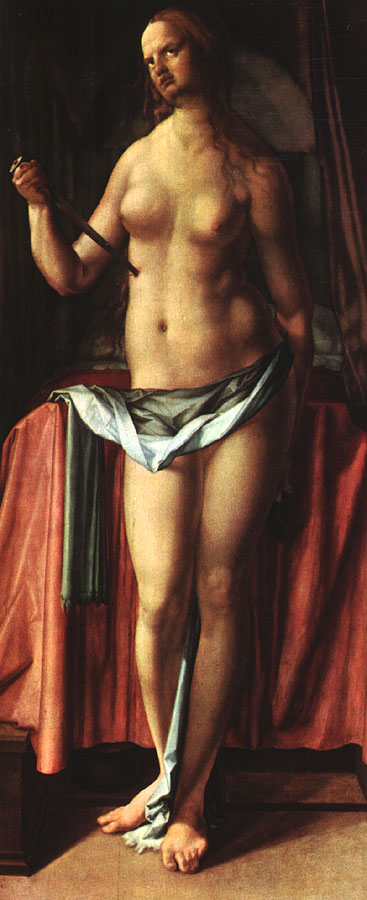
A Roman heroine stands in a cramped room, eyes raised, a sword turned on herself. Dürer's Lucretia has puzzled and divided critics for centuries, and that unease is part of what makes her hard to forget.
The story behind the painting
The Suicide of Lucretia is an oil painting on lime panel, signed and dated 1518 by Albrecht Dürer, now in the Alte Pinakothek in Munich. It shows Lucretia, the heroine of ancient Rome who died around 510 BC, wife of Lucius Tarquinius Collatinus. In the story she kills herself rather than face the shame of having been raped by her cousin Sextus Tarquinius. The panel is Dürer's second treatment of the subject. It follows a very similar drawing of 1508, made in ink with wash on paper, which is now in the Albertina in Vienna. The tall, narrow format, 168 by 74 cm, sets her almost life size.
What to look for
Lucretia stands before a cramped, harshly lit room holding the bridal bed where she was raped. She looks up as if asking the gods to witness her death. The wound is not at the centre of her belly, as in the 1508 drawing, but below her right breast, echoing Christ's lance wound. The act is bloodless, with none of the spattered sheets usual in such scenes. The brushwork of the cloths is especially fine, built from reds, blues and greens. The white drapery around her hips is a later addition from around 1600. Notice also her other arm, placed oddly behind her back.
Meaning and intent
Her face is partly idealised, yet she is mostly shown as a real woman. Her expression, nearly the same as in the drawing, is hard to read: it has none of the passivity, chastity or sly sidelong glances common in images of her at the time. She has a monumental, statue-like pose, without the pagan sensuality of Dürer's Adam and Eve of 1507 in the Prado. Art historians see it as less formal than a similar work by Lucas Cranach the Elder, more inward and concerned with facing death. Linda Hults notes a mechanical quality in the gesture, which seems to work apart from her face.
Legacy
The painting has been called one of Dürer's most unpopular works. Max Friedländer and Erwin Panofsky remarked on its austerity and awkwardness, and critics have objected to her sour expression, elongated figure and uncomfortable contrapposto. Fedja Anzelewsky described her as a parody rather than an exaltation of the classical female figure. Art historians tend not to count it among his best, and often compare it unfavourably with Cranach. Yet the image kept speaking to artists: between 1959 and 1960 Alberto Giacometti made a ballpoint pen sketch after Dürer's Lucretia, a modern sculptor drawn to this strange, stiff and solitary figure.
Lo sapevi?
- Oil on lime panel, signed and dated 1518.
- Follows a similar 1508 drawing now in the Albertina, Vienna.
- The white drapery around her hips was added around 1600.
- Alberto Giacometti sketched it in 1959-1960.
L'artista
Albrecht Dürer (1471-1528)
woman · nude · waist-length hair · nudity · history painting · German Renaissance · Bavarian State Painting Collections · breast · navel · Lucretia · contrapposto
Altre opere di Albrecht Dürer
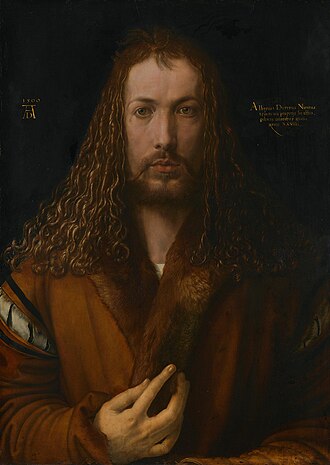 Self-Portrait with Fur-Trimmed Robe - Albrecht Dürer (1500)
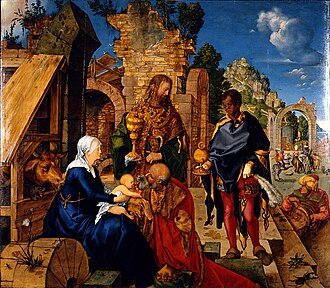 Adoration of the Magi - Albrecht Dürer (1504)
.jpg) Feast of the Rosary - Albrecht Dürer (1506)
Feast of the Rosary - Albrecht Dürer (1506)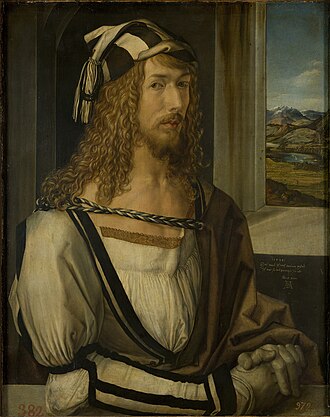 Self-Portrait - Albrecht Dürer (1498)
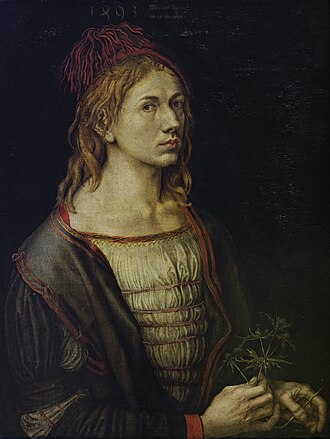 Portrait of the Artist Holding a Thistle - Albrecht Dürer (1493)
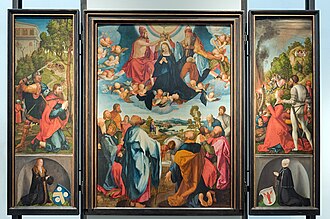 Heller Altarpiece - Albrecht Dürer (1500s)
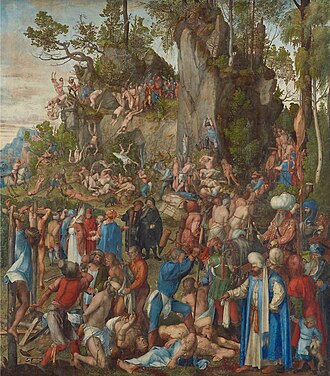 Martyrdom of the Ten Thousand - Albrecht Dürer (1508)
%20-%20Google%20Art%20Project.jpg) Adoration of the Trinity - Albrecht Dürer (1511)
Adoration of the Trinity - Albrecht Dürer (1511)