Jeunes Spartiates à l'entraînement
Edgar Degas · 1860
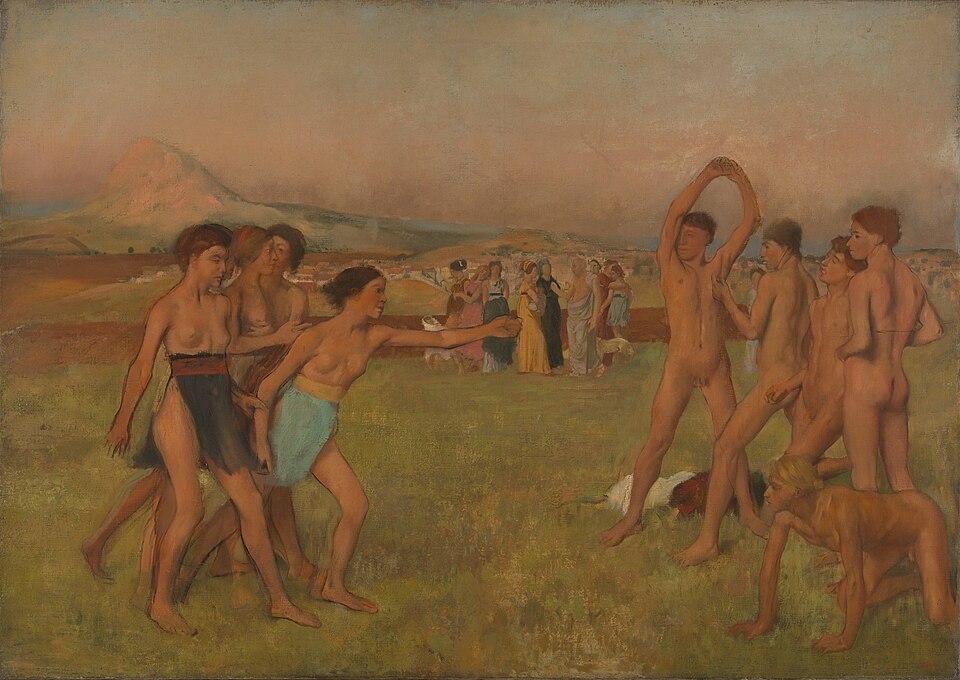
Spartan girls lean forward to taunt a line of naked boys while their mothers watch. Degas began this ancient scene in 1860 and kept changing it for years. It was still unfinished when he died.
The story behind the painting
Degas began Young Spartans Exercising in 1860, one of his early oil paintings, and returned to rework it over the following years, but left it unfinished at his death. X-rays in the early twenty-first century showed that he moved the youths, changed their faces and even their number. In 1879 the critic Diego Martelli called it one of the most classicising paintings imaginable. After that remark Degas went back and removed the classical architecture. A second full-scale, much less finished version is in the Art Institute of Chicago.
What to look for
Five girls stand on the left, one almost hidden, and five boys on the right, the girls apparently taunting or beckoning. Behind them a group of women and one man, identified as the mothers and the lawgiver Lycurgus, watch. The women are clothed, the girls and the man are topless, the boys fully nude. Beyond rises Sparta, dominated by Mount Taygetus, from which unfit children were supposedly thrown. The repainting left a strange trace: the four women in the foreground have ten legs among them. The canvas is about 110 by 155 cm.
Meaning and intent
Critics often note how Degas changed the young faces from the classical Greek ideal to a modern urban look. André Lemoisne first remarked that they resembled the street kids of Montmartre. Carol Salus argued in 1985 that the scene shows Spartan courtship rites rather than a challenge to wrestle or race. Linda Nochlin replied that it can hold many meanings, pointing to Degas's reluctance to explain it. Curator Christopher Riopelle said it starts as a traditional history painting based on classical research and ends as something much more enigmatic.
Legacy
The Chicago version shows how far the idea travelled: it has a more detailed landscape, a large building around which the background figures rest, and an extra boy on the right. The London canvas was bought by the trustees of the Courtauld fund in 1924 for the National Gallery, where as of February 2025 it hangs in Room 41. It is also known as Young Spartans and as Young Spartan Girls Challenging Boys, titles that already hint at the debate about what the girls are really doing.
Le saviez-vous ?
- Begun in 1860 and reworked for years, never finished.
- X-rays show Degas changed the figures and their number.
- A second version is in the Art Institute of Chicago.
- In the National Gallery, London, since 1924.
À propos de l'artiste
Edgar Degas (1834-1917)
National Gallery · garçon · nudité · peinture d'histoire · fille · lutte
Autres œuvres de Edgar Degas
 L'Absinthe - Edgar Degas (1875)
 La Famille Bellelli - Edgar Degas (1858)
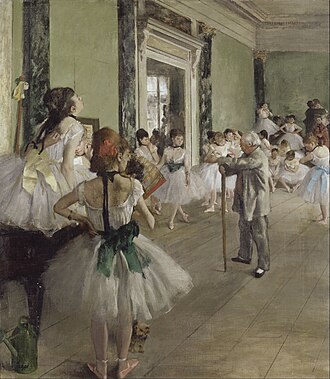 La Classe de danse - Edgar Degas (1871)
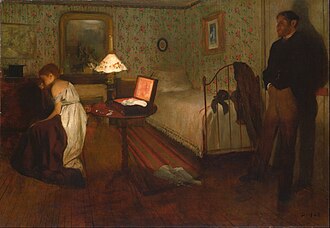 Intérieur - Edgar Degas (1868)
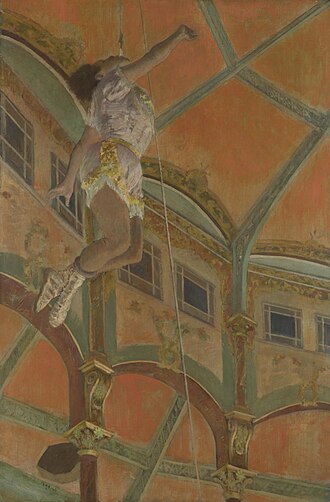 Mademoiselle La La au cirque Fernando - Edgar Degas (1879)
 Chez la modiste - Edgar Degas
 Le Tub - Edgar Degas (1886)
 Le Bureau de coton à La Nouvelle-Orléans - Edgar Degas (1873)
Œuvres d'artistes liés
 Impression, soleil levant - Claude Monet (1872)
 Nymphéas - Claude Monet (1906)
 Le Déjeuner sur l'herbe - Édouard Manet (1863)
 Olympia - Édouard Manet (1863)
 Bal du moulin de la Galette - Pierre-Auguste Renoir (1876)
 Le Déjeuner des canotiers - Pierre-Auguste Renoir (1881)
 Le Berceau - Berthe Morisot (1872)
 Jour d'été - Berthe Morisot (1879)
 Le Canal du Loing - Alfred Sisley (1892)
 L'Abreuvoir à Marly-Le-Roi, gelée blanche - Alfred Sisley (1876)
 Rue de Paris, temps de pluie - Gustave Caillebotte (1877)
 Les Raboteurs de parquet - Gustave Caillebotte (1875)