Champ de blé à l'alouette
Vincent van Gogh · 1887
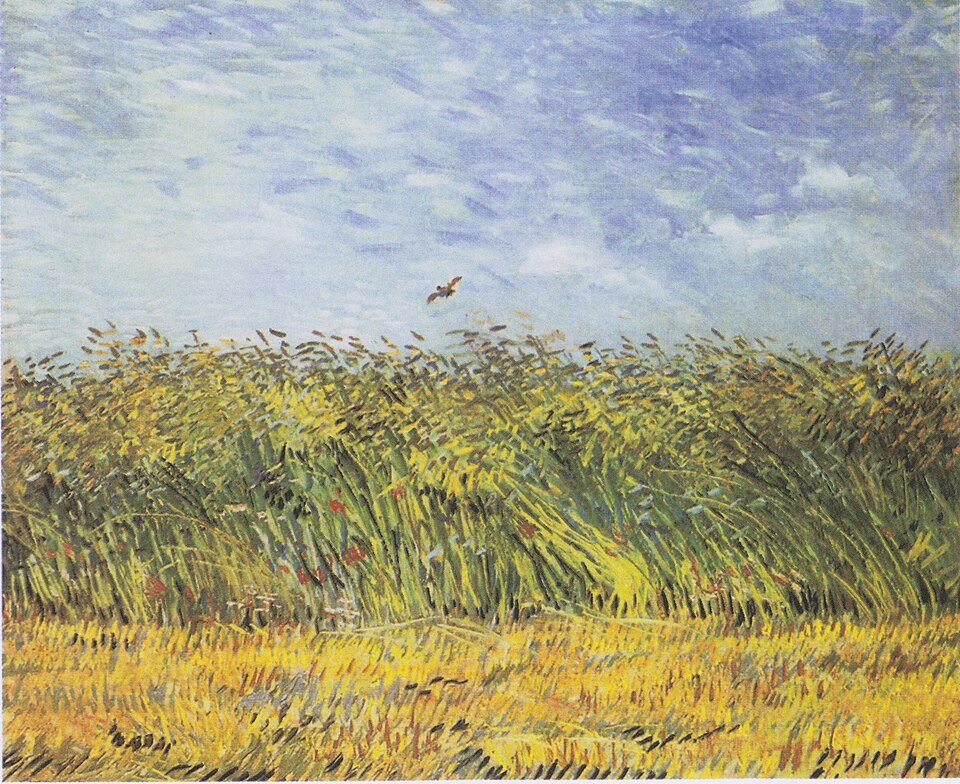
Half the canvas is ripe wheat, half is open sky, and between them a single small bird bursts into flight. Is it a lark or a partridge? Even the museum that owns it gives a different answer from the familiar title.
The story behind the painting
Vincent van Gogh painted this canvas in 1887, while he was living in Paris. The sources say very little about the circumstances of this particular painting, so it is fairest to admit that and turn to what is documented about his life then. He had moved to Paris in March 1886 to share an apartment in Montmartre with his brother Theo, an art dealer. The two years he spent there were the most prolific of his life, with around 230 paintings, and they transformed his art. Surrounded by young painters experimenting with new styles, he left behind the dark, earthy colours of his Dutch years and began working with brighter, contrasting colour and looser brushwork. Wheat Field with a Lark, about 54 by 65 centimetres, belongs to that year of change.
What to look for
The composition divides into two broad halves. The lower half shows a field of wheat that has been partially harvested, so part of it still stands while part has already been cut. Above stretches a sky patterned with light clouds. Now look into the wheat itself: poppies and cornflowers wave in the wind alongside the crop, small notes of colour scattered through the field. Finally, find the bird. Toward the upper left of the canvas it is taking flight, a tiny dark shape lifting away from the field into the open air. The whole scene is simple, almost bare, which is exactly why that small upward movement catches the eye. Let your gaze move from the cut stubble, up through the standing grain, to the bird and the sky.
Meaning and intent
Van Gogh left no comment on this painting in the sources used here, so its meaning has to be read gently from what we can see and from his situation. The canvas is about growth and harvest, wind and movement: a field caught partway through being cut, flowers bending, a bird rising. In 1887 he was absorbing the Impressionist idea of painting light and open air, and a field under a bright, cloud-flecked sky was an ideal subject for it. There is also a small puzzle at the heart of the work. The popular English title names the bird a lark, but the Van Gogh Museum calls the painting Korenveld met patrijs, Wheat field with partridge. The sources do not settle which bird Van Gogh intended, and that uncertainty is part of its charm.
Legacy
The painting is housed in the Van Gogh Museum in Amsterdam, where it hangs under its Dutch title, Wheat field with partridge. For many viewers it is a quiet surprise among Van Gogh's better-known works: a field of grain painted not in Provence but during his Paris period, well before the famous wheat fields of his final years. That makes it an interesting forerunner. Wheat would become one of his most enduring subjects, and here we see an early, light-filled version of it, made while his palette was brightening under the influence of Paris. The work rewards slow looking. Its power lies not in drama but in openness: wind passing through a field, a flash of red and blue among the stalks, and a bird that has just decided to fly.
Le saviez-vous ?
- The Van Gogh Museum calls it Korenveld met patrijs, meaning Wheat field with partridge, not lark.
- It was painted in 1887, during Van Gogh's two years in Paris.
- Poppies and cornflowers grow among the partially harvested wheat.
- The canvas measures about 53.7 by 65.2 centimetres.
Wikipedia · Wikipedia · Wikidata
À propos de l'artiste
Vincent van Gogh (1853-1890)
Autres œuvres de Vincent van Gogh
 La Nuit étoilée - Vincent van Gogh (1889)
.jpg) Terrasse du café le soir - Vincent van Gogh (1888)
Terrasse du café le soir - Vincent van Gogh (1888)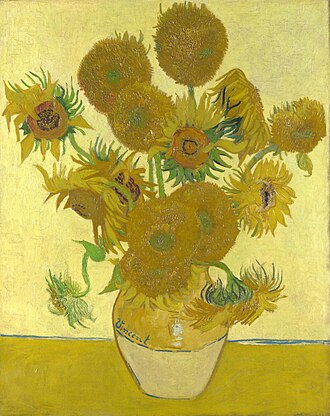 Les Tournesols - Vincent van Gogh (1888)
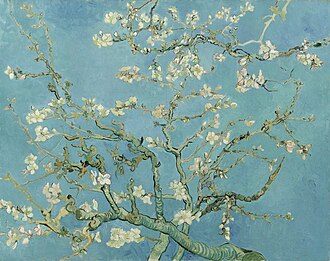 Amandier en fleurs - Vincent van Gogh (1890)
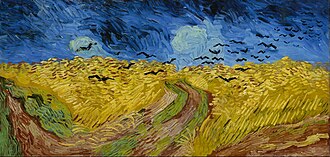 Champ de blé aux corbeaux - Vincent van Gogh (1890)
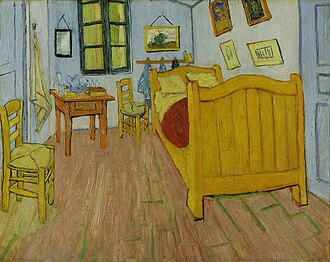 La Chambre à coucher - Vincent van Gogh (1888)
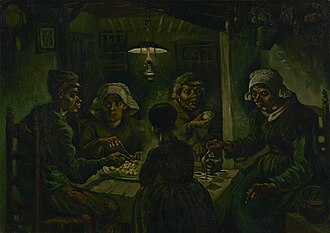 Les Mangeurs de pommes de terre - Vincent van Gogh (1885)
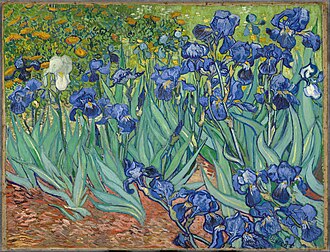 Iris - Vincent van Gogh (1889)
Œuvres d'artistes liés
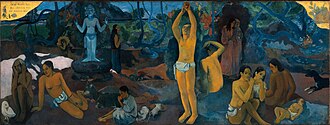 D'où venons-nous ? Que sommes-nous ? Où allons-nous ? - Paul Gauguin (1897-1898)
%201889.jpg) Le Christ jaune - Paul Gauguin (1889)
Le Christ jaune - Paul Gauguin (1889) Le Déjeuner sur l'herbe - Édouard Manet (1863)
 Olympia - Édouard Manet (1863)