Guerre. L'Exilé et l'Arapède
J. M. W. Turner · 1842
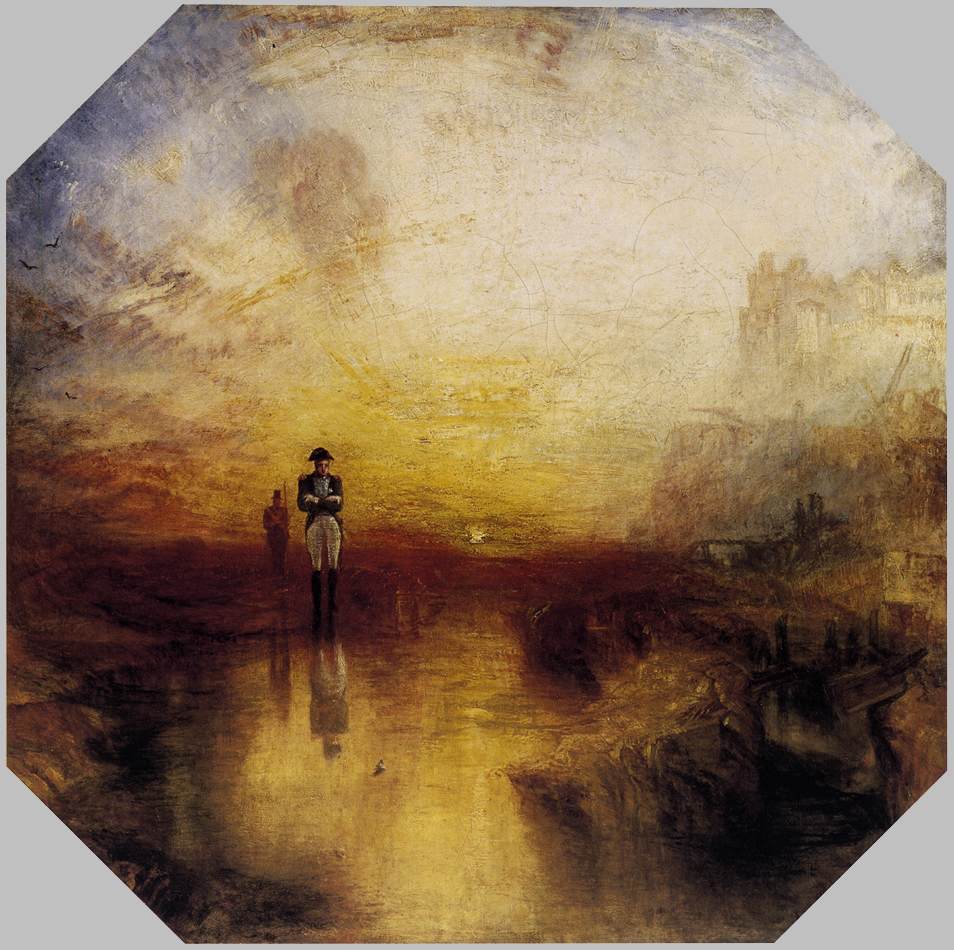
A lonely Napoleon, guarded on Saint Helena, bends to look at a tiny rock limpet under a blood-red sky. Turner called that sunset a sea of blood.
The story behind the painting
After his defeat at Waterloo in June 1815, Napoleon Bonaparte fell into British custody and in December was exiled to Saint Helena in the South Atlantic, housed under guard at Longwood House despite its poor condition. With no real hope of escape, he lived there until his death in 1821, falling into despair in his final years. Turner was often inspired by conflicts of the Napoleonic era. In 1840 Napoleon's ashes were returned to France for a state burial at the request of Louis Philippe I, and this inspired Turner to make the former Emperor the subject of this painting of 1842.
What to look for
The painting shows a moment of Napoleon's exile on the island. A British sentry stands by, a constant reminder of his captivity, while Napoleon bows slightly to study a single rock limpet on the shore. Behind him the sunset burns; Turner himself described it as a sea of blood. Like its companion piece, the work was painted on a small canvas, recorded on Wikidata as about 79.4 by 79.4 cm, and it was exhibited in an octagonal frame. The source also calls Turner's treatment of the scene abstract, with the figure almost swallowed by colour and light.
Meaning and intent
Turner wanted the picture to embody the futility of war. The sunset stands for the hardships of war that Napoleon's campaigns had brought. It was conceived as a companion to Peace - Burial at Sea, which commemorates Turner's friend, the Scottish painter Sir David Wilkie, who died of an illness in 1841 on a voyage home from the Far East. Together the two works contrast the heroic figure of Napoleon, now reduced to staring at a shellfish, with Wilkie's lonely burial at sea. The tiny limpet, clinging to its rock, becomes a quiet mirror of a man who once ruled a continent.
Legacy
War was first shown at the Royal Academy of Arts in 1842, beside Peace. It fared poorly with critics, who questioned Turner's decision to pair it with Peace, widely considered the better of the two. Yet Turner's abstract approach here is noted as an early stepping stone toward his more celebrated Rain, Steam and Speed - The Great Western Railway of 1844. The painting also belongs to a line of works shaped by the Napoleonic wars, alongside The Battle of Trafalgar and The Fighting Temeraire. Wikidata links the work to both the National Gallery and Tate in London.
Le saviez-vous ?
- Painted in 1842 as a companion to Peace - Burial at Sea.
- Shows Napoleon in exile on Saint Helena studying a rock limpet.
- Turner called the sunset a sea of blood.
- Seen as a step toward Rain, Steam and Speed (1844).
À propos de l'artiste
J. M. W. Turner (1775-1851)
Autres œuvres de J. M. W. Turner
 Le Dernier Voyage du Téméraire - J. M. W. Turner (1839)
 Pluie, Vapeur et Vitesse - J. M. W. Turner (1844)
 Le Négrier - J. M. W. Turner (1840)
 Didon construisant Carthage ou l'Ascension de l'Empire carthaginois - J. M. W. Turner (1815)
 La Bataille de Trafalgar - J. M. W. Turner (1820s)
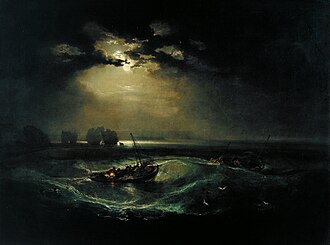 Pêcheurs en mer - J. M. W. Turner (1796)
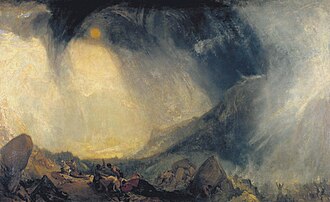 Hannibal traversant les Alpes - J. M. W. Turner (1812)
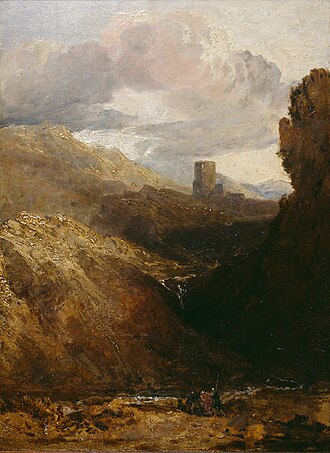 Château de Dolbadarn - J. M. W. Turner (1800)
Œuvres d'artistes liés
 The Ladies Waldegrave - Joshua Reynolds (1780)
 Capitaine George K. H. Coussmaker - Joshua Reynolds (1782)
 Impression, soleil levant - Claude Monet (1872)
 Nymphéas - Claude Monet (1906)
 Tres de Mayo - Francisco Goya (1814)
 La Maja nue - Francisco Goya (1800)
 Le Voyageur contemplant une mer de nuages - Caspar David Friedrich (c. 1818)
 L'Abbaye dans une forêt de chênes - Caspar David Friedrich (1800s)
 La Liberté guidant le peuple - Eugène Delacroix (1830)
 La Mort de Sardanapale - Eugène Delacroix (1827)
 L'Enfant bleu - Thomas Gainsborough (1770)
 Les Époux Andrews - Thomas Gainsborough (1748)