La Bataille de Trafalgar
J. M. W. Turner · 1820s
.jpg)
Smoke, shattered masts and drowning sailors swirl around HMS Victory. Turner's largest painting and his only royal commission did not show one moment of the battle, but folded several into a single, overwhelming scene.
The story behind the painting
The Battle of Trafalgar was fought on 21 October 1805 off Cape Trafalgar, between a British fleet under Horatio Nelson and a Franco-Spanish fleet. Nelson split his ships into two columns, one led by himself and the other by Cuthbert Collingwood, and won a decisive victory, though he was mortally wounded. The British public then campaigned for paintings of the battle. King George IV commissioned this one for a series in the state rooms of St James's Palace, linking his dynasty with military glory, as a companion to Loutherbourg's Glorious First of June. Wikipedia dates the painting 1822, while Wikidata gives the 1820s. It was Turner's only royal commission.
What to look for
This is Turner's largest work. Wikipedia gives it as 2,615 by 3,685 mm, while Wikidata lists about 259 by 366 cm. HMS Victory, Nelson's flagship, dominates the scene, a sign of how central Nelson and his tactics were to the story. Look up at the signal flags on the masts: they spell out part of the famous message, England expects that every man will do his duty. Below, smoke and clouds build up, and people struggle in the water in the foreground. The ships, rigging and uniforms were carefully studied, yet in places space dissolves into strokes of pure paint, and human and natural forces seem to mirror one another.
Meaning and intent
Turner treated a recent event as a history painting, the genre normally reserved for scenes from the Bible, myth or ancient history and regarded as the highest form of art. To do so he combined several moments from the battle, spread over several days, into a single scene. The pyramid-shaped composition speaks of triumph and sacrifice. The aim was something general, philosophical and national: an image affirming Britain as a great maritime power. Yet although it was a commission, Turner moved away from conventional naval painting towards his own style, with ambiguity and a sense of the sublime, a sign of how personally invested he was in Trafalgar.
Legacy
Turner had made sketches soon after the battle, with careful studies of ships, rigging and uniforms. The best known early work, The Battle of Trafalgar, as Seen from the Mizen Starboard Shrouds of the Victory, was well received and laid the foundation for this picture. For the commission he then made two oil sketches: the first followed traditional marine painting, the second moved towards the organised chaos of the finished canvas. Shortly after its installation at St James's Palace, the painting was given to Greenwich Hospital. Today it hangs in the National Maritime Museum in Greenwich, London, part of Royal Museums Greenwich.
Le saviez-vous ?
- Commissioned by King George IV; Turner's only royal commission.
- Wikipedia dates it 1822; Wikidata gives the 1820s.
- Turner's largest painting, combining several moments of the battle.
- Now in the National Maritime Museum, Greenwich.
À propos de l'artiste
J. M. W. Turner (1775-1851)
Autres œuvres de J. M. W. Turner
 Le Dernier Voyage du Téméraire - J. M. W. Turner (1839)
 Pluie, Vapeur et Vitesse - J. M. W. Turner (1844)
 Le Négrier - J. M. W. Turner (1840)
 Didon construisant Carthage ou l'Ascension de l'Empire carthaginois - J. M. W. Turner (1815)
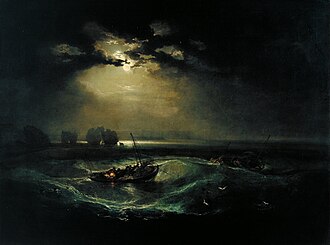 Pêcheurs en mer - J. M. W. Turner (1796)
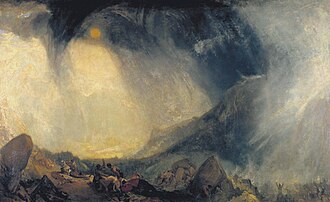 Hannibal traversant les Alpes - J. M. W. Turner (1812)
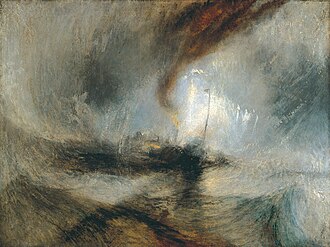 Tempête de neige - Bateau à vapeur au large de l'embouchure d'un port - J. M. W. Turner (1842)
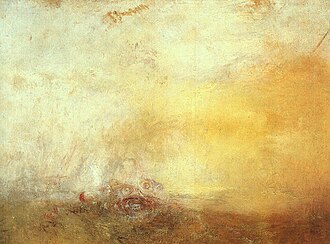 Lever de soleil avec monstres marins - J. M. W. Turner (1845)
Œuvres d'artistes liés
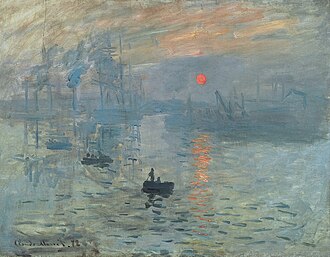 Impression, soleil levant - Claude Monet (1872)
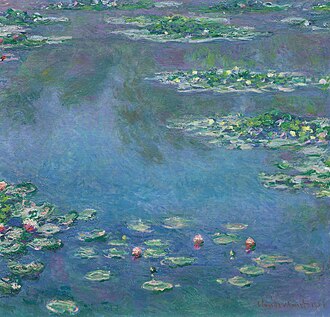 Nymphéas - Claude Monet (1906)
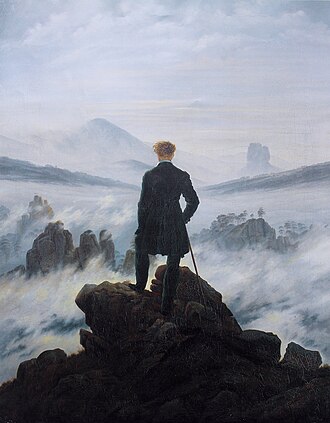 Le Voyageur contemplant une mer de nuages - Caspar David Friedrich (c. 1818)
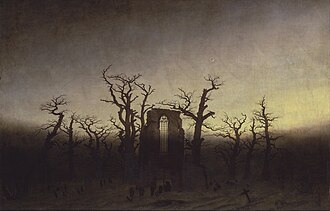 L'Abbaye dans une forêt de chênes - Caspar David Friedrich (1800s)
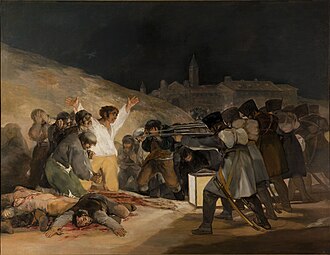 Tres de Mayo - Francisco Goya (1814)
.jpg) La Maja nue - Francisco Goya (1800)
La Maja nue - Francisco Goya (1800)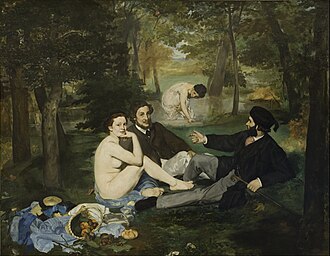 Le Déjeuner sur l'herbe - Édouard Manet (1863)
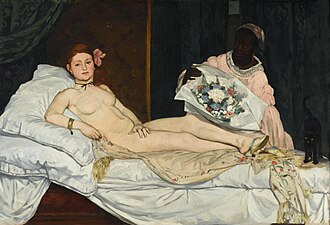 Olympia - Édouard Manet (1863)