Vase de pavots
Vincent van Gogh · 1886
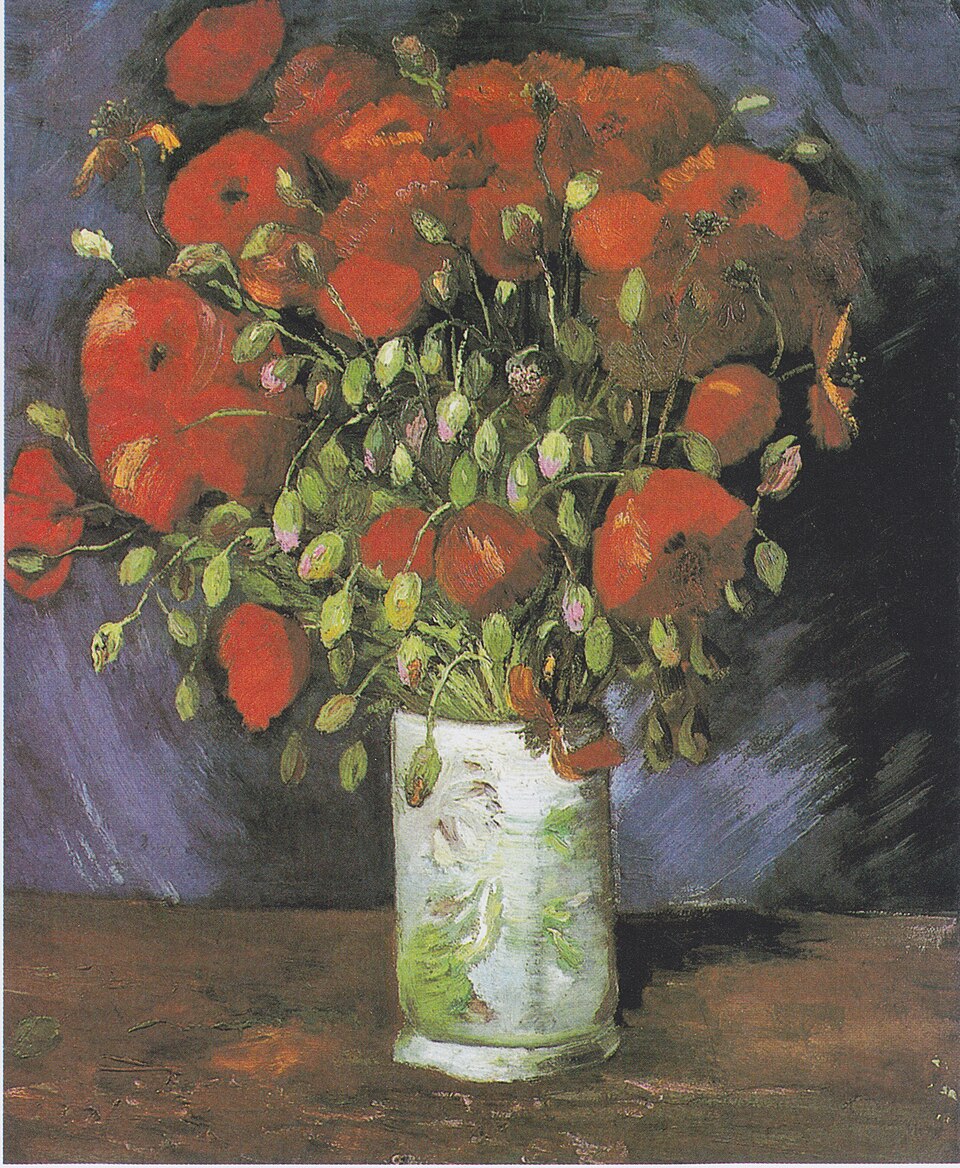
Red poppies in a vase, painted by Van Gogh in his first Paris year, 1886. For a time experts doubted it was his, until an X-ray revealed a man's portrait hidden underneath.
The story behind the painting
Van Gogh painted Vase with Poppies in Paris in 1886, the year he moved there from Antwerp. In Paris, friends and acquaintances sent him bouquets every week for his still lifes, and he also bought cheap flowers, choosing them for their range of colours. He later told his sister Wil that he had painted almost nothing but flowers that year to get used to colours other than grey. That was an exaggeration: of about 230 paintings from his Paris years, around 30 are flowers.
What to look for
Look at the red of the poppies against the vase and the background. Van Gogh named the colours he was chasing in that letter to Wil: pink, soft or bright green, light blue, violet, yellow and glorious red. The canvas, about 56 by 46.5 cm, is part of that search, flowers used as a way to train his eye and hand in colour after the darker palette he had worked with before coming to Paris.
Meaning and intent
Flowers mattered to him beyond the studio. He told his brothers Theo and Cor that looking at Japanese pictures would make you love to make bouquets and do things with flowers all the more. He advised Wil to cultivate her own garden, like Voltaire's Candide, to find joy and meaning in life. These Paris flower pieces led toward the paintings of sunflowers in vases he made in Arles in 1888 and 1889, now among his best known works.
Legacy
Anne Parrish Titzell gave the painting to the Wadsworth Atheneum in Hartford in 1957. In 1990 the art historian Walter Feilchenfeldt questioned whether it was really by Van Gogh. The museum sent it to the Van Gogh Museum in Amsterdam, which declared it genuine. An X-ray showed the outline of a man's portrait beneath the flowers, and the museum found the work consistent with other paintings Van Gogh made after moving from Antwerp that year.
Le saviez-vous ?
- Painted in Paris in 1886.
- One of about 30 flower paintings among some 230 Paris works.
- Authenticity questioned in 1990, then confirmed by the Van Gogh Museum.
- An X-ray shows a man's portrait beneath the flowers.
À propos de l'artiste
Vincent van Gogh (1853-1890)
vase · peinture de fleurs · bouquet de fleurs · coquelicot · Wadsworth Atheneum
Autres œuvres de Vincent van Gogh
 La Nuit étoilée - Vincent van Gogh (1889)
 Terrasse du café le soir - Vincent van Gogh (1888)
 Les Tournesols - Vincent van Gogh (1888)
 Amandier en fleurs - Vincent van Gogh (1890)
 Champ de blé aux corbeaux - Vincent van Gogh (1890)
 La Chambre à coucher - Vincent van Gogh (1888)
 Les Mangeurs de pommes de terre - Vincent van Gogh (1885)
 Iris - Vincent van Gogh (1889)
Œuvres d'artistes liés
 Les Grandes Baigneuses - Paul Cézanne (1900s)
 Le Garçon au gilet rouge - Paul Cézanne
 D'où venons-nous ? Que sommes-nous ? Où allons-nous ? - Paul Gauguin (1897-1898)
 Le Christ jaune - Paul Gauguin (1889)
 L'Érection de la croix - Peter Paul Rubens (1609)
 L'Enlèvement des filles de Leucippe - Peter Paul Rubens (1618)
 Promenade au bord de la mer - Joaquín Sorolla (1909)
 Triste héritage - Joaquín Sorolla (1898)
 Bal du moulin de la Galette - Pierre-Auguste Renoir (1876)
 Le Déjeuner des canotiers - Pierre-Auguste Renoir (1881)
 Au Moulin-Rouge - Henri de Toulouse-Lautrec (1892)
 La Toilette - Henri de Toulouse-Lautrec (1896)