Deux Singes
Pieter Bruegel the Elder · 1562
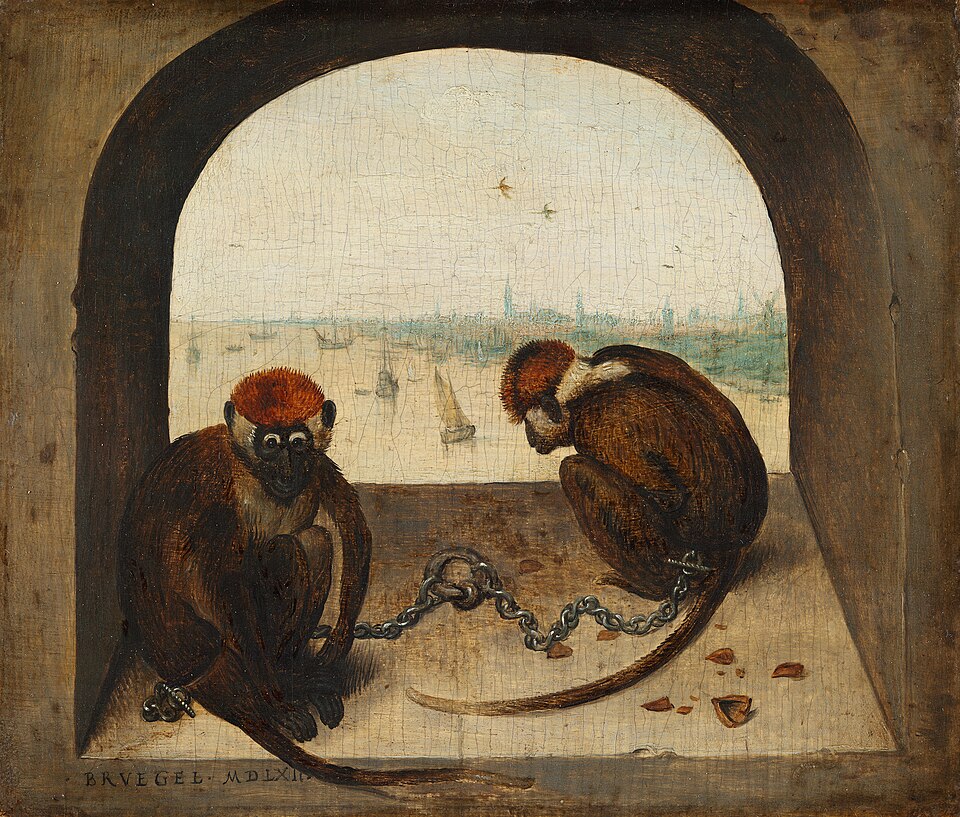
Two small monkeys sit chained to an iron ring in a window arch, their backs to the port of Antwerp. Bruegel painted them on a panel barely 20 by 23 cm, and a Nobel laureate later wrote a poem about them.
The story behind the painting
Pieter Bruegel the Elder painted Two Monkeys, also called Two Chained Monkeys, in 1562. It is one of his smallest works, about 20 by 23 cm, and belongs today to the Gemäldegalerie of the Berlin State Museums. The animals are red-capped mangabeys, African monkeys. Antwerp was a great port city, and the monkeys were probably taken from their natural habitat by animal traders and shipped there, which is where Bruegel could have seen creatures like these for himself.
What to look for
Look first at the two monkeys, shackled to a single iron ring beneath an archway, and then past them. Behind, in the background, lies the city of Antwerp, open and wide, while the animals sit locked in their stone frame. The contrast between the closed foreground and the free distance is the heart of the picture. Bruegel likely borrowed the image of two chained monkeys under an arch from Gentile da Fabriano's Adoration of the Magi.
Meaning and intent
According to the critic Kelly Grovier, Bruegel both echoed and reinvented Gentile's monkeys, using them to show the follies of men and how they chain themselves and each other. Margaret A. Sullivan of Montana State University calls the pair a small allegory of foolish sinners, imprisoned by an immoderate attitude to material wealth. She reads the left monkey as avarice and greed and the right one as prodigality, based on a fundamental resemblance she sees to Bruegel's Dull Gret, also known as Mad Meg.
Legacy
To mark the 450th anniversary of Bruegel's death, the painting was shown in Bruegel, The Hand of the Master at the Kunsthistorisches Museum in Vienna, from October 2018 to January 2019. Before that, from January to August 2017, the Gemäldegalerie studied it in depth with tree-ring dating, stereomicroscope, UV light, X-ray, infrared reflectography and X-ray fluorescence, and the restorer and copyist Bertram Lorenz was able to reconstruct the painting. The Polish poet and Nobel laureate Wisława Szymborska wrote the poem Two Monkeys by Bruegel about it.
Le saviez-vous ?
- Painted in 1562, about 20 by 23 cm.
- The monkeys are red-capped mangabeys, with Antwerp behind them.
- Read as an allegory of greed and prodigality.
- Inspired a poem by Wisława Szymborska.
À propos de l'artiste
Pieter Bruegel the Elder (1525-1569)
scène de genre · Gemäldegalerie
Autres œuvres de Pieter Bruegel the Elder
 Les Chasseurs dans la neige - Pieter Bruegel the Elder (1565)
 Les Proverbes flamands - Pieter Bruegel the Elder (1551)
 Le Triomphe de la Mort - Pieter Bruegel the Elder (1560s)
 La Parabole des aveugles - Pieter Bruegel the Elder (1568)
 Le Repas de noce - Pieter Bruegel the Elder (1560s)
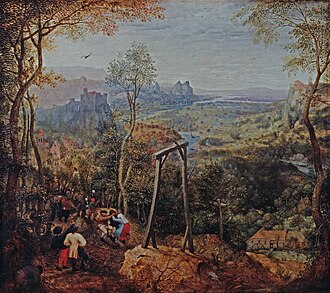 La Pie sur le Gibet - Pieter Bruegel the Elder (1568)
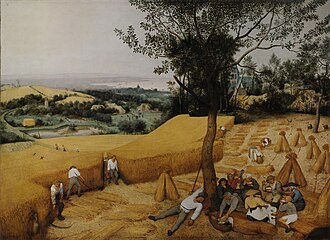 Les Moissonneurs - Pieter Bruegel the Elder (1565)
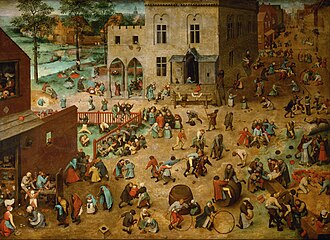 Les Jeux d’enfants - Pieter Bruegel the Elder (1560)
Œuvres d'artistes liés
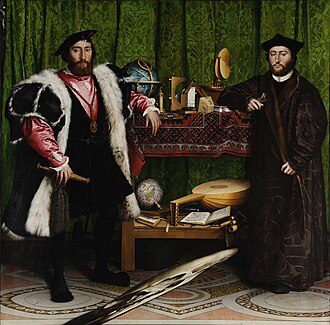 Les Ambassadeurs - Hans Holbein the Younger (1533)
 Le Christ mort - Hans Holbein the Younger (1520s)
 Le Jardin des délices - Hieronymus Bosch
 La Nef des fous - Hieronymus Bosch (1500s)
 Les Époux Arnolfini - Jan van Eyck (1434)
 L'Agneau mystique - Jan van Eyck (1432)