La Parabole des aveugles
Pieter Bruegel the Elder · 1568
%20-%20Blind%20leading%20the%20blind%20Google%20Art%20Project.jpeg)
Six men, linked by their staffs, walk toward a ditch. The first has already fallen - and you can watch, figure by figure, the fall travelling down the line.
The story behind the painting
Bruegel painted this in 1568, the year before his death. He was living in Brussels, seat of the Spanish government of the Netherlands, where he had moved after marrying Mayken, daughter of his teacher Pieter Coecke van Aelst, in 1563. In 1567 the Duke of Alba had set up the Council of Troubles, the so-called "Blood Council", which ordered mass arrests and executions to suppress Protestantism and enforce Spanish rule. The painting's bitter, sorrowful tone, shared with late works such as The Magpie on the Gallows, may be linked to those times. Whether Bruegel meant a political statement is not clear.
What to look for
Read the picture from left to right, like a sentence. Six blind men move along a path between a river and a village. The leader has fallen on his back into a ditch; we cannot see his face. The second twists as he falls. The third, in shinguards, is on his toes, knees bent, face turned to the sky, pulled down by the staff he shares. The last three have not yet stumbled. Notice how the men lift their heads, relying on hearing and smell. The palette is austere - greys, greens, brownish-reds and blacks - and in the flat Flemish landscape rises a church identified as St. Anna's in Sint-Anna-Pede. A cowherd stands in the background.
Meaning and intent
The subject comes from Matthew 15:14, where Christ says that if the blind lead the blind, both shall fall into the ditch - words aimed at the Pharisees. Bruegel's audience may also have known Horace's phrase "the blind leader of the blind", published in Erasmus's Adagia. Bruegel expands two blind men into six, dresses them well rather than as peasants, and portrays them without sympathy, unlike earlier images of the blind as recipients of divine gifts. The church behind them has prompted both pro- and anti-Catholic readings. The plunging diagonal turns a proverb into motion: the error of one becomes the fate of all.
Legacy
The painting is one of four surviving Bruegel works in distemper on linen, a fragile technique, yet it remains in good condition, the linen grain still visible beneath the brushstrokes. It is signed and dated BRVEGEL.M.D.LX.VIII and hangs in the Museo di Capodimonte in Naples. Its realism was so precise that physicians later diagnosed the men's conditions: Jean-Martin Charcot and Paul Richer wrote about them in 1889, and the eyes show afflictions such as corneal leukoma and atrophy of the globe, though experts still disagree on some diagnoses. Pieter Brueghel the Younger made a larger copy, and the image inspired Baudelaire, William Carlos Williams and novelist Gert Hofmann.
Le saviez-vous ?
- Each of the six men shows a different eye condition, painted so accurately that later doctors tried to diagnose them.
- The church in the background has been identified as St. Anna's Church in Sint-Anna-Pede.
- It was painted in distemper on linen, a medium that rarely survives well.
- Bruegel painted it the year before he died.
À propos de l'artiste
Pieter Bruegel the Elder (1525-1569)
art religieux · Munich Central Collecting Point · musée de Capodimonte
Autres œuvres de Pieter Bruegel the Elder
%20-%20Google%20Art%20Project.jpg) Les Chasseurs dans la neige - Pieter Bruegel the Elder (1565)
Les Chasseurs dans la neige - Pieter Bruegel the Elder (1565)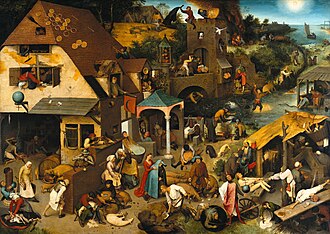 Les Proverbes flamands - Pieter Bruegel the Elder (1551)
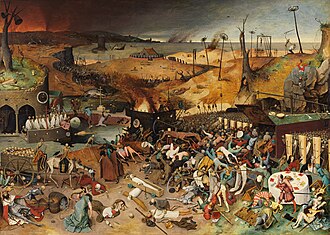 Le Triomphe de la Mort - Pieter Bruegel the Elder (1560s)
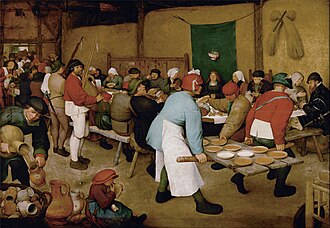 Le Repas de noce - Pieter Bruegel the Elder (1560s)
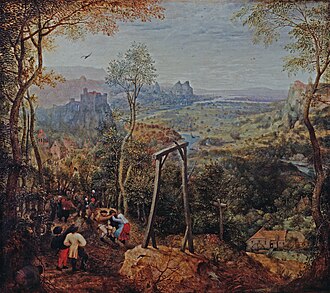 La Pie sur le Gibet - Pieter Bruegel the Elder (1568)
 Les Moissonneurs - Pieter Bruegel the Elder (1565)
 Les Jeux d’enfants - Pieter Bruegel the Elder (1560)
%20-%20Christ%20and%20the%20woman%20taken%20in%20adultery.jpg) Le Christ et la femme adultère - Pieter Bruegel the Elder (1565)
Le Christ et la femme adultère - Pieter Bruegel the Elder (1565)
Œuvres d'artistes liés
 Le Jardin des délices - Hieronymus Bosch
 La Nef des fous - Hieronymus Bosch (1500s)