Three girls
Lovis Corinth · 1902
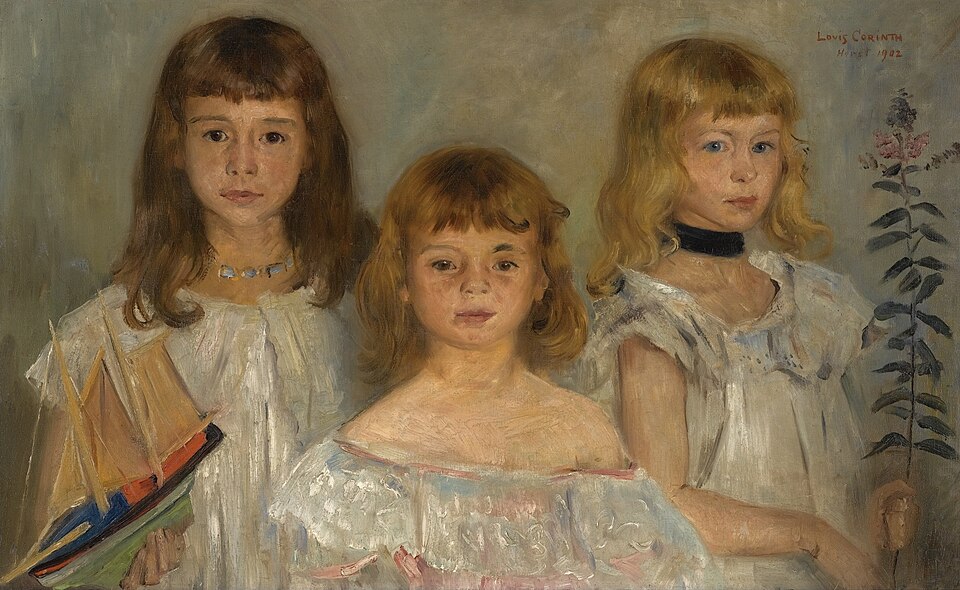
Three little girls in white blouses look straight at the painter, one holding a flower, one a toy boat. Corinth painted them in a Baltic seaside resort in 1902, the summer he fell in love with Charlotte Berend.
The story behind the painting
In 1902 Lovis Corinth travelled with Charlotte Berend, later his wife, to the seaside resort of Horst on the Pomeranian Baltic coast, today Niechorze in Poland. There he painted landscapes and portraits, including several pictures of her, and during the stay the two became a couple. In the catalogue of his paintings, Charlotte Berend-Corinth wrote that he painted the three little girls at the suggestion of the scholar Eduard Fuchs, and that he set up the picture so she could watch him at work from her window.
What to look for
Three young girls stand side by side, shown to the chest, all looking directly at the painter in airy white blouses. The girl on the right stands sideways with only her head turned; she is light blonde with blue eyes and a black band at her neck, and she alone shows her arms, holding a single long-stemmed flower with a pink-violet bloom. The middle girl, the smallest, is darker blonde with brown eyes. The girl on the left wears a necklace of blue stones and holds a toy sailing boat, green with orange and blue. The background is a plain grey.
Meaning and intent
This is a simple group portrait, and its charm lies in the directness of the three gazes and the small, personal details: a flower, a necklace, a toy boat with bright colours. The plain grey background keeps all attention on the children. The picture also belongs to a happy moment in Corinth's life, painted in the summer his relationship with Charlotte Berend deepened, and with her watching from a window. In the top right corner he signed it on two lines: Lovis Corinth, Horst 1902.
Legacy
According to the catalogue, the painting first belonged to the collection of E. Prost in Stettin and then remained in private hands for more than a century. It was auctioned at Christie's in London in 1978, at Schloss Ahlden in 1980, again at Christie's in 1981, and at Sotheby's in London in 2010. It was later acquired by Wolf Schulz, a former chief physician at the Johanna Etienne Hospital in Neuss, who donated it in early 2025, together with a painting by Armand Guillaumin, to the Clemens Sels Museum in Neuss.
Le saviez-vous ?
- Painted in the Baltic resort of Horst in 1902.
- Made at the suggestion of the scholar Eduard Fuchs.
- Signed Lovis Corinth, Horst 1902.
- Donated to the Clemens Sels Museum, Neuss, in 2025.
À propos de l'artiste
Lovis Corinth (1858-1925)
Autres œuvres de Lovis Corinth
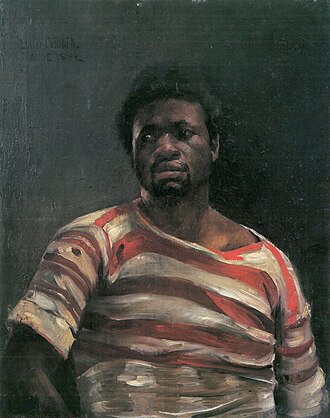 Le Nègre Othello - Lovis Corinth (1884)
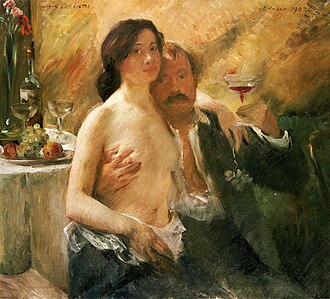 Self portrait with his wife Charlotte Berend-Corinth and a sekt glass - Lovis Corinth (1902)
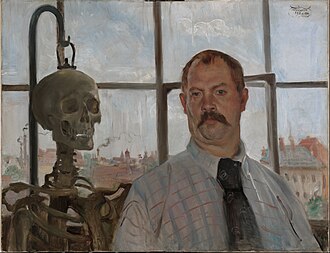 Autoportrait au squelette - Lovis Corinth (1896)
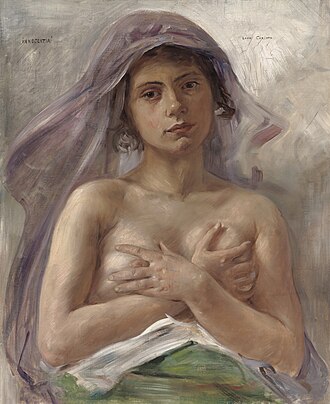 Innocentia - Lovis Corinth (1890)
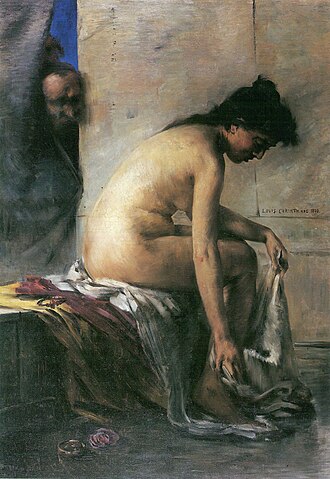 Susanna in the Bath - Lovis Corinth (1890)
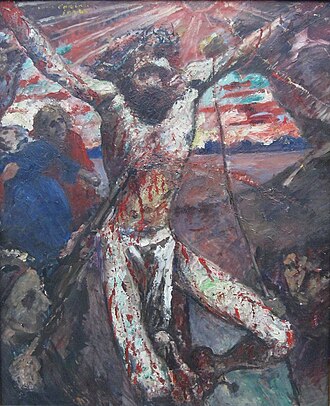 The Red Christ - Lovis Corinth (1922)
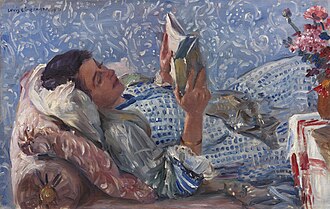 Reading Woman - Lovis Corinth (1911)
 Carmencita - Lovis Corinth (1924)