Susanna in the Bath
Lovis Corinth · 1890
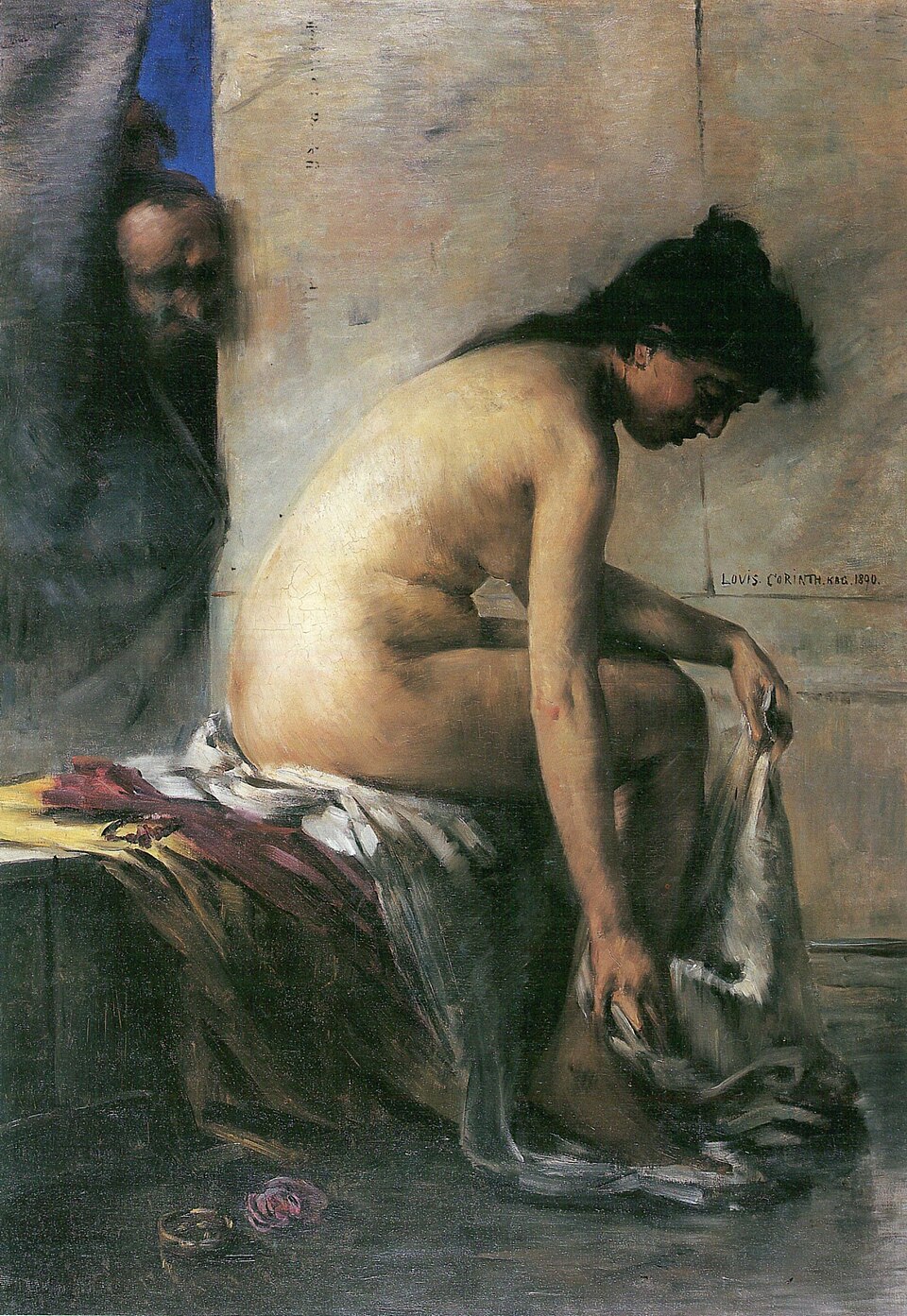
A young woman dries herself after her bath, her face in shadow, while two men stare through a gap in the curtain. Lovis Corinth painted the watchers from his own face in a mirror, casting himself as the voyeur.
The story behind the painting
Corinth trained in Munich from 1880, then in Antwerp and, from October 1884, at the Académie Julian in Paris, where Tony Robert-Fleury and William Adolphe Bouguereau guided him in painting the female nude. In 1888 he returned to his seriously ill father in Königsberg, who died on 10 January 1889. Susanna in the Bath followed in 1890, still in Königsberg, now Kaliningrad. He painted two versions that differ only in small details; the first was shown at the Paris Salon in 1891, was believed lost and was rediscovered at a private auction in 2006. This page tells of the better-known second version, 159 by 111 cm, in the Museum Folkwang in Essen since 1966.
What to look for
Susanna sits on a bench in the foreground, leaning forward, drying her leg with an arched back. Her right hand reaches for a white towel on the floor; her left holds one end of it on her knee. Light from the left makes her back glow at the centre of the picture, while the front of her body and her legs fall into shadow, and her face stays dark, turned to her clothes. Behind her rise smooth stone slabs; on the left a grey curtain is pulled aside, and through the opening in the blue sky a bearded man looks at her, with a second, less distinct face behind. Her white undergarment and a red and gold robe lie on the bench and floor, with a golden bracelet, another bangle and a rose petal. The signature reads Lovis Corinth KBG 1890.
Meaning and intent
The story comes from the Apocrypha of the Book of Daniel: two elders spy on the God-fearing Susanna in her husband's garden, harass her and, when she refuses, accuse her of adultery, until Daniel reveals the truth. Corinth turns it into a nude, with Susanna's body painted with a realism that did not follow the usual manner of the masters of the day. Yet pairing a nude with a history subject suited the taste of the public and the Salon jury, which is why it was accepted. A colleague, Carl Bublitz, painted Corinth looking into a hand mirror before the unfinished canvas as he painted the two elders, so the man who watches in the picture is the painter himself.
Legacy
According to Charlotte Berend-Corinth, the two versions differ only in the bangle on the bench, the rose on the floor and the drapery. She also noted that his Königsberg portrait Polanger Jüdin was a preparatory work for this painting, so that young woman likely posed as Susanna. The picture stands among Corinth's early works and his first ventures into religious subjects, made in the same period as The Corpse of Christ and the Pietà that won him an honourable mention at the Salon of 1890. Encouraged by that success, he left Königsberg for Munich in 1891, where colour gradually entered pictures once dominated by tonal browns.
Le saviez-vous ?
- Painted in 1890 in Königsberg, now Kaliningrad.
- Corinth used his own mirror image for the two watching elders.
- The first version, shown at the 1891 Paris Salon, resurfaced at auction in 2006.
- The second version has been in the Museum Folkwang, Essen, since 1966.
À propos de l'artiste
Lovis Corinth (1858-1925)
art religieux · nu · musée Folkwang
Autres œuvres de Lovis Corinth
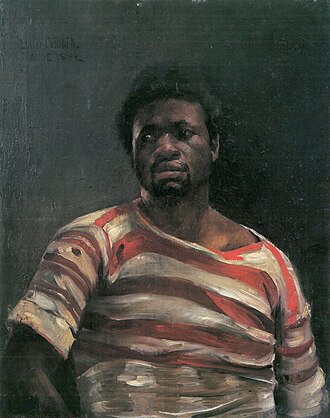 Le Nègre Othello - Lovis Corinth (1884)
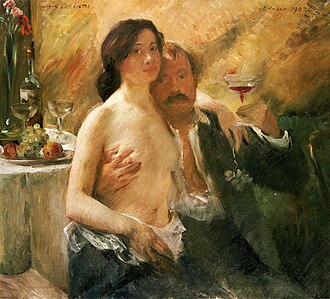 Self portrait with his wife Charlotte Berend-Corinth and a sekt glass - Lovis Corinth (1902)
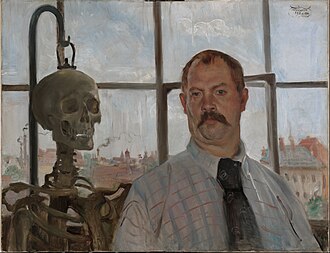 Autoportrait au squelette - Lovis Corinth (1896)
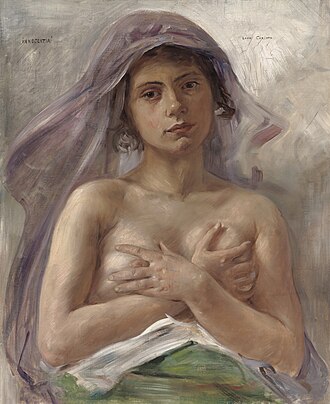 Innocentia - Lovis Corinth (1890)
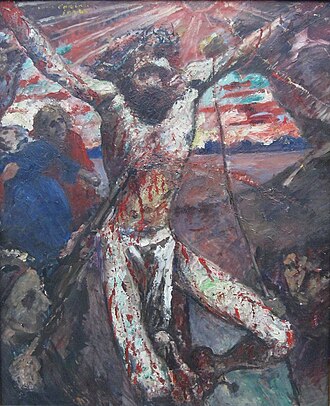 The Red Christ - Lovis Corinth (1922)
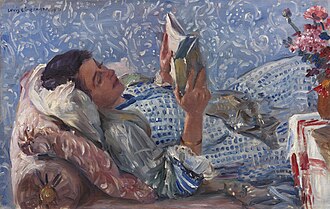 Reading Woman - Lovis Corinth (1911)
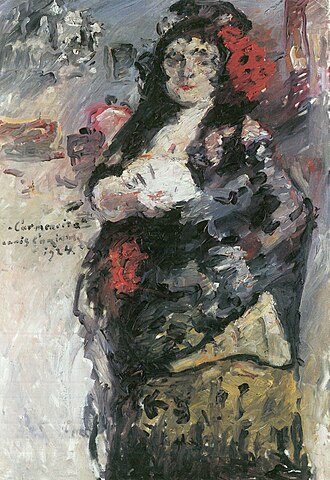 Carmencita - Lovis Corinth (1924)
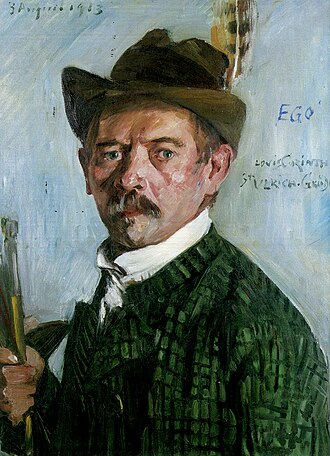 Autoportrait au chapeau tyrolien - Lovis Corinth (1913)