Autoportrait au squelette
Lovis Corinth · 1896
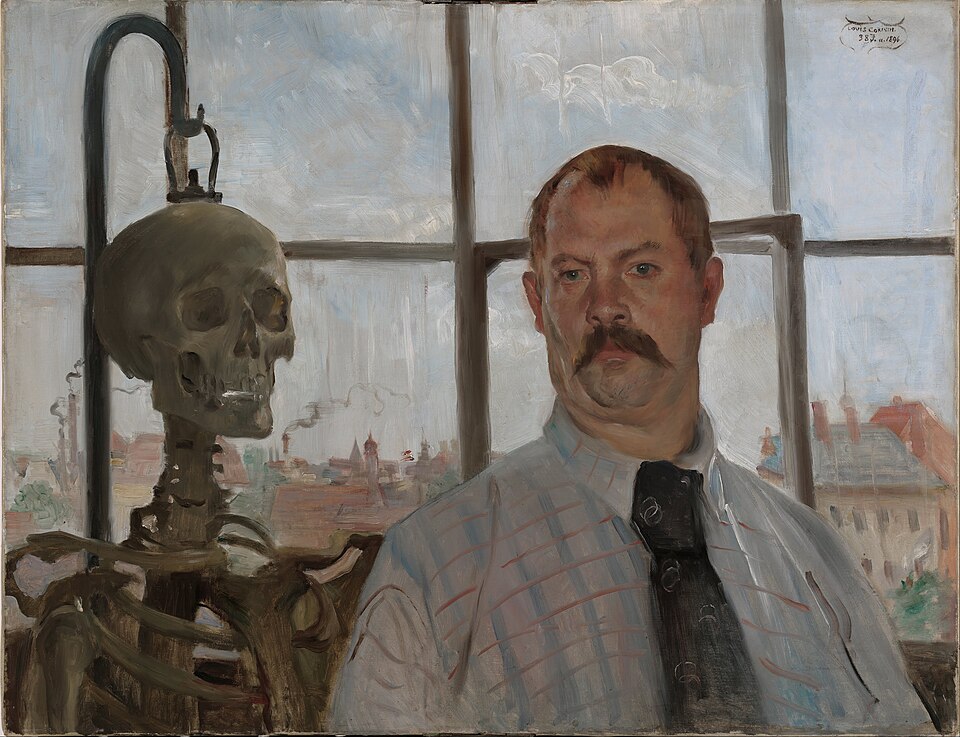
A painter in a checked shirt stands beside a hanging skeleton, the roofs and smoking chimneys of Munich behind them. Lovis Corinth, aged 38, looked death in the face and saw no mystery in it at all.
The story behind the painting
Corinth painted this in Munich in 1896, before he was famous and before his important move to Berlin. He had been painting self-portraits regularly since 1886, but the skeleton appears in none of the others. He is believed to have answered Arnold Böcklin's Self-Portrait with Death Playing the Fiddle of 1872, much admired in Germany at the time. Hans Thoma had also used a skull as a muse in a self-portrait of 1875. In the same year Corinth painted View from the Munich-Schwabing Studio, which shows the same view through his studio window.
What to look for
Both figures are cut off at the chest. Corinth paints himself plainly, with a moustache, short dark receding hair, a pale checked shirt and a dark tie. The skeleton hangs from a pole by a bracket in its skull, a little lower than the artist. Behind them a wide metal-framed studio window fills the picture and backlights them both. One pane, opening toward us, sits right behind Corinth and pushes him forward, and the frames form crosses on either side of him. Below a grey-white sky lie ochre roofs, church towers and smoking chimneys. Note the fine signature in a cartouche: Lovis Corinth, 38 years old, 1896.
Meaning and intent
Böcklin made death a living fiddler and a muse, in the old tradition of the memento mori. Corinth took the motif and stripped it bare. His skeleton is the kind used then to teach anatomy, a lifeless object that only stays upright on its iron stand, without threat or symbolic power. The real city with its industry entering through the window ties the scene to everyday reality. Standing beside it, the artist shows the clear, natural limit that death sets on life, with no mysticism. The unusual signature is read as a nod to Albrecht Dürer's frontal self-portrait of around 1500.
Legacy
It is one of the most famous of Corinth's many self-portraits. Twenty years later, in 1916, five years after his stroke, he returned to the hanging skeleton in The Artist and Death, this time with no window but a goat skull hanging like a trophy on the wall. After Germany's defeat in 1918, death as a skull appears often in his prints and drawings, now with a threatening symbolism missing here, as in the six drypoints of The Danse Macabre of 1921. The painting belonged to Dr A. Ulrich from 1899, who later sold it to the Lenbachhaus in Munich, where it hangs today.
Le saviez-vous ?
- Oil on canvas, painted in Munich in 1896.
- Signed with Corinth's age, 38, in a cartouche.
- Thought to respond to Böcklin's self-portrait with Death playing the fiddle.
- Held by the Lenbachhaus, Munich.
À propos de l'artiste
Lovis Corinth (1858-1925)
homme · autoportrait · ciel · fenêtre · Munich Central Collecting Point · vanité · Lenbachhaus · moustache en guidon · Lovis Corinth
Autres œuvres de Lovis Corinth
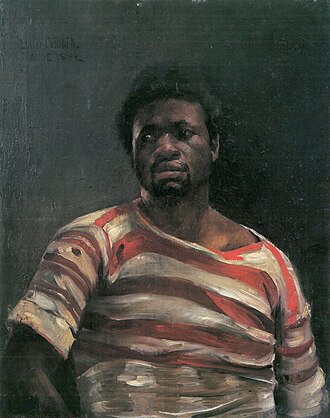 Le Nègre Othello - Lovis Corinth (1884)
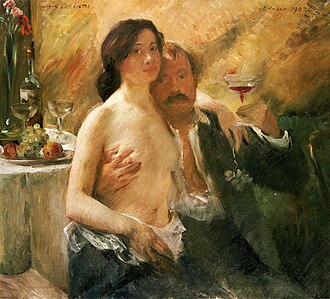 Self portrait with his wife Charlotte Berend-Corinth and a sekt glass - Lovis Corinth (1902)
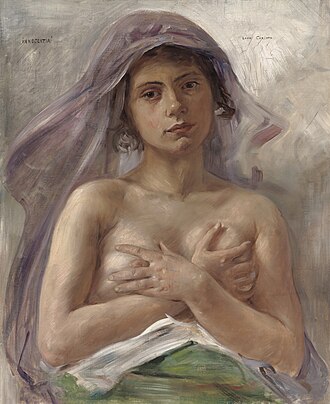 Innocentia - Lovis Corinth (1890)
 Susanna in the Bath - Lovis Corinth (1890)
 The Red Christ - Lovis Corinth (1922)
 Reading Woman - Lovis Corinth (1911)
 Carmencita - Lovis Corinth (1924)
 Autoportrait au chapeau tyrolien - Lovis Corinth (1913)