La Tour de Babel
Pieter Bruegel the Elder · 1568
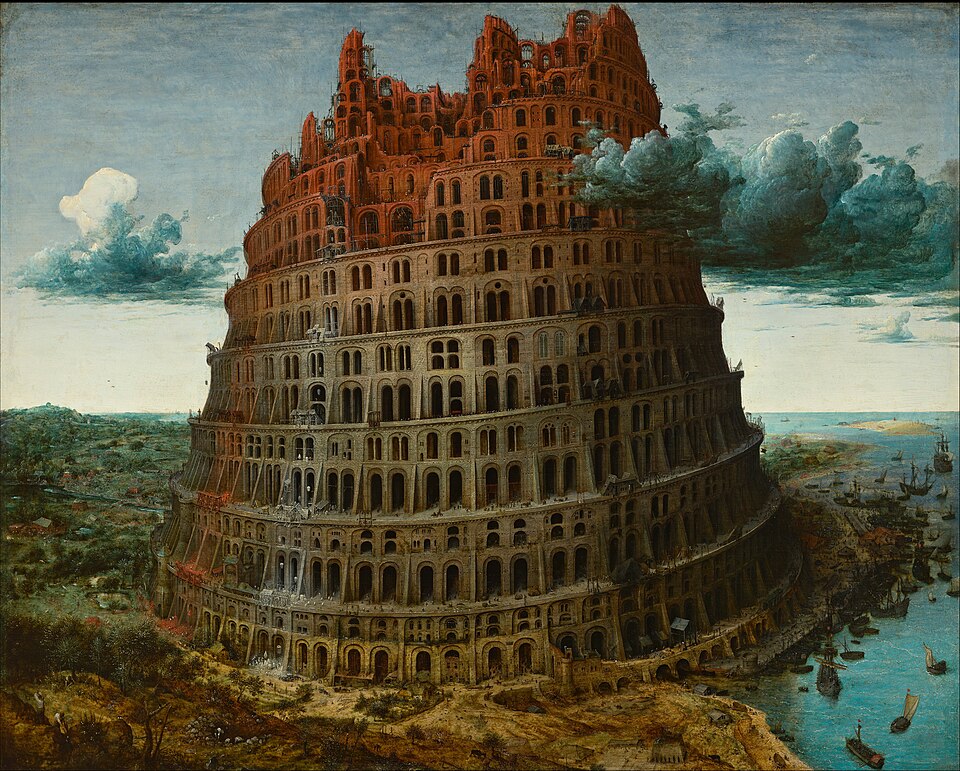
A colossal tower spirals above the clouds, so large that its builders shrink to specks, while a tiny procession under a red canopy climbs its ramp. This is Bruegel's smaller, darker Tower of Babel in Rotterdam.
The story behind the painting
The subject is the Tower of Babel told in the Book of Genesis and in the Histories of Herodotus. Bruegel painted it in oil on a wooden panel of about 60 by 74.5 cm, now in the Museum Boijmans Van Beuningen in Rotterdam. A second version, dated 1563, is the larger Tower of Babel in the Kunsthistorisches Museum in Vienna. The dates of the Rotterdam panel disagree: the German Wikipedia article gives about 1563, recent research places it on stylistic grounds between 1564 and 1567, after Bruegel's marriage and move from Antwerp to Brussels in 1563, and Wikidata gives 1568. Nothing on the panel names its patron or the artist, yet it is attributed to Bruegel without dispute.
What to look for
We look down from a height onto a vast building site in a polder landscape, with its own harbour at a river mouth or bay. The tower already rises above low clouds that bathe everything in gloomy twilight. Compared with Vienna, the horizon sits lower, near the middle, and the tower is closer, denser and slimmer. Two coloured stripes on the left run its full height; Ulrike Wegener reads them as dust from the chain carrying red bricks and white lime. A ramp spirals upward from a gateway, crowded with huts and treadwheel cranes, tiny like the people. The tower leans left because the builders set each storey at right angles to the ramp.
Meaning and intent
Relative to its figures, this tower is about 250 percent larger than the Vienna one, and the land feels emptier: no homely scenes on the tower, scattered houses instead of a dense city, though more ships in the harbour. Bruegel set the biblical story in his own time and country, with a Dutch polder and sixteenth-century building techniques. Just below the centre, a church procession under a red canopy climbs the ramp, which the source reads as a sign that even the church is not safe from pride. The scale itself speaks: human ambition has grown so large that the humans nearly disappear.
Legacy
According to Ulrike Wegener, more than 180 paintings of the Tower of Babel were recorded up to the middle of the seventeenth century, besides countless prints, most of them concentrated around Antwerp. To explain that limit in time and place, scholars have mainly pointed to politics, since the theme's popularity coincided with political and religious unrest in the Netherlands. Bruegel's two towers stand at the heart of that wave. Seen together, the Vienna and Rotterdam panels show the same story at two moments, a busy city building upward, and later a near-empty construction pushing into the clouds.
Le saviez-vous ?
- Oil on panel, about 60 x 74.5 cm, in the Museum Boijmans Van Beuningen.
- A larger version dated 1563 is in Vienna.
- Dated variously about 1563, 1564-1567 or 1568.
- A procession under a red canopy climbs the tower's ramp.
À propos de l'artiste
Pieter Bruegel the Elder (1525-1569)
art religieux · musée Boijmans Van Beuningen
Autres œuvres de Pieter Bruegel the Elder
 Les Chasseurs dans la neige - Pieter Bruegel the Elder (1565)
 Les Proverbes flamands - Pieter Bruegel the Elder (1551)
 Le Triomphe de la Mort - Pieter Bruegel the Elder (1560s)
 La Parabole des aveugles - Pieter Bruegel the Elder (1568)
 Le Repas de noce - Pieter Bruegel the Elder (1560s)
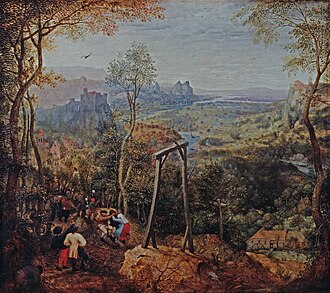 La Pie sur le Gibet - Pieter Bruegel the Elder (1568)
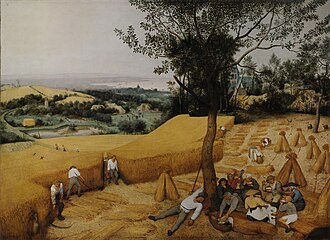 Les Moissonneurs - Pieter Bruegel the Elder (1565)
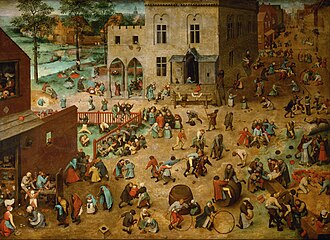 Les Jeux d’enfants - Pieter Bruegel the Elder (1560)
Œuvres d'artistes liés
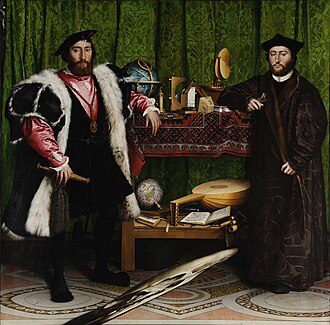 Les Ambassadeurs - Hans Holbein the Younger (1533)
 Le Christ mort - Hans Holbein the Younger (1520s)
 Le Jardin des délices - Hieronymus Bosch
 La Nef des fous - Hieronymus Bosch (1500s)
 Les Époux Arnolfini - Jan van Eyck (1434)
 L'Agneau mystique - Jan van Eyck (1432)