La Danse des paysans
Pieter Bruegel the Elder · 1568
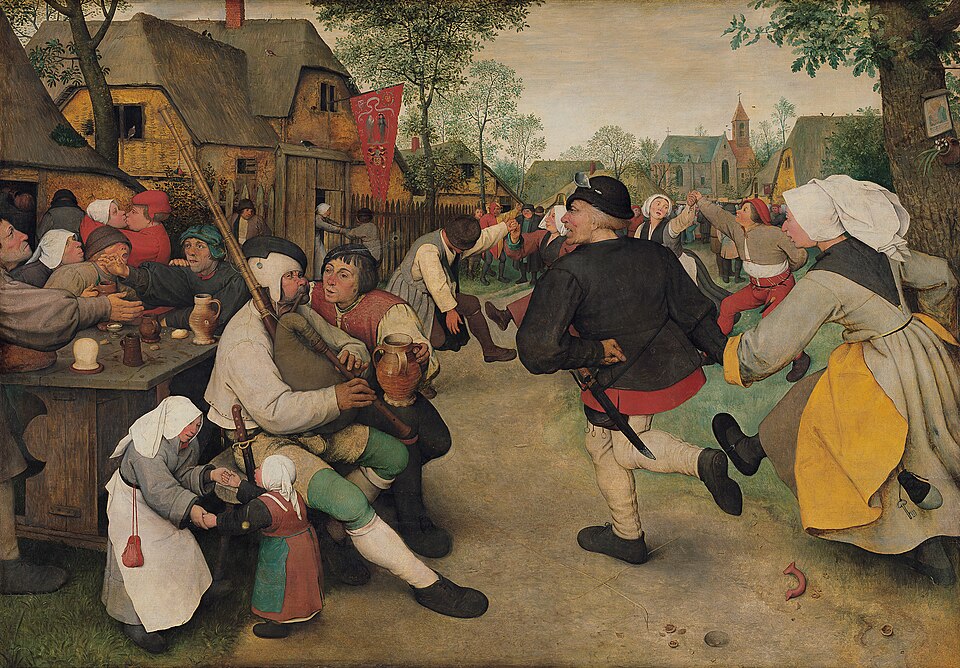
A bagpiper puffs out his cheeks, couples stride hand in hand across the square, and the tavern table is crowded with drinkers. It looks like pure joy, but Bruegel's village fair hides a sharper lesson about what the dancers have turned their backs on.
The story behind the painting
Pieter Bruegel the Elder painted The Peasant Dance, in Dutch De boerendans or De dorpskermis, the village fair, on panel. It is neither signed nor dated. Wikipedia places it around 1567, at about the time of The Peasant Wedding, while Wikidata gives 1568. The two panels are the same size and may have been meant as a pair or part of a series on peasant life. They are the finest examples of Bruegel's late style, with large, monumental figures in the Italian manner. The scene is the yearly feast of a village patron saint; a big red flag on the building at left shows it is Saint George's day.
What to look for
On the left, peasants sit at a table of food and beer outside the inn, drinking, arguing and embracing. On the right a couple stride across the square hand in hand, and behind them two more couples run together. The bagpiper swells his cheeks as he blows into his doedelzak, and the man beside him wears a peacock feather in his hat. The raised clasped hands of a couple in the middle ground form an arch that echoes the arches of the church behind. Left of the central man in black, follow a chain of faces: a peasant woman, a man from the city, and a smiling jester in the distance.
Meaning and intent
Like The Peasant Wedding, the picture probably carries a moral as well as affection. Gluttony, lust and anger can all be found here. The peacock feather is a sign of vanity and pride. The feast is held for a saint, yet the dancers turn their backs on the church and ignore the image of the Virgin Mary hanging on a tree. The prominent tavern makes clear that their minds are on material rather than spiritual things. The rough faces, with bared teeth, add to the sense of an unrefined, almost primitive dance.
Legacy
The painting has travelled. Napoleon Bonaparte's forces took it to Paris in 1808, and it was returned in 1815. It now hangs in the Kunsthistorisches Museum in Vienna. What keeps people looking is that both readings live together: the warning about sin is there, but so is the energy of bodies in motion, the swing of linked arms and legs that pulls the eye through the crowd. Bruegel's late, monumental peasants are both lessons and living people.
Le saviez-vous ?
- Painted around 1567 (Wikipedia); Wikidata gives 1568.
- Same size as The Peasant Wedding, possibly a pair.
- Taken to Paris in 1808 and returned in 1815.
- In the Kunsthistorisches Museum, Vienna.
À propos de l'artiste
Pieter Bruegel the Elder (1525-1569)
scène de genre · musée d'Histoire de l'art de Vienne · danse traditionnelle
Autres œuvres de Pieter Bruegel the Elder
%20-%20Google%20Art%20Project.jpg) Les Chasseurs dans la neige - Pieter Bruegel the Elder (1565)
Les Chasseurs dans la neige - Pieter Bruegel the Elder (1565) Les Proverbes flamands - Pieter Bruegel the Elder (1551)
 Le Triomphe de la Mort - Pieter Bruegel the Elder (1560s)
%20-%20Blind%20leading%20the%20blind%20Google%20Art%20Project.jpeg) La Parabole des aveugles - Pieter Bruegel the Elder (1568)
La Parabole des aveugles - Pieter Bruegel the Elder (1568) Le Repas de noce - Pieter Bruegel the Elder (1560s)
 La Pie sur le Gibet - Pieter Bruegel the Elder (1568)
 Les Moissonneurs - Pieter Bruegel the Elder (1565)
 Les Jeux d’enfants - Pieter Bruegel the Elder (1560)
Œuvres d'artistes liés
 Le Jardin des délices - Hieronymus Bosch
 La Nef des fous - Hieronymus Bosch (1500s)
 Les Ambassadeurs - Hans Holbein the Younger (1533)
 Le Christ mort - Hans Holbein the Younger (1520s)