Le Jardin du presbytère de Nuenen au printemps
Vincent van Gogh · 1884
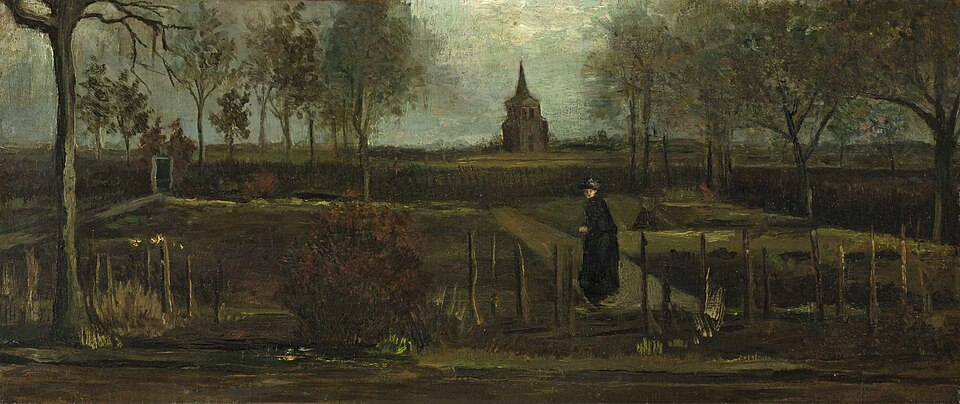
A dark figure stands in a garden just waking from winter, while the ruins of an old church rise in the distance. Van Gogh caught the exact moment a season turned.
The story behind the painting
The Parsonage Garden at Nuenen, also called Spring Garden, is an early oil painting by Vincent van Gogh, probably made in May 1884. In December 1883, after living in The Hague and then briefly in Drenthe, Van Gogh moved in with his parents at the parsonage of the Dutch Reformed Church in Nuenen, near Eindhoven, where his father was pastor. The family turned the laundry room at the back of the house into a studio. He stayed for nearly two years and produced about 200 drawings and paintings, including his first major work, The Potato Eaters. The parsonage garden became one of his recurring subjects: he made several drawings and oil paintings of it and of the house's garden façade, following the garden through the changing seasons. This painting was preceded by a series of wintry drawings.
What to look for
The format is the first surprise: the canvas is unusually wide, 25 by 57 centimetres, more than a double square, so the garden stretches out like a panorama. Van Gogh may have used a perspective window, a wooden frame strung with wires, to help him draw it. In the foreground stands a female figure in dark clothes. Let your eye travel past her into the distance, where the ruins of the old church tower rise, a building he painted in other works and which was demolished in 1885. The palette is the dark one of greens and browns typical of his early years. But look closely for small touches of fresh green and red: they are the signals, within that sober colour, that winter has passed and spring has begun.
Meaning and intent
This is a painting about transition. In a letter to his friend Anthon van Rappard in March 1884, Van Gogh wrote that he was searching for the colour of the winter garden, but that it was already a spring garden, and had become something completely different. The painting holds that discovery: the old, dark tones of winter still dominate, yet the first notes of new colour are breaking through. The garden itself was a closed, private world, enclosed by a high stone wall, with a duck pond and boat dock, paths and hedges, flower and vegetable plots and an orchard. Set against the ruined church in the distance, the solitary figure and the reviving garden suggest the quiet passing of time, observed by a young painter still finding his way.
Legacy
The painting belonged to the Groninger Museum in the Netherlands from 1962. On 30 March 2020, Van Gogh's birthday, it was stolen while on loan to the Singer Laren museum, which was closed because of the COVID-19 pandemic; thieves smashed the glass doors around 3:15 in the morning. In June that year, photographs of the painting beside a copy of the New York Times were sent to the art detective Arthur Brand. In 2021 a man was arrested and later convicted of the theft, though the painting was not then found. In September 2023, Brand recovered it in cooperation with the Dutch police. Its story is a reminder of how fragile our shared heritage can be, and of the early, searching Van Gogh who painted it, long before the bright colours of his later fame.
Le saviez-vous ?
- The painting is more than twice as wide as it is tall, an unusual format for Van Gogh.
- It was stolen on 30 March 2020, Van Gogh's birthday, from the Singer Laren museum.
- Art detective Arthur Brand recovered it in September 2023 with the Dutch police.
- The old church tower in the distance was demolished in 1885.
À propos de l'artiste
Vincent van Gogh (1853-1890)
femme · paysage · paysage · jardin
Autres œuvres de Vincent van Gogh
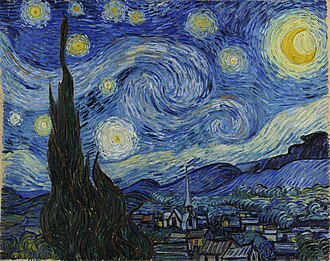 La Nuit étoilée - Vincent van Gogh (1889)
.jpg) Terrasse du café le soir - Vincent van Gogh (1888)
Terrasse du café le soir - Vincent van Gogh (1888)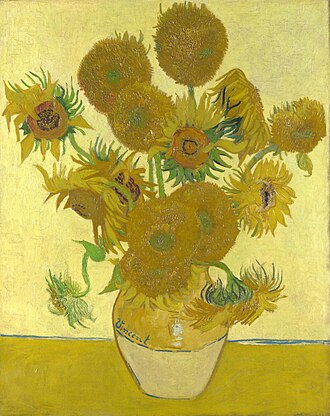 Les Tournesols - Vincent van Gogh (1888)
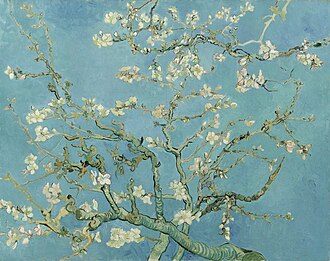 Amandier en fleurs - Vincent van Gogh (1890)
 Champ de blé aux corbeaux - Vincent van Gogh (1890)
 La Chambre à coucher - Vincent van Gogh (1888)
 Les Mangeurs de pommes de terre - Vincent van Gogh (1885)
 Iris - Vincent van Gogh (1889)
Œuvres d'artistes liés
 D'où venons-nous ? Que sommes-nous ? Où allons-nous ? - Paul Gauguin (1897-1898)
%201889.jpg) Le Christ jaune - Paul Gauguin (1889)
Le Christ jaune - Paul Gauguin (1889) Le Déjeuner sur l'herbe - Édouard Manet (1863)
 Olympia - Édouard Manet (1863)